


Key Takeaways
- Oracle stock has lost 54% over the past year, but 80% of the analysts who cover it still rate it a buy.
- Steve Eisman says half of Oracle’s $638 billion backlog comes from OpenAI. That would make Oracle’s growth story largely a bet on one customer’s ability to pay.
- Oracle’s free cash flow was negative $23.7 billion in fiscal 2026, and its total debt rose to $167 billion, so it is borrowing to build that capacity.
- OpenAI’s $20 billion revenue revision looks like an accounting difference. The thing to watch is whether Oracle’s spending starts turning into billed revenue.
Oracle (ORCL) has lost 54% of its value over the past year, yet 80% of the analysts who cover it still rate it a buy, according to CNN’s tally.
The bulls are counting the order book. As of its latest quarter, Oracle had $638 billion of signed contracts to supply computing capacity. Its revenue for the year ended May 2026 was $67.4 billion.
Steve Eisman, the investor made famous by The Big Short, looked at that same order book and saw one name. Here’s what he said on The Compound and Friends on Oct. 16:
“Oracle is much worse because half of Oracle’s backlog is just OpenAI.”
Half of $638 billion is about $320 billion, all owed by one private company.
One customer, a lot of building
Eisman led into it with a story from his time at Oppenheimer in the 1990s. A software analyst there refused to help take public a fast-growing company that had only two customers. Her reason: “if one of those customers goes away that’s the end of the company.”
Oracle has far more than two customers. Eisman’s point is that it’s more exposed to OpenAI than the bigger cloud providers like Microsoft (MSFT) are. By his estimate, Anthropic and OpenAI make up 70% of the hyperscalers’ AI revenue, and that AI revenue is something like 25% to 30% of their total cloud revenue. At Microsoft and its peers, everything else they sell dilutes that exposure. At Oracle, Eisman puts it at half the backlog.
Wall Street’s forecasts lean heavily on that backlog. Consensus has Oracle’s revenue almost doubling in two years, from $67.4 billion in fiscal 2026 to $132 billion in fiscal 2028.

Those 39 analysts are assuming the backlog turns into revenue on schedule. By Eisman’s count, OpenAI owns half of it.
The $20 billion that went missing
This is where it gets uncomfortable. Eisman again:
“last week OpenAI came out and said that their annualized revenue at the end of September was 50 billion. A month ago they said 70. What happened to 20? Where’d the 20 go?”
If you take his math at face value, OpenAI’s share of Oracle’s backlog alone equals more than six years of OpenAI’s current revenue.
Mostly accounting, but the bills are the same size
To be fair to OpenAI, the $20 billion probably didn’t vanish. The [Financial Times](LINK NEEDED) first reported the $50 billion figure on Oct. 8. A person familiar with the matter told CNBC that the widely reported $68 billion figure counted OpenAI’s partners’ revenue gross, so it could be compared with Anthropic’s. The same person said OpenAI reported 77% run-rate growth in the third quarter.
So demand hasn’t fallen. But $50 billion is the revenue OpenAI actually records, and the money to pay Oracle has to come from that or from investors. OpenAI raised $122 billion in March, and CFO Sarah Friar told CNBC it is still “very well capitalized.”
Liaquat Ahamed, the Pulitzer Prize-winning author of Lords of Finance, sees funding as the weak point. On Prof G Markets, he was asked how an AI crash might play out:
“One of the major players will face financing problems. Will it be Oracle? Will it be OpenAI?”
Oracle is the one borrowing
Oracle is already deep in debt to fund this buildout. Its free cash flow fell from $11.8 billion in fiscal 2024 to negative $23.7 billion in fiscal 2026.
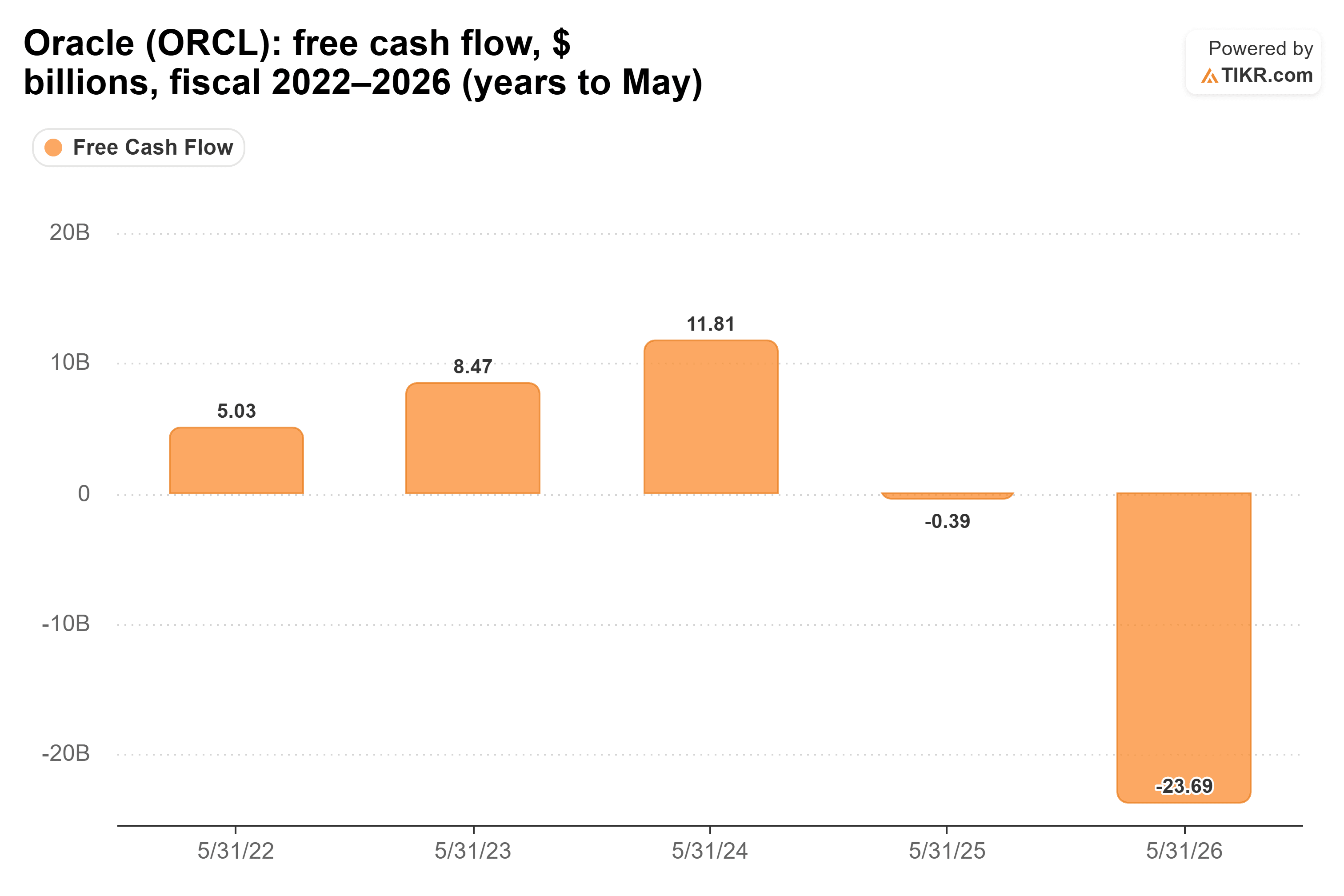
The last twelve months look even worse. Oracle spent $75.7 billion on capital projects and brought in $46.9 billion of cash from operations, a shortfall of nearly $29 billion.
Oracle has borrowed to cover it. Total debt has more than doubled since fiscal 2022, to $167 billion, and $58 billion of that was added in fiscal 2026 alone.

Investors have noticed. Ted Mortonson, technology desk strategist at Baird, said on Bloomberg Surveillance on Oct. 15 that his clients are moving to “anything with strong free cash flow,” adding:
“The names that don’t have free cash flow like Oracle or NBIS or CoreWeave in this area is just being thrown out at this point.”
Oracle’s growth is an OpenAI bet
If Eisman is right that half the backlog is OpenAI, then Oracle’s growth story depends on OpenAI raising money and growing into commitments several times its revenue. Meanwhile, Oracle is paying for its side with borrowed money. The 80% of analysts rating it a buy are counting the orders. I’d rather count the cash, and right now that’s too much riding on one customer for a company running a $29 billion annual shortfall.
Of course, if OpenAI keeps growing anywhere near the 77% it reported for the third quarter, those commitments start to look much more manageable. Oracle’s next quarterly report will show whether its spending is turning into billed revenue, and that’s the number to watch.
So what is Oracle stock actually worth?
TIKR lets you forecast the future price of any stock in less than a minute. Just enter a few assumptions into TIKR’s valuation model and see what Oracle could be worth. Start from Wall Street consensus estimates, or adjust the inputs to reflect your own view of the business. It’s free to use.
Disclaimer:
Please note that the articles on TIKR are not intended to serve as investment or financial advice from TIKR or our content team, nor are they recommendations to buy or sell any stocks. We create our content based on TIKR Terminal’s investment data and analysts’ estimates. Our analysis might not include recent company news or important updates. TIKR has no position in any of the stocks mentioned. Thank you for reading, and happy investing!


