


Key Takeaways
- UPS yields 7.1% against Chevron’s 3.5%, so $10,000 in UPS pays $710 a year today against $350 from Chevron.
- UPS’s dividend used up 99% of its free cash flow over the twelve months to June 30, 2026, while Chevron’s used 51%.
- UPS’s dividend per share rose 0.6% in fiscal 2025, while Chevron, which says it has raised its dividend for 39 consecutive years, grew its own 4.9%.
- The thing to watch is whether UPS’s free cash flow pulls clear of its dividend now that its Amazon glide-down is finished.
Any retiree hunting for dividend income is going to notice United Parcel Service (UPS) first. At a 7.1% yield, it pays more than twice what Chevron (CVX) does at 3.5%.
And both have just come off a strong summer. UPS finished cutting back its Amazon volume in the second quarter, while Chevron turned in $18.1 billion of free cash flow in Q2 2026, up from $4.9 billion in Q2 2025.
But a retiree living on dividends needs a check they can count on. So which of these two is the better bet?
| Metric | United Parcel Service (UPS) | Chevron (CVX) |
|---|---|---|
| Dividend yield | 7.1% | 3.5% |
| Annual dividend | $6.56 | $7.12 |
| Dividend growth, fiscal 2020 to fiscal 2025 | 10.2% a year | 5.8% a year |
| Dividend growth, fiscal 2025 | 0.6% | 4.9% |
| Cash dividend payout ratio (TTM to June 30, 2026) | 99% | 51% |
| Net debt/EBITDA (LTM) | 1.63x | 0.56x |
| Interest coverage (LTM) | 7.56x | 18.93x |
UPS: a 7% yield with almost nothing to spare
UPS’s revenue is growing again. It rose 7.6% to $22.8 billion in Q2 2026 from a year earlier, and adjusted operating profit rose 12% to $2.1 billion. Management raised its full-year 2026 outlook to approximately $91.2 billion of revenue and $7.22 of adjusted EPS. CEO Carol Tomé put it this way on the call: “this reconfiguration was never the destination. It was the foundation.”
The dividend is the problem. Over the twelve months to June 30, 2026, UPS paid $5.41 billion in dividends out of $5.46 billion of free cash flow, a stretched 99%. Free cash flow fell from $10.8 billion to $4.77 billion between fiscal 2021 and fiscal 2025.

Dividends ran ahead of free cash flow in two of the last three years, fiscal 2023 and fiscal 2025.
Management plans to keep paying: “we are still planning to pay out around $5.4 billion in dividends in 2026, subject to Board approval.” Free cash flow of $1.57 billion for the six months to June 30, 2026, up from $742 million in the same period of 2025, is a start. At 99%, though, one weak year means paying the dividend from something other than free cash flow, as UPS did in fiscal 2025.
Chevron: a smaller check with plenty behind it
UPS has almost nothing to spare, and Chevron has plenty. Its Q2 2026 adjusted earnings came to $12.0 billion ($6.06 a share), up from $3.1 billion ($1.77) in Q2 2025, as net production rose 20% with the Hess acquisition. CEO Michael Wirth on the call: “The Hess assets are generating strong free cash flow, which has been roughly double the incremental dividends and accretive to shareholders on a per share basis.”
Over the twelve months to June 30, 2026, Chevron paid $13.86 billion in dividends from $27.01 billion of free cash flow, a comfortable 51%. Dividends paid rose every year from $8.03 billion in fiscal 2016 to $12.8 billion in fiscal 2025, even in fiscal 2020, when free cash flow was $1.66 billion against $9.65 billion of dividends.
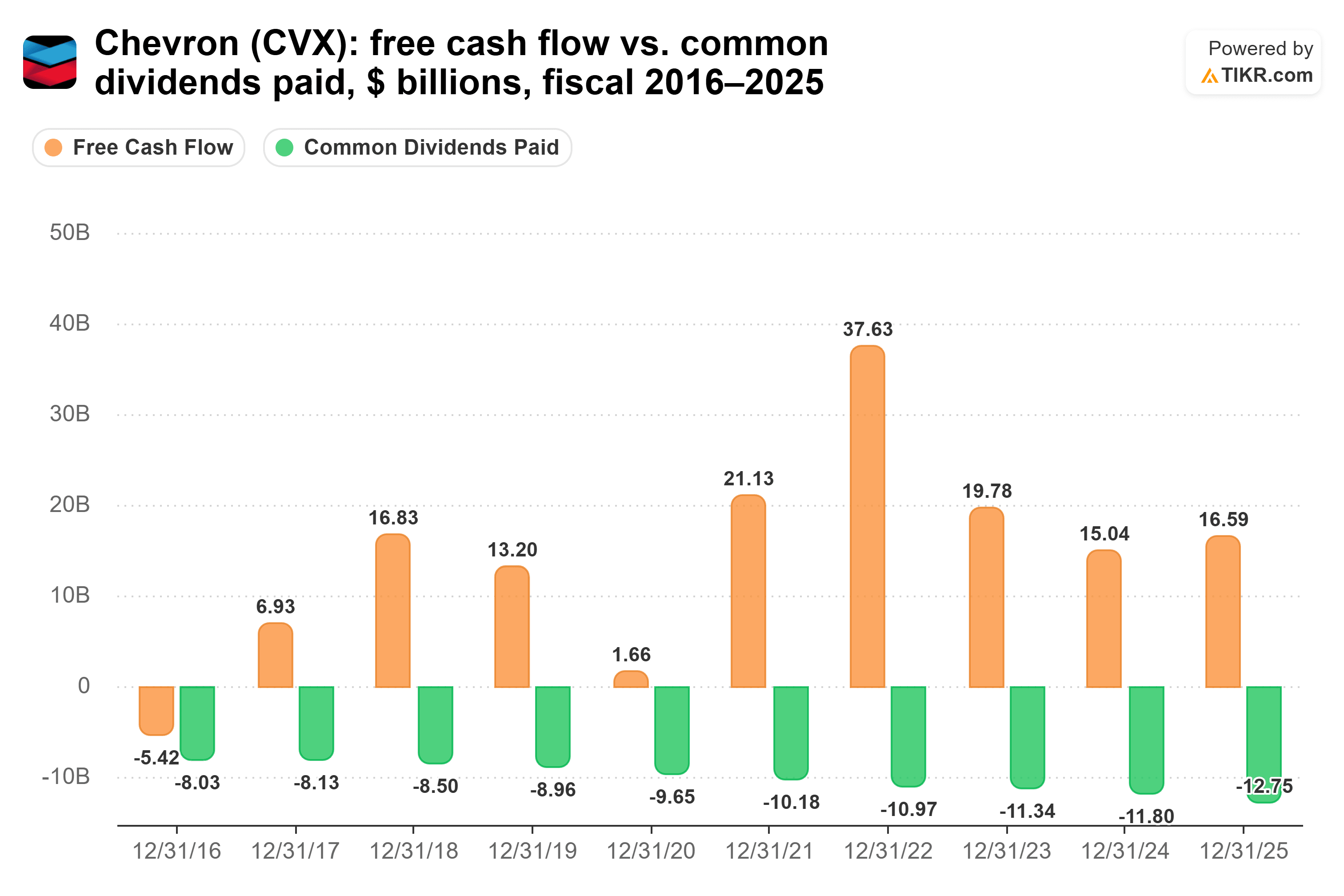
As Chevron said on its first-quarter call, it keeps “growing the dividend. And this year, we’ve grown it for the 39th consecutive year.” It now pays $1.78 a share each quarter, or $7.12 a year.
The risk is oil itself. When prices drop, free cash flow drops with them, as fiscal 2020 shows. In fiscal 2025, before this year’s big quarter, dividends took 77% of free cash flow.
So which dividend wins?
For a retiree who needs a check they can count on, Chevron is the better dividend stock. Its dividend uses 51% of its free cash flow, against 99% at UPS, and its net debt is 0.56x EBITDA, against UPS’s 1.63x. It also kept raising its dividend through years when oil left it next to nothing.
This isn’t to say UPS’s dividend is in trouble. Its 7.1% yield turns $10,000 into $710 a year today, against $350 from Chevron. Even at each dividend’s fiscal 2025 pace, 0.6% for UPS and 4.9% for Chevron, UPS would still pay more in year 10: about $750, against about $539 from Chevron. Chevron wouldn’t catch up for about 17 years, around 2043.
It’s just that a dividend that eats 99% of free cash flow, and ate more than all of it in fiscal 2025, leaves a retiree no margin for a bad year. Chevron’s leaves plenty.
Of course, UPS just finished overhauling its network. If its free cash flow keeps climbing the way it did in the first half of 2026, that 7.1% yield starts to look a lot more reliable.
So what is Chevron stock actually worth?
TIKR lets you forecast the future price of any stock in less than a minute. Just enter a few assumptions into TIKR’s valuation model and see what Chevron could be worth. Start from Wall Street consensus estimates, or adjust the inputs to reflect your own view of the business. It’s free to use.
Disclaimer:
Please note that the articles on TIKR are not intended to serve as investment or financial advice from TIKR or our content team, nor are they recommendations to buy or sell any stocks. We create our content based on TIKR Terminal’s investment data and analysts’ estimates. Our analysis might not include recent company news or important updates. TIKR has no position in any of the stocks mentioned. Thank you for reading, and happy investing!


