Key Takeaways
- Bank of America stock fell 12.7% in the month through October 19 after a $1.21 billion regulatory penalty and disappointing third-quarter results.
- Net interest income grew 8% to $16.4 billion, while average loans increased for the 10th consecutive quarter.
- BAC traded near its five-year average price-to-tangible-book-value multiple, while analysts expected earnings growth through 2028.
- The selloff could offer a buying opportunity, although compliance costs and weaker investment banking activity remain risks.
Bank of America (BAC) stock declined 12.7% in the month through October 19, compared with a 0.6% gain for the S&P 500.
The selloff followed a major regulatory penalty and disappointing investment banking results, raising concerns about the bank’s earnings outlook.
Why Did Bank of America Stock Fall?
On October 13, U.S. regulators announced more than $1.21 billion in penalties against Bank of America over anti-money-laundering and sanctions failures.
The bank subsequently reported a $1.2 billion regulatory settlement charge, reducing third-quarter earnings by $0.17 per share.
Excluding the charge, adjusted EPS reached $1.08, slightly below the $1.10 consensus estimate reported by TheFly.
Investment banking fees declined 11%, while fixed-income, currencies, and commodities trading revenue fell 17%.
However, net interest income increased 8% to $16.4 billion, supported by continued loan growth. CEO Brian Moynihan also indicated that net interest income growth could reach 8% or more in 2027.
Is BAC Stock Undervalued After Its Recent Decline?
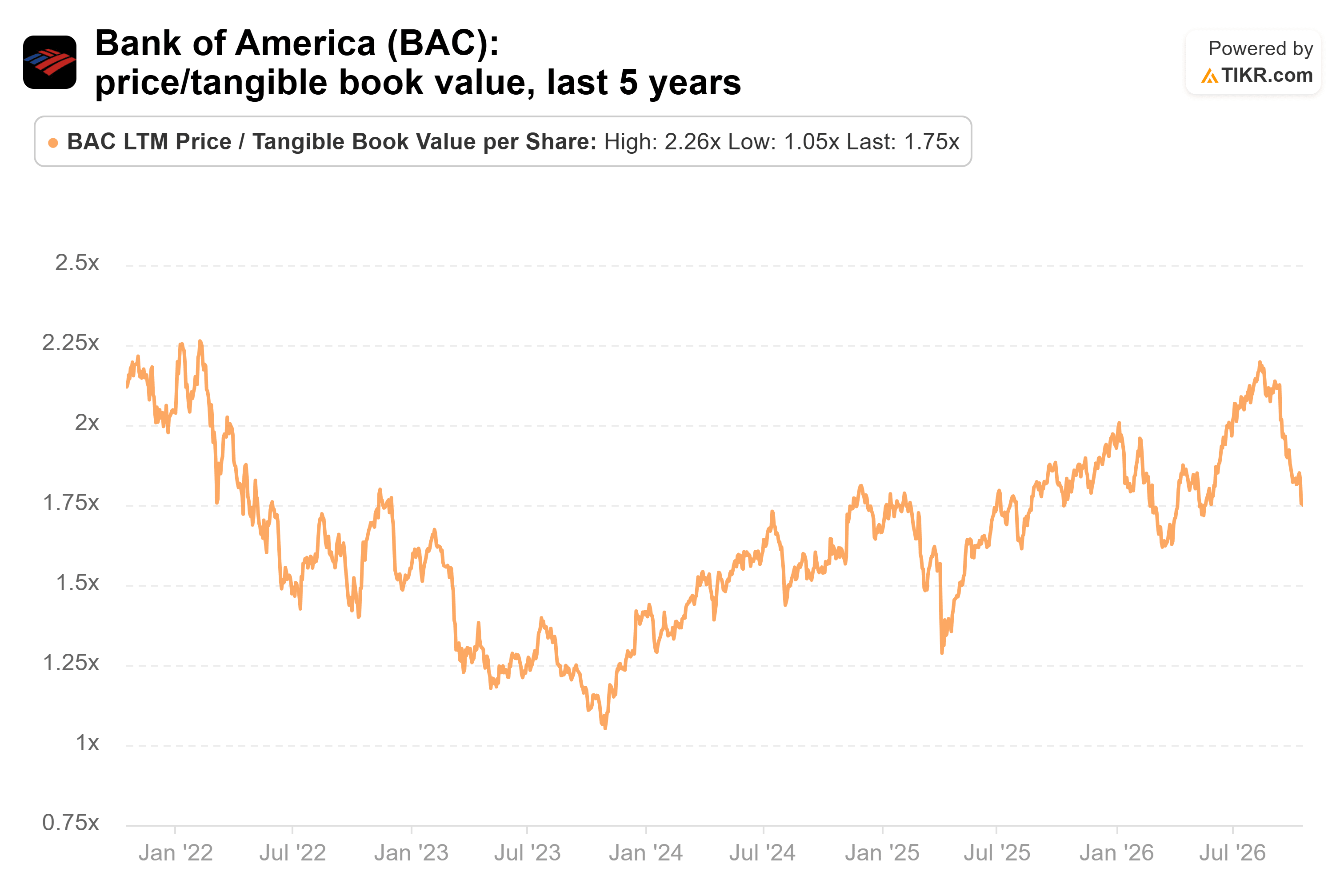
At its October 19 closing price of $50.39, BAC traded at approximately 1.7 times tangible book value, near its five-year average and below its early-2022 peak of 2.3 times.
Ten analyst firms lowered their price targets following the results while maintaining their ratings. Meanwhile, Baird upgraded BAC to Outperform, arguing that the selloff had become excessive.
As of October 16, Wall Street’s consensus target stood near $63, suggesting approximately 26% upside from the October 19 closing price.

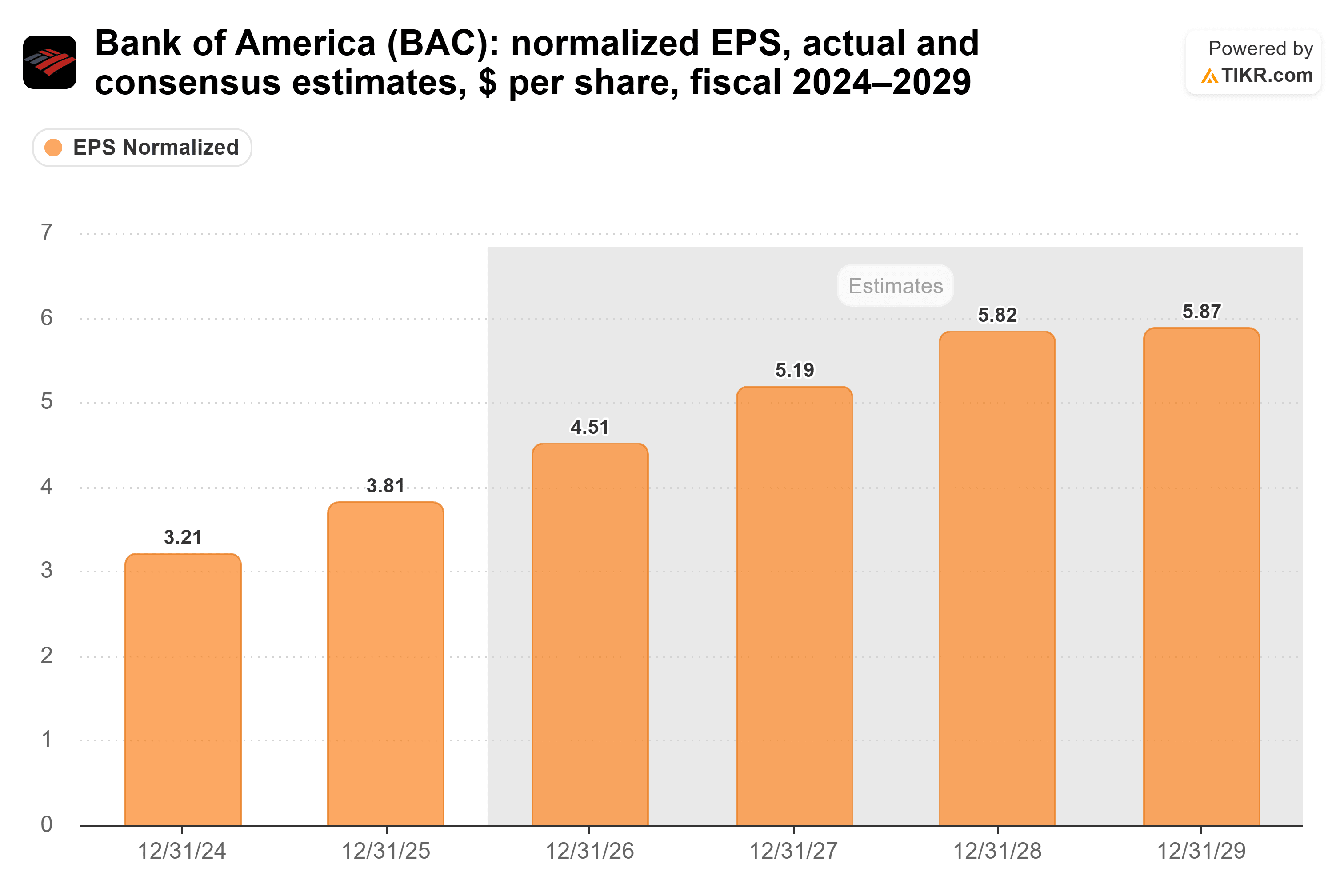
Consensus estimates projected normalized EPS of approximately $4.51 in 2026, $5.19 in 2027, and $5.82 in 2028, representing roughly 15% growth in 2027 and another 12% in 2028.
Is BAC Stock a Sell or a Buying Opportunity?
Bank of America looks more like a buying opportunity than a stock investors need to sell after its recent decline.
The bank continues growing net interest income and its loan portfolio. However, compliance spending, weaker dealmaking activity, and a third-quarter CET1 ratio of 10.9% remain important risks.
With analysts expecting earnings growth through 2028, the selloff has improved BAC’s potential risk-reward profile. Still, its valuation near historical averages means the opportunity depends more on continued earnings growth than on buying the stock at a substantial discount.
So what is Bank of America stock actually worth?
TIKR lets you forecast the future price of any stock in less than a minute. Just enter a few assumptions into TIKR’s valuation model and see what Bank of America could be worth. Start from Wall Street consensus estimates, or adjust the inputs to reflect your own view of the business. It’s free to use.
Value Bank of America for free
Disclaimer:
Please note that the articles on TIKR are not intended to serve as investment or financial advice from TIKR or our content team, nor are they recommendations to buy or sell any stocks. We create our content based on TIKR Terminal’s investment data and analysts’ estimates. Our analysis might not include recent company news or important updates. TIKR has no position in any of the stocks mentioned. Thank you for reading, and happy investing!