


Key Takeaways
- Russ Fradin, whose company Larridin tracks how employees use AI, says six or seven in ten employees at the average company that rolled out Microsoft Copilot use it “basically zero.”
- Microsoft’s 30 million paid Copilot seats count licenses sold, so light use puts its renewals and expansion at risk.
- At $30 per month, 30 million seats would represent $10.8 billion in annualized subscription value before discounts. Fradin’s comments raise adoption concerns but do not establish how much of Microsoft’s paid base is inactive.
- Microsoft’s forward P/E has climbed from 19.1x in late June to 26.8x. Its fiscal first-quarter report later this month is the next chance to show Copilot is actually being used.
Microsoft (MSFT) has one number it bwants investors to remember:
30 million.
That’s how many paid Microsoft 365 Copilot seats it had when it reported fiscal fourth-quarter results on July 29. In the earnings release, CEO Satya Nadella called it a sign of “the confidence customers are placing in us to power their AI transformation.” Jim Cramer’s version, on the Sept. 30 episode of Mad Money, was shorter: “They’re paying.”
Russ Fradin’s company, Larridin, tracks how employees use AI tools. On Monday’s episode of the MTS podcast, he said the average company has rolled out Microsoft Copilot, and “six or seven in ten of their employees are using it basically zero.”
Fradin added, “That’s not a criticism of Microsoft,” and said the same holds for OpenAI’s and Anthropic’s tools. But Microsoft is the one whose stock has been sold on a paid-seat count.
Paid for, barely used
The 30 million figure counts licenses sold, not who’s using them, and those licenses come up for renewal.
Microsoft lists Copilot at $30 per user per month on an annual commitment. That puts 30 million seats at $10.8 billion a year (at list price; many customers pay less). If 60%–70% of those seats were barely used, their annualized list-price value would be $6.5 billion–$7.6 billion. That is an illustrative scenario, not a measured estimate of inactive Copilot subscriptions.
That’s a small slice of a $332 billion business. But Copilot is the clearest proof that companies will pay extra for AI inside software they already use, and with AI bills at big companies climbing into the hundreds of millions, Fradin said, “it’s not a little experimental budget anymore.”
Microsoft said net seat adds more than doubled quarter over quarter, so plenty of those seats haven’t faced a renewal yet.
What Wall Street is counting on

Consensus has revenue going from $332 billion in fiscal 2026 (the year to June) to $391 billion in fiscal 2027 and $468 billion in fiscal 2028, growth of about 18% and then 20%.
Those estimates lean on Azure at least as much as Copilot. But they do assume companies keep adding AI seats, and renewal season is when idle ones get cut.
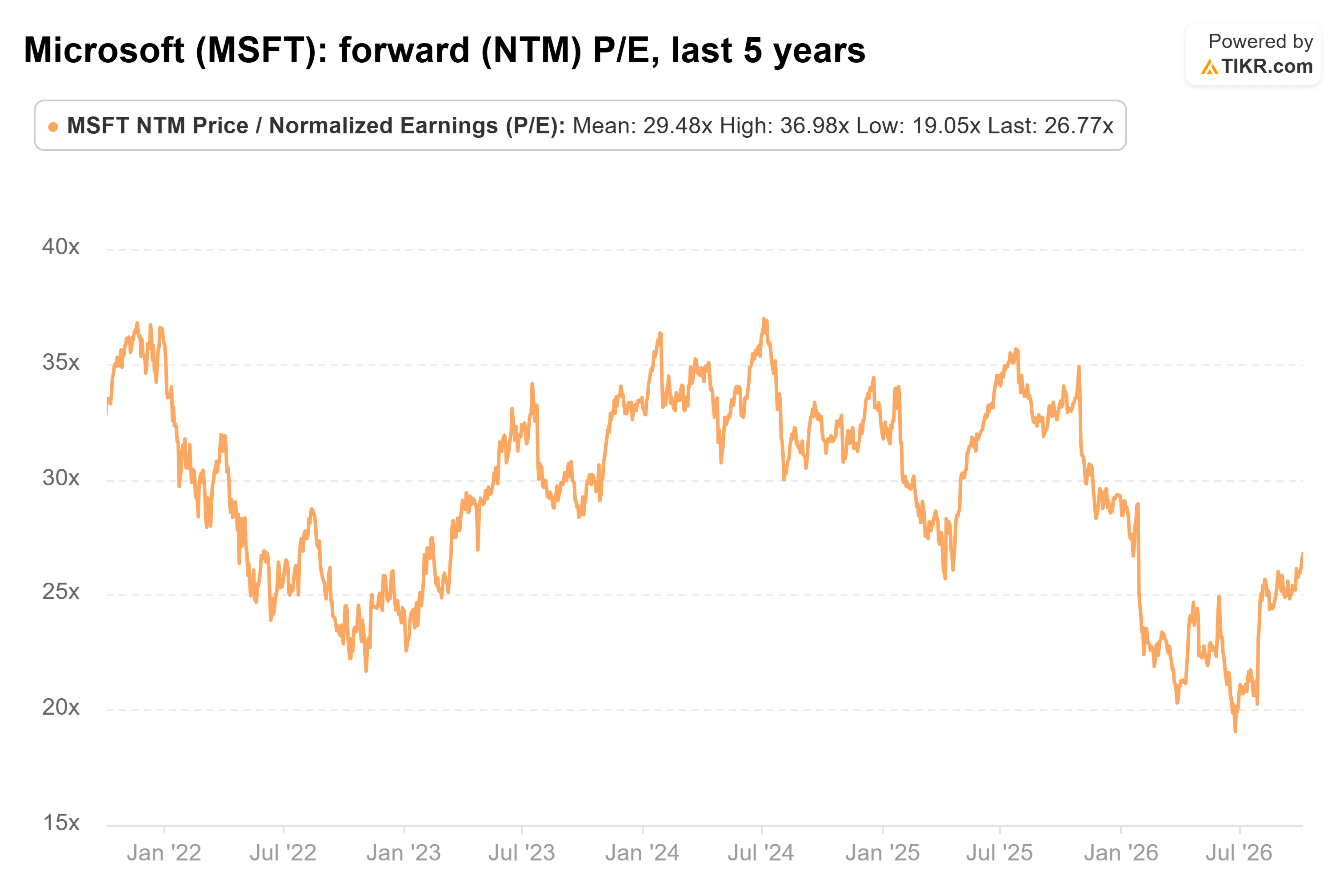
Microsoft’s valuation multiple has also risen over that period. Microsoft trades at 26.8x forward earnings, up 40% from its five-year low of 19.1x on June 25. That’s still below its five-year average of 29.5x, but the whole rerating came in about three months.
The case for shrugging it off
The obvious objection: Copilot is sold inside big enterprise agreements, which tend to renew whether every employee uses every product or not. And Fradin sells usage tracking, so idle seats are good for his business.
Fair, but a CFO who can see usage seat by seat has a much easier time cutting the seats nobody opens. Even Microsoft seems to know where the scoreboard is heading: the day after earnings, its Microsoft 365 blog ran the headline “The next measure of AI momentum is work transformed.”
Where that leaves Microsoft
I see Fradin’s comments as a warning about adoption and renewal risk, not proof that most paid Copilot seats are idle. Microsoft reports that conversations per user nearly doubled year over year and average weekly engagement reached parity with Outlook and Teams. Those measures show growing engagement, but do not establish what share of paid seats remains inactive.
Microsoft reports fiscal first-quarter results later this month, and usage figures alongside the seat count would help settle the question.
So what is Microsoft stock actually worth?
TIKR lets you forecast the future price of any stock in less than a minute. Just enter a few assumptions into TIKR’s valuation model and see what Microsoft could be worth. Start from Wall Street consensus estimates, or adjust the inputs to reflect your own view of the business. It’s free to use.
Disclaimer:
Please note that the articles on TIKR are not intended to serve as investment or financial advice from TIKR or our content team, nor are they recommendations to buy or sell any stocks. We create our content based on TIKR Terminal’s investment data and analysts’ estimates. Our analysis might not include recent company news or important updates. TIKR has no position in any of the stocks mentioned. Thank you for reading, and happy investing!


