Key Stats for Atlassian Stock
- Current Price: $185.62
- Target Price (Mid): ~$283
- Street Target: ~$190
- Potential Total Return: ~53%
- Annualized IRR: ~9% / year
Now Live: Discover how much upside your favorite stocks could have using TIKR’s new Valuation Model (It’s free) >>>
What Happened?
Atlassian (TEAM) closed at $185.62 on August 27, up 10.18% on the day and finishing at a 52-week high. The move came on the software sector’s strongest day in over a year. Salesforce, CrowdStrike, and Okta all reported blowout quarters, and Salesforce alone jumped more than 22%, dragging the entire enterprise-software group higher. What stands out is that Atlassian led the pack, rising far more than peers like ServiceNow on a day when its own news was three weeks old.
A business the market left for dead in the spring, at a max drawdown of 68.66% on April 10, is now trading at the same level as the average Wall Street target and outrunning its whole sector on a broad rally day. The snap-back from panic pricing has been made. What investors are weighing now is whether the fundamentals support a stock at its highs, or whether the re-rating has outrun the business.
Why Atlassian Led the Rally, Not Just Joined It
The Salesforce-led wave lifted every enterprise-software name on August 27, but Atlassian rose far more than the sector’s roughly 1% gain. It was positioned to lead because a three-week re-rating was already underway. On August 25, RBC Capital Markets initiated coverage at Outperform with a $215 target, with analyst Matthew Hedberg arguing that current growth expectations leave room for an upside surprise. Truist had lifted its target to $185 from $160 on August 20, part of a broad wave of hikes after earnings.
That re-rating traces back to the August 6 report. Revenue hit $1,766.47 million in fiscal Q4 (ended June 30, 2026), up 27.6% year over year and beating the Street by 6.24%. Adjusted EPS of $1.87 topped the $1.50 consensus by 24.52%, a fifth straight quarterly beat. Cloud revenue growth accelerated to 31% just as the market had priced the business for deceleration.
Two numbers from the sales engine explain the conviction. Remaining performance obligations, the contracted revenue not yet recognized, grew 44% year over year, and the cohort of customers spending more than $3 million annually grew over 50%. That is enterprise demand hardening into signed commitments, not a one-quarter pop.

See historical and forward estimates for Atlassian stock (It’s free!) >>>
Why the Seat Model Held, and What Still Threatens It
The reacceleration broke the year’s dominant bear thesis, that AI agents would hollow out seat-based software. At the KeyBanc Technology Leadership Forum on August 11, Head of Investor Relations Martin Lam said seats expanded across both developers and knowledge workers, who make up roughly two-thirds of Jira users and around 70% on Confluence. “In the AI era, the need to track, manage, plan all your work across the organization that doesn’t change,” Lam said. Customers who adopt the Rovo AI layer grow their ARR at twice the rate of those who do not.
Management expects fiscal 2027 total revenue growth to slow to around 13% as legacy data center revenue declines, and subscription ARR growth to step down to around 18% from 23%. Non-GAAP operating margin is also guided lower, toward the mid-20s, as a one-time revenue-recognition tailwind reverses and the company shifts more compensation to cash.
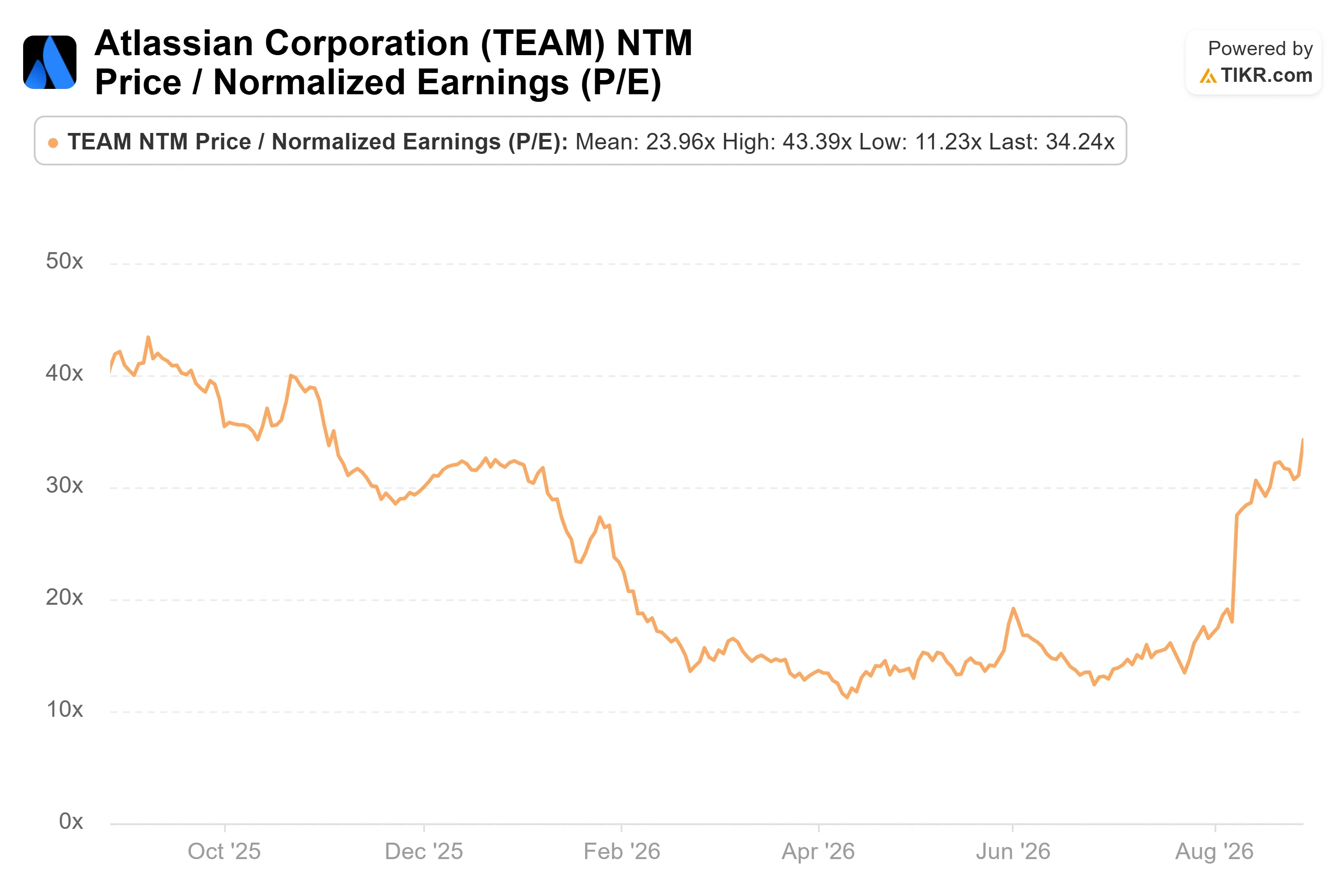
On valuation, the stock is no longer the bargain it was in April. Atlassian trades at 34.24x NTM P/E, a premium to slower-growing software peers like ServiceNow (30.55x), Salesforce (17.26x), and Workday (16.69x). None of the three is compounding cloud revenue at 31%, which is what makes the premium defensible rather than egregious.
See how Atlassian performs against its peers in TIKR (It’s free!) >>>
TIKR Advanced Model Analysis
- Current Price: $185.62
- Target Price (Mid): ~$283
- Potential Total Return: ~53%
- Annualized IRR: ~9% / year

See analysts’ growth forecasts and price targets for Atlassian stock (It’s free!) >>>
The TIKR mid-case values Atlassian at around $283 by 2031, a total return near 53%, and an annualized return of roughly 9% over the next 4.8 years. That is the honest read after the run: still a positive expected return, but a normal one, not the deep-value setup that existed at the April lows.
Two drivers carry the revenue line. The first is the cloud migration, as Atlassian sunsets data center and moves customers to higher-value cloud subscriptions. The second is enterprise expansion, with only about 400 quota-carrying reps selling into 350,000 customers today. The margin driver is the pivot to GAAP profitability, reached in Q4 at a 12% operating margin. The primary risk is that fiscal 2027’s guided slowdown, revenue to around 13%, and ARR to around 18%, marks the start of a longer deceleration rather than a conservative setup.
The mid case assumes revenue compounds at around 14% with net margins near 22%. On a longer ten-year horizon, that same trajectory points toward roughly $480 by 2036 in the mid case, with a low-case near $355 and a high-case near $630 depending on how far seat expansion and AI up-tiering run. The nearer-term 2031 target of around $283 is the number that matters for today’s buyer.
Conclusion
The next real test is fiscal Q1 2027, which Atlassian is expected to report on October 29. Management guided to $1,705 to $1,715 million in revenue and roughly 28.5% cloud growth for the quarter. Above the high end reads as the FY2027 guide being conservative, exactly what RBC is betting on. Below $1,705 million, or any softening in cloud growth, and the deceleration bears get their opening. The stock is no longer priced for pessimism, so the burden has flipped: at a 52-week high and level with the Street’s average target, Atlassian now has to keep beating to keep climbing.
See what stocks billionaire investors are buying so you can follow the smart money with TIKR.
Should You Invest in Atlassian?
The only way to really know is to look at the numbers yourself. TIKR gives you free access to the same institutional-quality financial data that professional analysts use to answer exactly that question.
Pull up Atlassian, and you’ll see years of historical financials, what Wall Street analysts expect for revenue and earnings in the quarters ahead, how valuation multiples have moved over time, and whether price targets are trending up or down.
You can build a free watchlist to track Atlassian alongside every other stock on your radar. No credit card required. Just the data you need to decide for yourself.
Analyze Atlassian on TIKR Free →
Looking for New Opportunities?
- See what stocks billionaire investors are buying so you can follow the smart money.
- Analyze stocks in as little as 5 minutes with TIKR’s all-in-one, easy-to-use platform.
- The more rocks you overturn… the more opportunities you’ll uncover. Search 100K+ global stocks, global top investor holdings, and more with TIKR.
Disclaimer:
Please note that the articles on TIKR are not intended to serve as investment or financial advice from TIKR or our content team, nor are they recommendations to buy or sell any stocks. We create our content based on TIKR Terminal’s investment data and analysts’ estimates. Our analysis might not include recent company news or important updates. TIKR has no position in any stocks mentioned. Thank you for reading, and happy investing!