


Key Takeaways
- Former Stability AI CEO Emad Mostaque says that at 10 AI agents per American, there wouldn’t be enough CPUs in the world, and that the CPU build-out is only just starting.
- Intel’s server CPU demand is strong, but it can’t get enough supply to ship more, which leaves an opening for AMD.
- AMD still gets about 27% of its sales from PCs, and the hyperscalers’ own chips built on Arm’s designs compete for the same agent workloads.
- AMD reports after the close on Tuesday, and the number to watch is its server growth against management’s guide of more than 80% for the second half.
Advanced Micro Devices (AMD) reports third-quarter results after the close on Tuesday. That comes days after Intel (INTC) sank 28% on a fourth-quarter outlook hurt by weak PC demand and too few server chips to sell.
Emad Mostaque, the former CEO of Stability AI, was talking through the week’s AI selloffs on Saturday’s episode of the Moonshots podcast. He said the market is missing something huge:
“If we have 10 agents per American, there are not enough CPUs in the world.”
That’s a big deal for AMD.
Agents need CPUs, too
Mostaque thinks the GPU build-out is already well underway, including AMD’s own MI450. But agents need CPUs to carry out their tasks, and he expects the world to go from less than one agent per person to more than one. In his view, “The CPU build-out with two to three years of lag time is only just starting.”
AMD’s management sees the same demand. At its November 2025 analyst day, it put the 2030 server CPU market at about $60 billion. On its August earnings call, it raised that to about $220 billion. In the second quarter, its server CPU sales to cloud customers and to enterprise customers each grew more than 70% from a year earlier.
Analysts expect AMD’s revenue to more than triple, from $34.6 billion in 2025 to $125 billion in 2028:
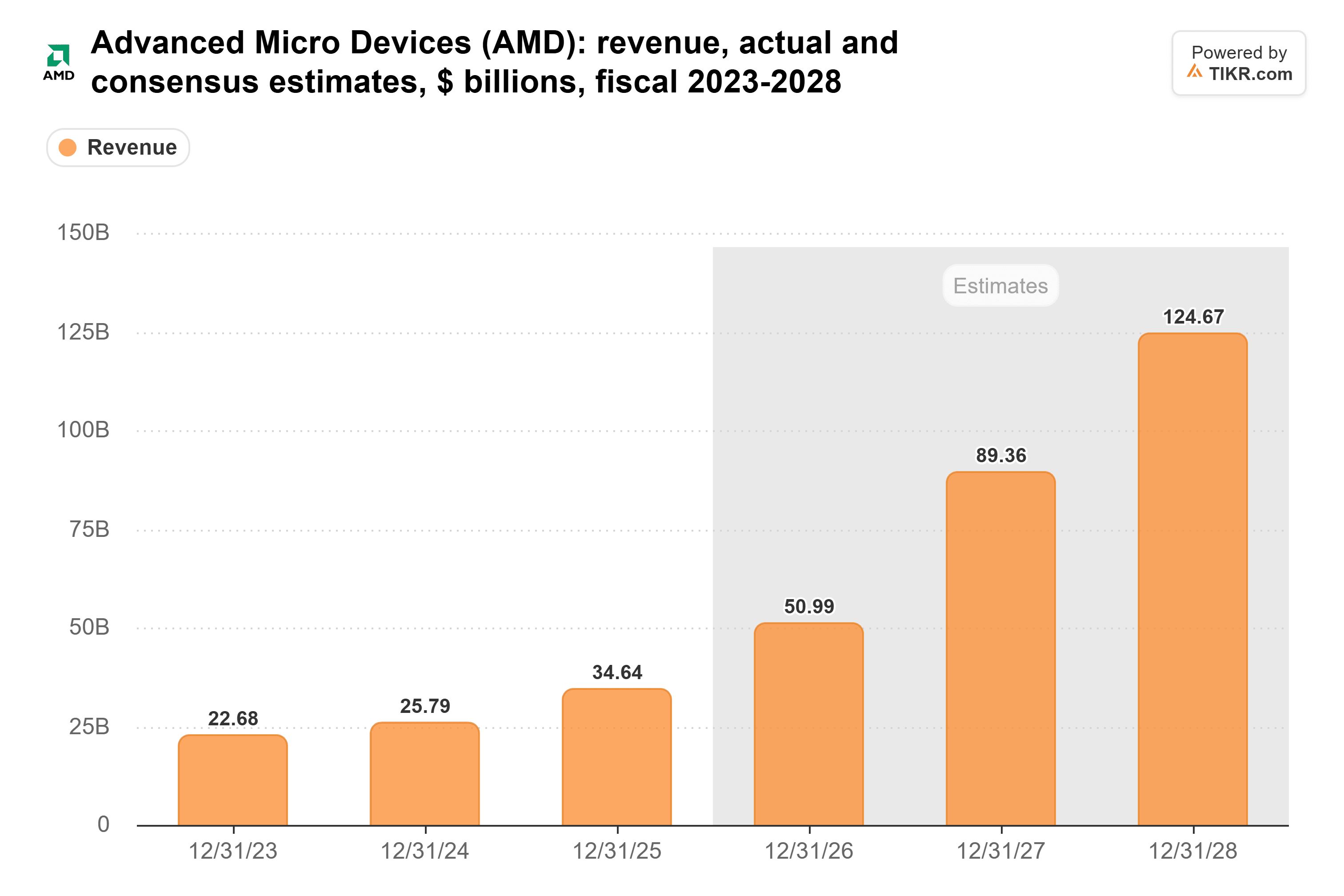
Much of that growth depends on AMD’s Helios GPU racks for the big AI labs. If the CPU build-out has barely started, I’d expect the server side of those estimates to keep rising.
TIKR tracks 55 analysts on AMD. How many say “Buy”?
See the full breakdown of Buy, Hold, and Sell ratings on AMD, along with Wall Street’s revenue and earnings estimates, all in one place. More than 500,000 investors use TIKR to research stocks like this one. See AMD’s Analyst Ratings
Intel can’t ship enough server chips
Kunjan Sobhani, senior semiconductor analyst at Bloomberg Intelligence, spoke on the Bloomberg Intelligence podcast the day Intel fell. He said “the only sort of good news is that their server CPU demand continues to stay strong.” The problem, he said, is that shortages of wafers and substrates limit how much Intel can ship.
Intel’s data center and AI revenue jumped 78% to $7.3 billion in the third quarter. For two years before that, its total revenue sat between $12.7 billion and $14.3 billion a quarter. It then rose to $16.1 billion and $16.5 billion in the last two quarters:
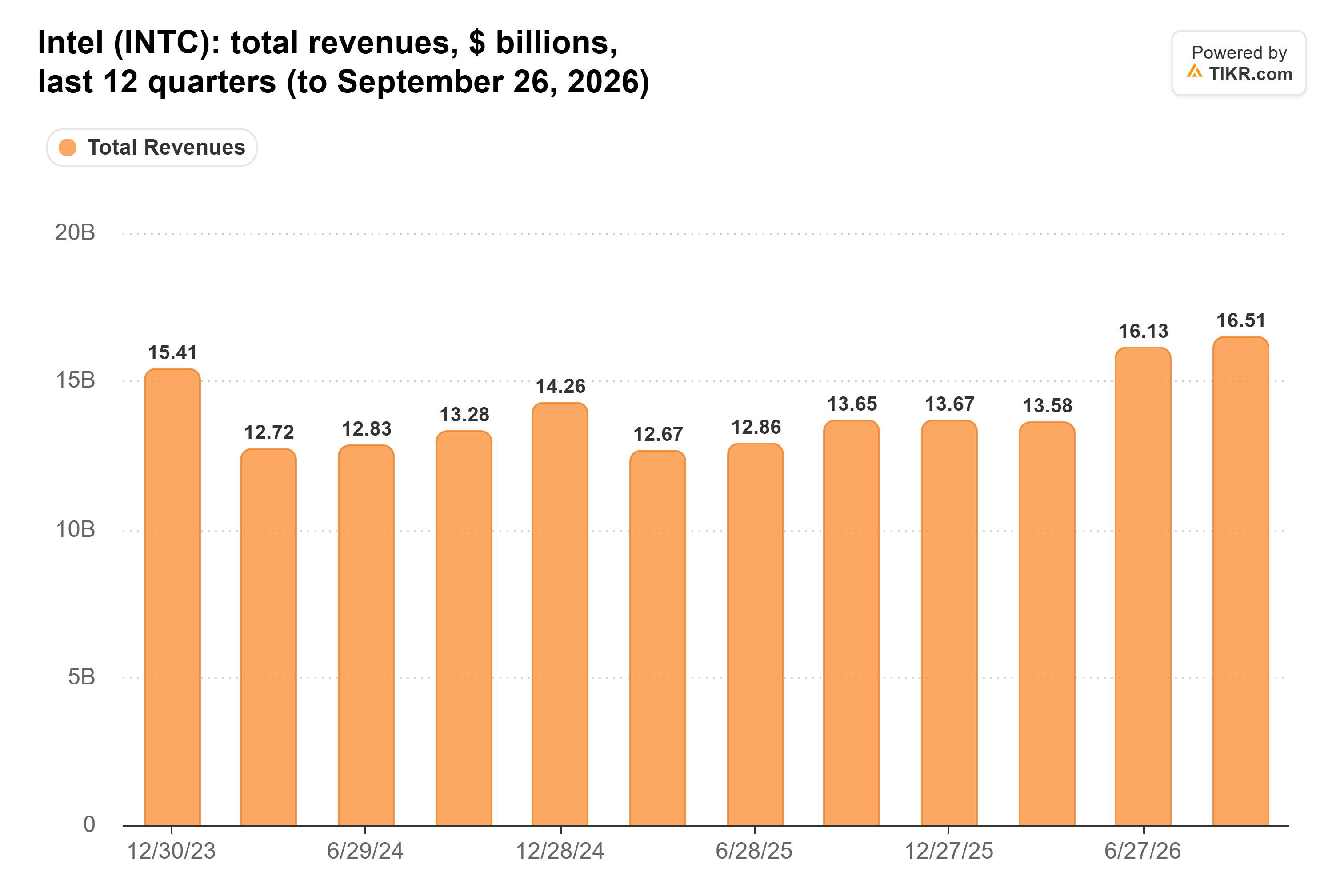
Intel guides fourth-quarter revenue to $15.0-$16.0 billion, below the third quarter’s $16.5 billion. It also expects client revenue to fall more than 20% from the third quarter.
That leaves an opening for AMD, the one other big x86 option for a customer Intel can’t supply. New Street Research upgraded Intel on Oct. 26, arguing that server CPU supply will stay tight for years. AMD is short on server chips too (management expects its supply to improve in 2027). But its server share was already about 40% at its 2025 analyst day, and it’s aiming for more than 50%.
Server chips pay better
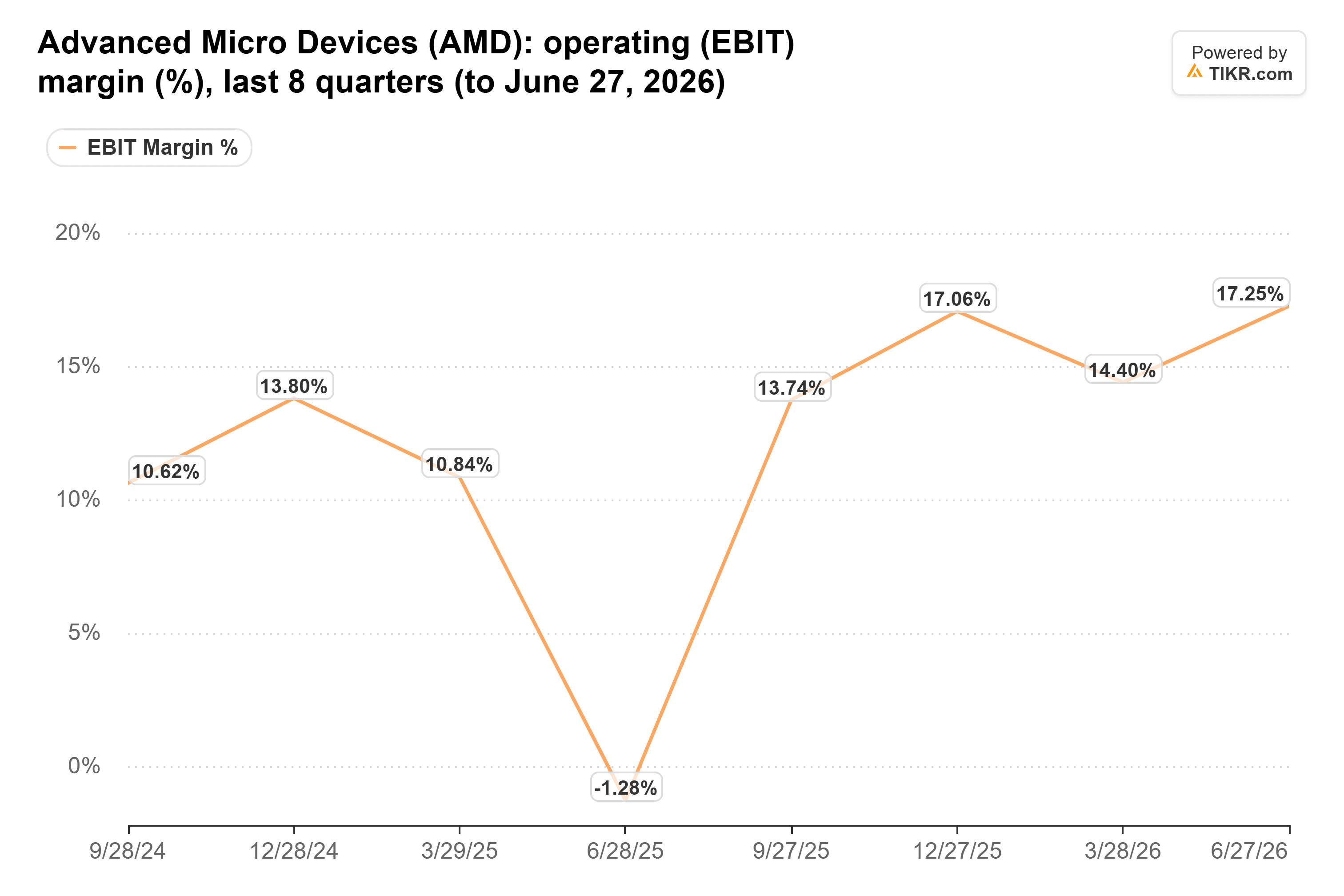
Management says server CPUs carry gross margins above the company average, so every extra server chip helps the margin. AMD’s operating margin rose from 10.6% in the quarter to Sept. 28, 2024, to 17.3% in the quarter to June 27, 2026. The exception was a loss in the June 2025 quarter, when about $800 million of MI308 charges hit:
PCs are still a quarter of AMD’s sales
AMD’s client business brought in $3.1 billion in the second quarter, about 27% of sales. Management expects higher memory and component prices to weigh on PC and gaming demand in the second half.
Not every agent will run on AMD’s chips, either. The hyperscalers design their own server CPUs on designs from Arm Holdings (ARM). AMD says its Venice chips deliver up to 3.3x the performance per watt of leading Arm chips. And on the same show, another panelist argued that stronger models may need fewer agents, which would mean fewer CPUs.
Watch the server number on Tuesday
AMD guided third-quarter revenue to about $13.0 billion, plus or minus $300 million, and analysts expect $13.09 billion. I care more about server revenue against management’s guide of more than 80% growth in the second half. Intel says higher average selling prices, up 54%, drove its server gain. So strong unit growth at AMD would show it’s selling the chips Intel can’t.
The way I see it, Mostaque is onto something. Agents give CPU demand a reason to keep growing long after this server refresh, and AMD is the CPU maker best placed to fill Intel’s gap. The PC slump will sting this quarter, but the agent money isn’t going into PCs.
Of course, the build-out Mostaque describes takes two to three years, so we won’t know from one quarter whether he’s right.
So what is AMD stock actually worth?
TIKR lets you forecast the future price of any stock in less than a minute. Just enter a few assumptions into TIKR’s valuation model and see what AMD could be worth. Start from Wall Street consensus estimates, or adjust the inputs to reflect your own view of the business. It’s free to use.
Disclaimer:
Please note that the articles on TIKR are not intended to serve as investment or financial advice from TIKR or our content team, nor are they recommendations to buy or sell any stocks. We create our content based on TIKR Terminal’s investment data and analysts’ estimates. Our analysis might not include recent company news or important updates. TIKR has no position in any of the stocks mentioned. Thank you for reading, and happy investing!


