Key Takeaways
- Sequoia partner Shaun Maguire’s model has SpaceX’s revenue going from about $51.5 billion in 2026 to $731 billion in 2028, with most of the growth from renting out AI compute.
- He says the model rests on rivals struggling to build, and he called Amazon, Alphabet’s Google and Microsoft “absolute jokes” at physical building.
- Microsoft’s delayed third-party capacity backs his premise, but Wall Street expects $336 billion of SpaceX revenue in 2028, less than half his figure.
- SpaceX rents its compute at spot prices to a few big buyers, so its speed is a real edge, but Maguire’s model looks like the best case.
Sequoia partner Shaun Maguire thinks SpaceX (SPCX) can build AI data centers faster than Amazon (AMZN), Alphabet (GOOG) and Microsoft (MSFT), and he built a financial model around that idea.
“The numbers that came out are insane,” he posted on X on October 30, noting that Sequoia is a major SpaceX shareholder.
When a skeptic joked that the model amounts to building three AWSs from scratch at 70% operating margins, Maguire shot back: “Amazon, Google and Microsoft are absolute jokes at building in the physical world compared to SpaceX.”
Elon Musk’s reply to the model was “I think we can do better.” He meant it. After SpaceX’s third-quarter results, Musk had already written that $1 trillion of SpaceX revenue in 2028 is “no longer impossible.”
Maguire’s $731 Billion SpaceX Model
According to a summary of the model posted on X, Maguire takes SpaceX’s revenue from about $51.5 billion this year to about $274 billion in 2027 and $731 billion in 2028. Most of the growth, about four-fifths, comes from renting out AI compute in data centers on the ground. Capacity climbs from about 1 gigawatt in early 2026 to 21 gigawatts by the end of 2028, at about $40 billion of revenue a year per gigawatt.
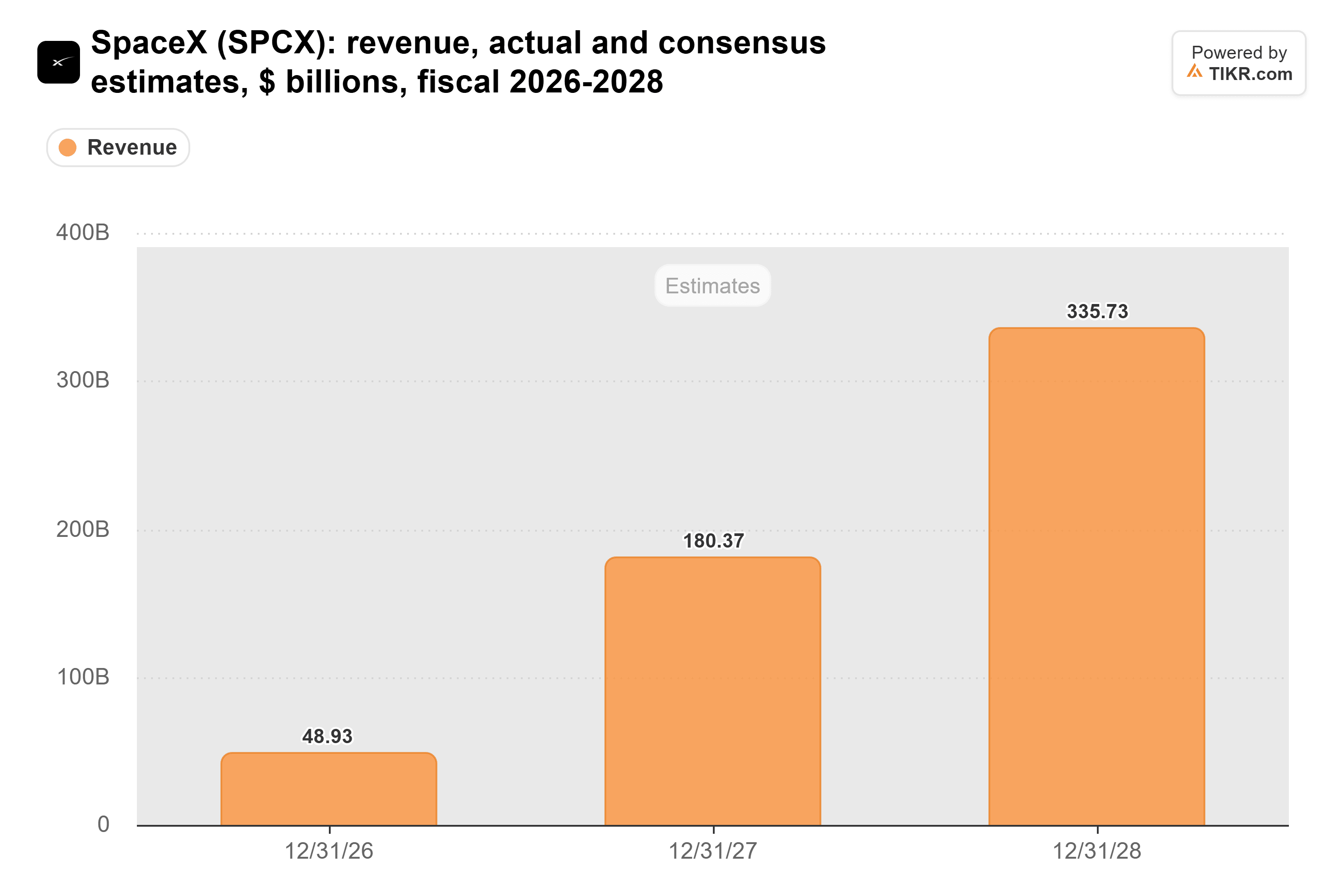
Wall Street expects far less. Consensus has SpaceX at $180 billion of revenue in 2027 and $336 billion in 2028, less than half of Maguire’s 2028 figure:
SpaceX’s own guidance points the same way. It guided first-quarter 2027 revenue to $33 billion to $37 billion. Four quarters at the top of that range come to $148 billion, a little over half of Maguire’s 2027 number.
TIKR Tracks 41 Analysts on SpaceX. How Many Say “Buy”?
See the full breakdown of Buy, Hold, and Sell ratings on SpaceX, along with Wall Street’s revenue and earnings estimates, all in one place. More than 500,000 investors use TIKR to research stocks like this one. See SpaceX’s Analyst Ratings
Microsoft Just Helped Maguire’s Case
Maguire says “the key assumption is that others will struggle to build terrestrial compute.” In another reply, he said he expects quite a few neoclouds, and even hyperscalers, to scale back their plans as they run behind schedule.
Microsoft gave him a data point two days earlier. CFO Amy Hood said on its October 28 earnings call that capital spending came to $45.2 billion in the September quarter because “some third-party capacity deliveries we expected in Q1 were delayed.” Microsoft now expects about $170 billion of capex in 2026, down from $175 billion.
Satori Fund founder Dan Niles saw the same thing across the week’s cloud reports. He wrote on X that results showed “datacenter pushouts causing cloud growth to be lower than expected.”
SpaceX, meanwhile, says it built its Colossus data center in 122 days and Colossus II in 91, against an industry norm of about two years. Score one for Maguire.
Why SpaceX’s Compute Rents Could Fall
The catch is that SpaceX rents out the same chips anyone with enough money can buy. Management said on the third-quarter call that it prices compute at “effectively the spot market rate,” so its rents can fall as fast as rivals catch up. The same Niles post that flagged the pushouts also argued that chip supply is a lot closer to demand than most companies think.
The buyers are concentrated, too. One customer, which Bloomberg identified as Anthropic, supplied 34.5% of SpaceX’s third-quarter revenue. Anthropic’s IPO filing says either side can cancel on 90 days’ notice once the deal’s noncancelable periods end in January and March 2027.
And SpaceX pays for its capacity up front. Its capital spending climbed from $4.4 billion in 2023 to $20.9 billion in 2025:

Capex hit $55.1 billion over the 12 months to September, and management guides to $35 billion to $40 billion for the fourth quarter alone. Analysts expect free cash flow of negative $140.7 billion in 2027, and SpaceX is borrowing $40 billion for GPUs arriving in the first half of next year. Even Maguire’s model keeps free cash flow negative through 2027.
Where SpaceX Could Prove Maguire Right
Maguire is right that SpaceX builds faster than the hyperscalers, and Microsoft just showed how a third party’s delay can hold one of them back. But to hit his numbers, SpaceX would need to grow its capacity nearly tenfold from the roughly 2.2 gigawatts it expected by the end of October. Then it would need to rent all of it at spot prices that hold while everyone else catches up. That makes his model the best case, and I’d want SpaceX to beat the Street’s numbers before paying for anything close to it.
The other side is real, though. Hood also said demand for Microsoft’s AI infrastructure still outpaces its capacity, and SpaceX said its short-term compute contracts were renewing at higher prices. If that shortage lasts into 2028, spot pricing works for SpaceX, not against it. The first real read comes with SpaceX’s first-quarter 2027 results. A print at the top of its $33 billion to $37 billion guide, with growth from there, would make Maguire’s numbers look a lot less insane.
So what is SpaceX stock actually worth?
TIKR lets you forecast the future price of any stock in less than a minute. Just enter a few assumptions into TIKR’s valuation model and see what SpaceX could be worth. Start from Wall Street consensus estimates, or adjust the inputs to reflect your own view of the business. It’s free to use.
Disclaimer:
Please note that the articles on TIKR are not intended to serve as investment or financial advice from TIKR or our content team, nor are they recommendations to buy or sell any stocks. We create our content based on TIKR Terminal’s investment data and analysts’ estimates. Our analysis might not include recent company news or important updates. TIKR has no position in any of the stocks mentioned. Thank you for reading, and happy investing!