Key Takeaways
- Affirm shares fell 16% in the past month as a hot inflation report, a post-midterm sell-off and credit warnings from Upstart and Block hit consumer lenders.
- Affirm’s fiscal first quarter beat its own guidance on volume, revenue and revenue less transaction costs, and it raised its full-year GMV outlook to more than $65.25 billion.
- The worry is late payments: Affirm’s 30-day delinquency rate rose to 2.9%, slightly above the 2.8% of a year earlier.
- The stock trades well below its usual forward P/E, which makes it a buy as long as delinquencies settle through the holiday quarter.
Affirm (AFRM) is down 16% in the past month, even though CEO Max Levchin wrote in his Nov. 5 shareholder letter, “It feels great to print another no-apologies quarter.”
Most of the damage came from outside. Yields jumped on a hot inflation report, the market sold off after the midterms, and two peers raised credit alarms: Upstart (UPST) cut its full-year outlook on Nov. 3, and Block (XYZ) said its third-quarter transaction and loan losses grew 66%, three times as fast as its gross profit.
Affirm fell hardest on a hot inflation print
On Oct. 14, September’s consumer prices came in 3.7% above a year earlier, hotter than expected, and long-term Treasury yields rose. Affirm fell 9% that day, while Klarna fell 3% and PayPal barely moved. Affirm funds its loans with warehouse debt, securitizations and sales to outside investors at market rates (its cost of funds was 5.8% in the June quarter), so higher yields come straight out of what it keeps on each loan.
Then on Nov. 5, hours before Affirm reported, fintechs sank with the market after Democrats won both chambers of Congress, as investors priced in tighter rules for buy-now-pay-later lending. Over the month, the Nasdaq 100 fell 9%.
TIKR tracks 36 analysts on Affirm. How many say “Buy”?
See the full breakdown of Buy, Hold, and Sell ratings on Affirm, along with Wall Street’s revenue and earnings estimates, all in one place. More than 500,000 investors use TIKR to research stocks like this one. See Affirm’s Analyst Ratings
Affirm beat its own guide across the board
GMV rose 34% to $14.4 billion, above its $13.7 billion-$14.0 billion guide, and revenue rose 35% to $1.26 billion, against a $1.19 billion-$1.22 billion guide. Revenue less transaction costs came in at $617 million, or 4.3% of GMV, above its $575 million-$590 million range. Affirm also raised its full-year GMV outlook to more than $65.25 billion, from more than $64 billion, and management called 30% growth the floor for the year.
Late payments are the catch
Affirm’s 30-day delinquency rate on monthly loans rose 35 basis points from June, to 2.9%, a touch above the 2.8% of a year earlier. Management puts the rise down to the usual seasonal pattern and to loans it made on purpose to test new lending categories.
The peers kept investors from shrugging it off. Upstart, which also relies on outside investors to fund its loans, grew originations 44% to $4.1 billion in its third quarter and still cut its outlook, with CEO Paul Gu saying in the release that “Macro is putting pressure on our near-term outlook.” Block’s consumer lending originations grew 40% to $19 billion, so shoppers still want to pay over time. The question for all three is whether losses grow faster than loans.
Affirm looks cheap if delinquencies settle
Analysts aren’t cutting their earnings numbers. Consensus normalized EPS climbs from $3.95 in fiscal 2027 to $6.17 in fiscal 2029:
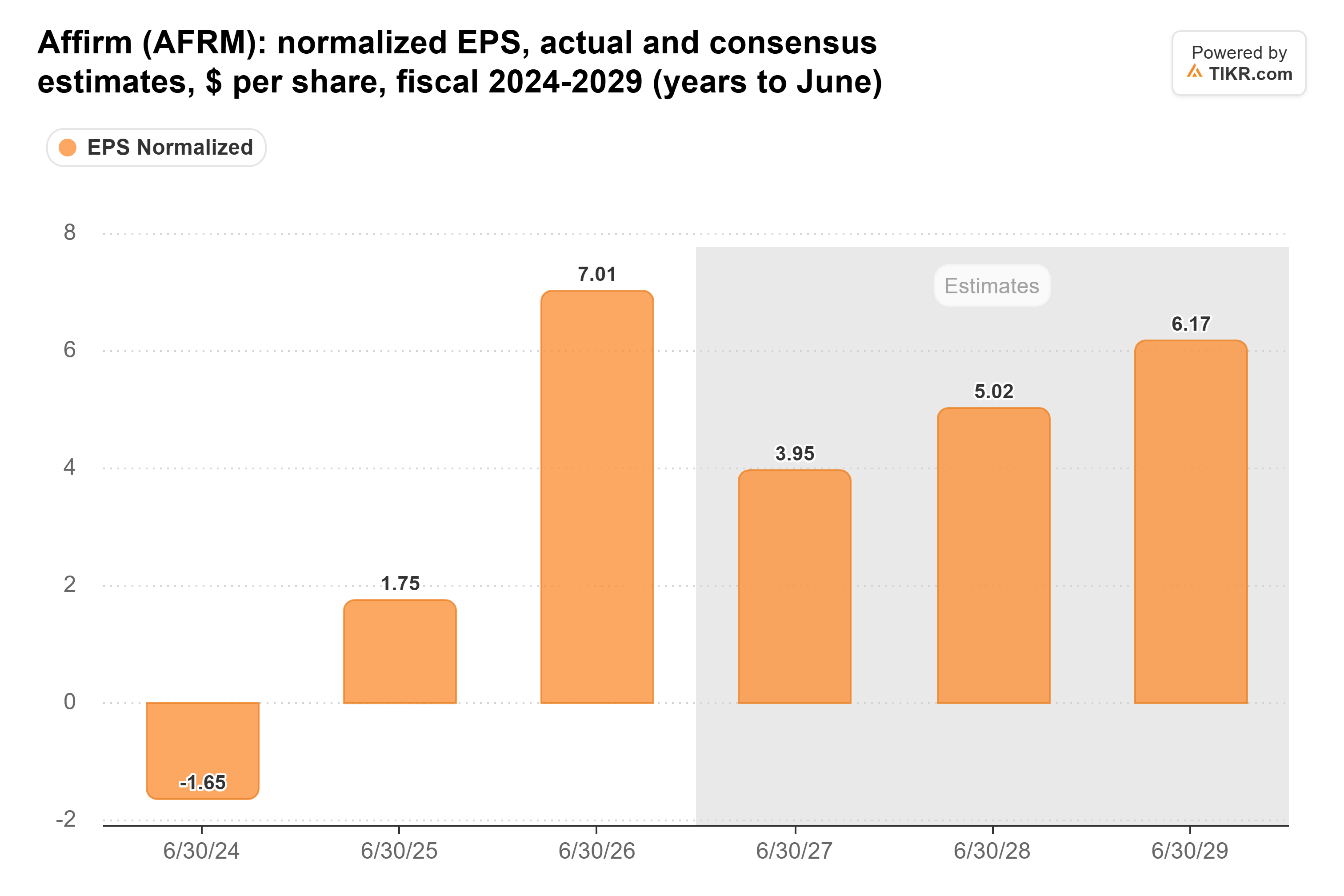
Fiscal 2026’s spike came from a one-time tax benefit. The fiscal 2027 estimate is up from $3.85 going into the report.
At about 16x forward earnings, Affirm trades well below its 28x average since its forward P/E turned positive in September 2024. Seven brokers trimmed their targets after the report, but BMO’s Andrew Bauch reiterated his Buy rating on Nov. 6 and raised his target to $104 from $102, 53% above Monday’s close.
I think Affirm is a buy here. It beat every figure it guided and raised its outlook, and its one blemish, a delinquency rate a tenth of a point above last year’s, comes with a stated reason. At 16x, investors are already pricing in worse credit.
Of course, the fiscal second-quarter report, due in early February, covers the holidays and Sam’s Club’s online launch. If delinquencies keep climbing there, Affirm will look a lot more like Upstart, and the multiple could stay low.
So what is Affirm stock actually worth?
TIKR lets you forecast the future price of any stock in less than a minute. Just enter a few assumptions into TIKR’s valuation model and see what Affirm could be worth. Start from Wall Street consensus estimates, or adjust the inputs to reflect your own view of the business. It’s free to use.
Disclaimer:
Please note that the articles on TIKR are not intended to serve as investment or financial advice from TIKR or our content team, nor are they recommendations to buy or sell any stocks. We create our content based on TIKR Terminal’s investment data and analysts’ estimates. Our analysis might not include recent company news or important updates. TIKR has no position in any of the stocks mentioned. Thank you for reading, and happy investing!