Key Takeaways
- CoreWeave’s unsecured parent-company debt yields about 16% while the company is still worth roughly $30 billion, and analyst Nick Del Deo says one of those two prices is wrong.
- The bond market has the better read for now, and shareholders are likely to pay to close the gap through new stock or convertible debt.
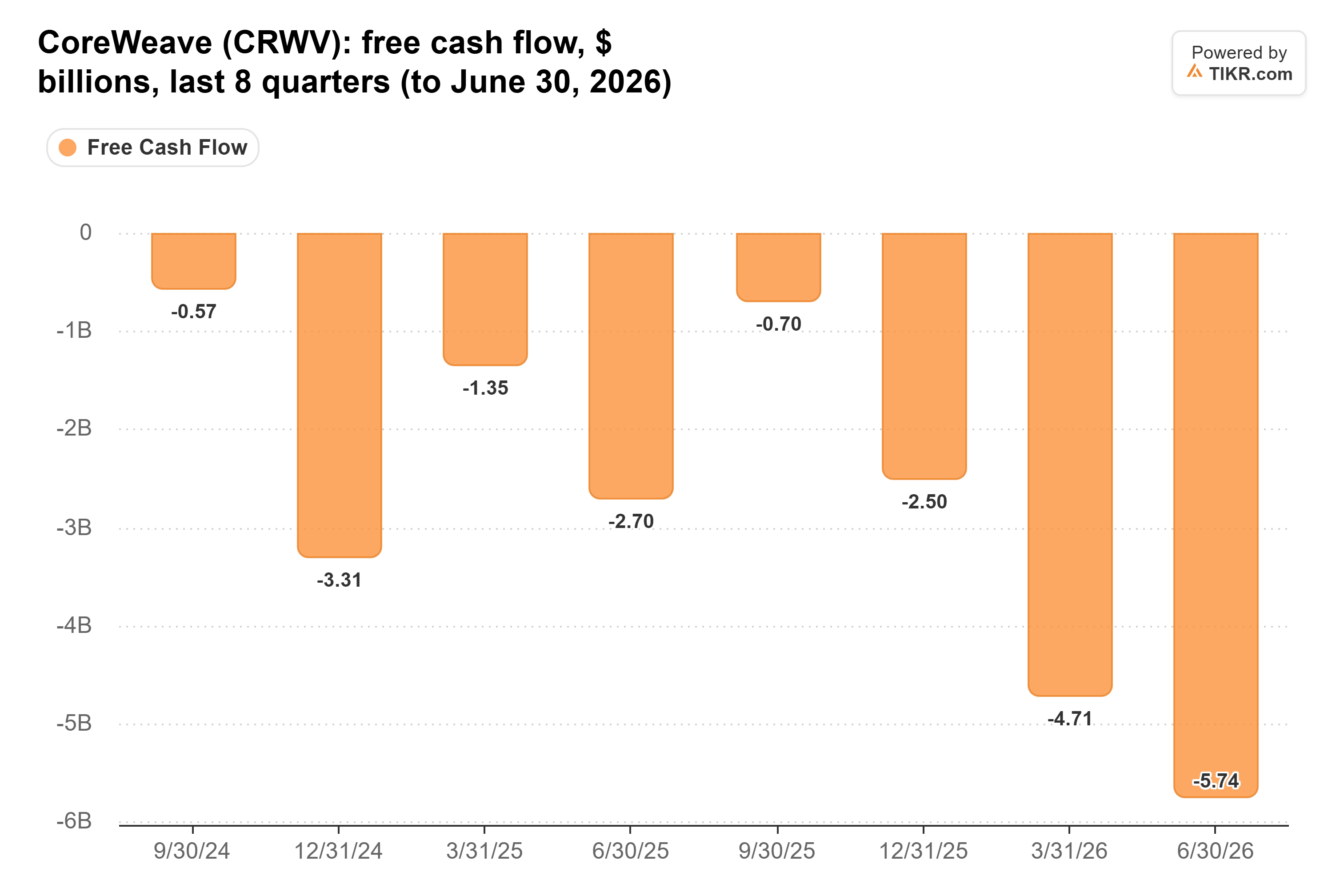
- Analysts expect revenue to more than double in 2026 and again in 2027, but free cash flow was negative $5.74 billion in the second quarter of 2026 alone.
- Nvidia, CoreWeave’s chip supplier and a $2 billion investor, is still a key backer, and the coupon on CoreWeave’s next unsecured bond is the number to watch.
Bondholders and shareholders in CoreWeave (CRWV) are looking at the same company and coming to very different conclusions.
Its unsecured bonds sank after last week’s midterm elections, pushing some to prices widely considered distressed, with yields above 15%, Bloomberg reported. The stock is down 65% from its high six months ago, but CoreWeave is still worth roughly $30 billion. And its chip supplier and investor, Nvidia (NVDA), has troubles of its own.
MoffettNathanson analyst Nick Del Deo put it bluntly on CNBC’s Closing Bell Overtime the night before CoreWeave’s third-quarter report:
“Their unsecured parent company debt is yielding approximately 16%. It’s pretty uncommon to see a company with debt yielding at that level in the market, but also have a 30 billion or so market cap. One of those two things is wrong.”
So which is it?
Wall Street still sees the growth
You can see the stock’s case in the estimates. Analysts expect CoreWeave’s revenue to go from $5.13 billion in 2025 to $26.5 billion in 2027, and $43.7 billion in 2028:
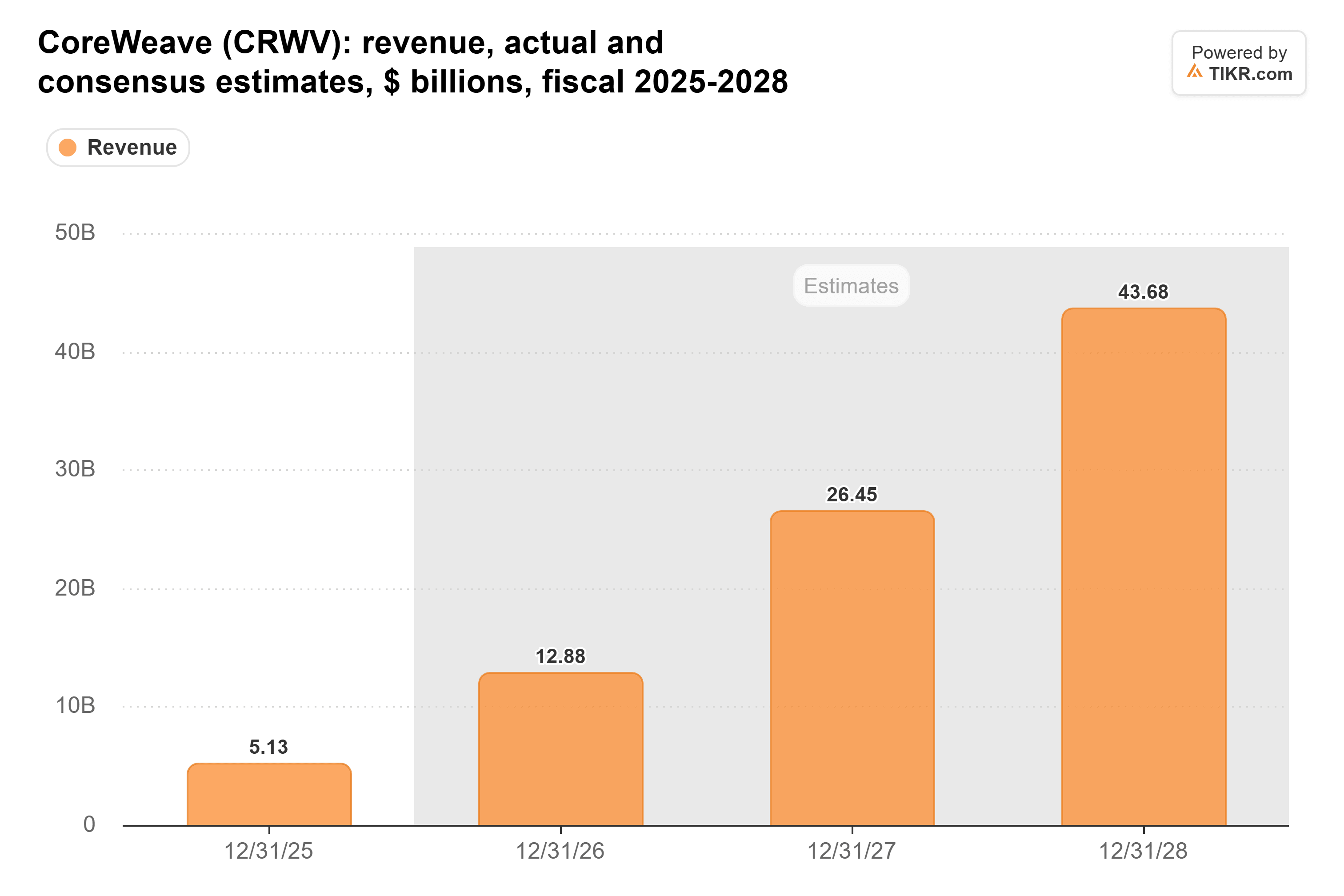
CoreWeave reported third-quarter revenue of [Q3 revenue] on Tuesday, against guidance of $3.45 billion to $3.6 billion. At roughly $30 billion, the stock trades at about 1x the revenue analysts expect for 2027. So shareholders are still paying for a business that grows into its debt, just at a steep discount.
TIKR tracks 42 analysts on CoreWeave. How many say “Buy”?
See the full breakdown of Buy, Hold, and Sell ratings on CoreWeave, along with Wall Street’s revenue and earnings estimates, all in one place. More than 500,000 investors use TIKR to research stocks like this one. See CoreWeave’s Analyst Ratings
The bill keeps getting bigger
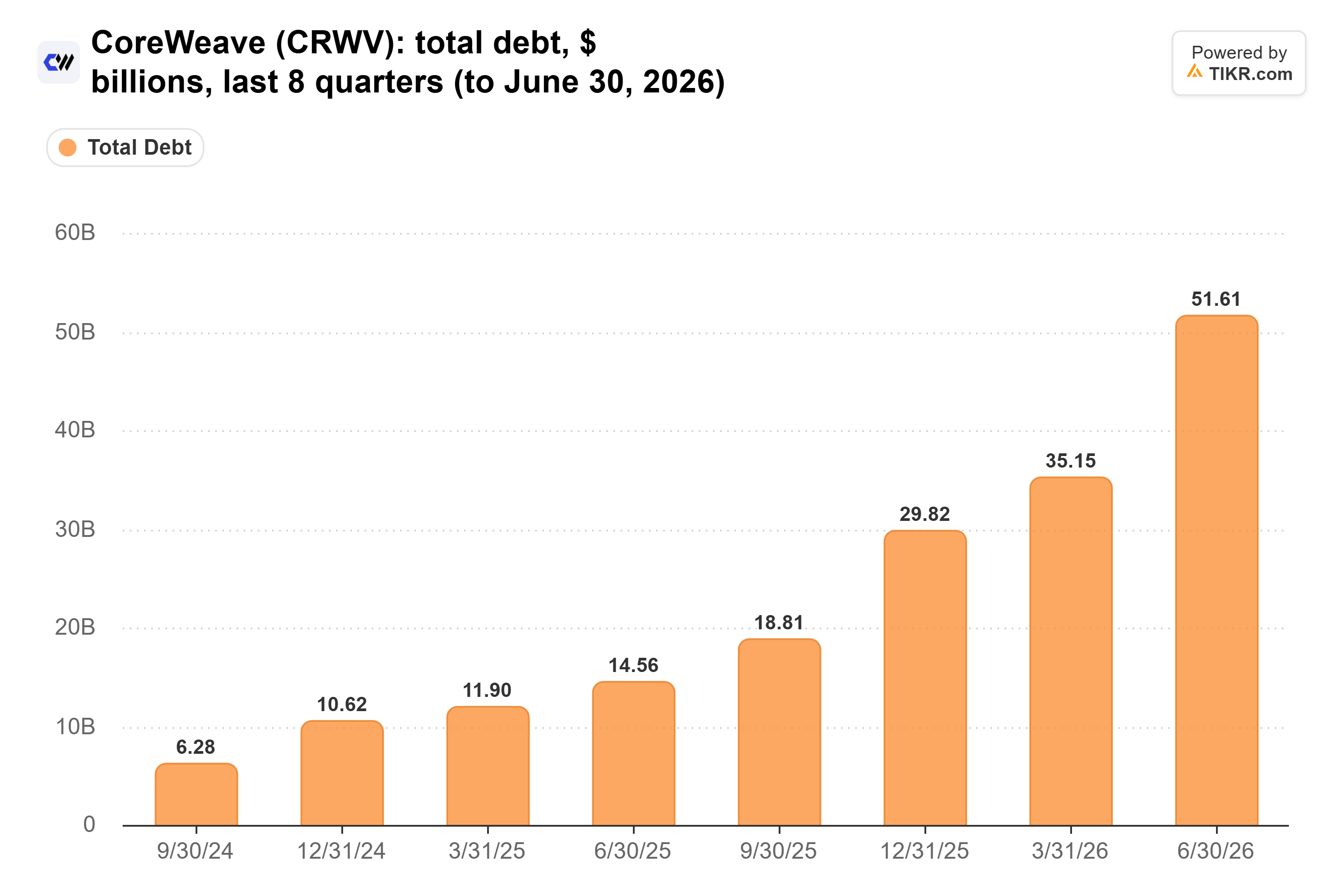
Growth like that takes a lot of money, and CoreWeave has borrowed most of it. TIKR’s total debt figure, which includes $16.5 billion of lease liabilities, climbed from $14.6 billion a year earlier to $51.6 billion at June 30, 2026:
And the buildout keeps burning cash. Free cash flow was negative $5.74 billion in the second quarter of 2026 alone, the deepest of the last eight quarters:
CoreWeave borrowed unsecured at 9.00% in July 2025 and at 9.75% in April 2026, and those bonds now trade around 16%. Management guided to third-quarter adjusted operating income of $200 million to $260 million against interest expense of $860 million to $940 million; the actuals were [Q3 adjusted operating income] and [Q3 interest expense]. Analysts expect free cash flow to stay negative every year through 2030. And Del Deo said CoreWeave is largely shut out of the unsecured debt market just as it needs tens of billions of dollars over the coming quarters.
Both prices can make sense, up to a point
Bondholders and shareholders are making different bets here. The best a bondholder can hope for is to collect the coupon and get paid back, so bondholders price the chance of not getting paid, while shareholders own whatever the business earns beyond that. And the 16% applies to only part of the pile: unsecured notes and convertibles were $16.6 billion of CoreWeave’s $35.6 billion of borrowings at June 30, while its investment-grade DDTL 4.0 loan priced under 6% in March.
But CoreWeave still has to raise the next dollar, with 2026 capex guided at $35 billion to $39 billion. Del Deo thinks the likeliest fix over time is more stock or convertible debt, and the diluted share count already rose 13% in the year to the second quarter of 2026. So the bonds can be right and the revenue can still show up, with today’s shareholders paying the difference through dilution.
Nvidia has a stake in the answer
That’s where Nvidia comes in. It supplies CoreWeave’s GPUs and invested $2 billion in its stock at $87.20 a share in January, well above today’s price. Last month, CEO Jensen Huang defended CoreWeave after debt worries set off a selloff, and now Nvidia is reportedly investigating Huang’s affair with an alleged Chinese spy. Del Deo sees CoreWeave as a critical outlet for Nvidia against hyperscalers building their own chips, and doesn’t expect Nvidia’s troubles to derail it as long as the chips keep arriving. I agree, though a distracted backer is the last thing a company shut out of the unsecured market needs.
The bonds have the better read
Here’s where I land: of Del Deo’s two prices, I’d side with the bond yield for now. Until CoreWeave can borrow unsecured money well below what its existing bonds yield, it has to share the growth in that revenue chart with whoever funds it, and more and more that means new shareholders. Of course, a new unsecured bond priced near this year’s 9.625% to 9.75% coupons would show the market is open again. More investment-grade loans like DDTL 4.0 would also let CoreWeave work around the parent’s bonds entirely.
So what is CoreWeave stock actually worth?
TIKR lets you forecast the future price of any stock in less than a minute. Just enter a few assumptions into TIKR’s valuation model and see what CoreWeave could be worth. Start from Wall Street consensus estimates, or adjust the inputs to reflect your own view of the business. It’s free to use.
Disclaimer:
Please note that the articles on TIKR are not intended to serve as investment or financial advice from TIKR or our content team, nor are they recommendations to buy or sell any stocks. We create our content based on TIKR Terminal’s investment data and analysts’ estimates. Our analysis might not include recent company news or important updates. TIKR has no position in any of the stocks mentioned. Thank you for reading, and happy investing!