


Key Takeaways
- NVIDIA agreed in September to buy Hugging Face, the main platform for sharing open AI models, for $12.9 billion.
- The deal is a bet that the AI model market stays fragmented, because many model buyers leave NVIDIA with more pricing power than two big token sellers would.
- Open models already produce a large share of AI tokens, but Ramp data puts them under 5% of what businesses spend on AI.
- NVIDIA trades at 19.8x forward earnings, well below its three-year average of 30.5x.
NVIDIA (NVDA) is paying $12.9 billion for a company that gives most of what it hosts away for free.
That company is Hugging Face, the platform where AI developers share open models. NVIDIA says it hosts more than 3 million of them.
Hugging Face co-founder and chief science officer Thomas Wolf explained the logic on this week’s episode of MTS:
“We think the future of AI hopefully will be more than just two companies selling tokens to everyone.”
From NVIDIA’s side, that’s a story about pricing.
Two customers are a bad place to sell chips
The “two companies” are OpenAI and Anthropic. If they end up selling most of the world’s tokens, they also end up controlling most of the demand for the chips that make those tokens, whether they buy the chips or rent them. Customers that big get to negotiate.
For now, NVIDIA holds the pricing power. Its gross margin climbed from 56.9% in the year to January 2023 to 75.0% two years later, and it was still 71.1% in the year to January 2026…
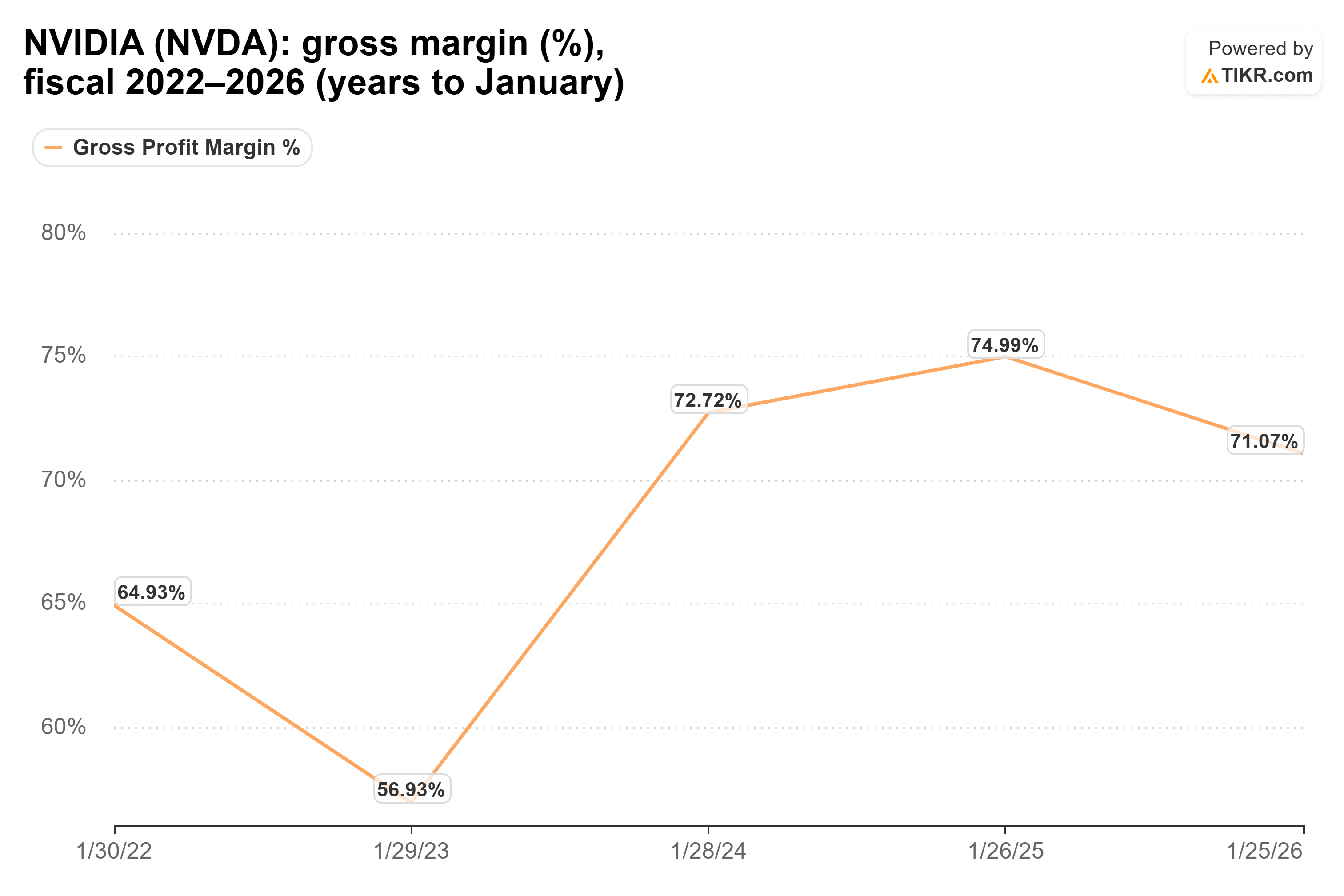
Measured against that, the deal is small. NVIDIA brought in $216 billion of revenue in the year to January 2026. At a 71.1% gross margin, that’s about $154 billion of gross profit, or roughly $12.8 billion a month. So Hugging Face cost NVIDIA about one month of gross profit.
NVIDIA isn’t even using the deal to lock developers in. In a [blog post](LINK NEEDED) announcing the deal, CEO Jensen Huang said: “Nvidia compute will not be required to build on or deploy through Hugging Face.”
NVIDIA can afford to be that open because what it really needs is lots of buyers.
The open side is catching up
That makes this a big step up from backing single open models, like the Reflection AI bet TIKR covered on Oct. 6. NVIDIA now owns the hub, and the data suggests the hub keeps getting busier.
Wolf pointed to Vercel, which publishes how tokens on its API split between open and closed models: “they’ve seen as a threshold of 50% passed just before the summer where 50% of the tokens were open weights.”
That figure covers one platform. Wolf’s own estimate for the whole market is still heavily tilted toward closed models, though he added, “I would hope that in two to three years we arrive at parity.”
The quality gap is shrinking too. PyTorch Foundation CTO Matt White, on another MTS episode, puts open models “Anywhere from maybe four to five months behind the frontier at this point.”
Crusoe CEO Chase Lochmiller, whose company runs inference for customers, sees the split on 20VC: “people are spending more money on closed source frontier models than they are on open source, but they are generating more tokens on open source than closed source.”
But do tokens turn into dollars?
That’s the obvious objection. The latest Ramp AI Index, which Ara Kharazian posted on X, found: “Open source models remain <5% of business spend.”
Investor Jack Altman went further on 20VC: “I think open source has reached its maximum as a market share. I think it’s going to keep going down.”
Here’s the thing: Lochmiller’s numbers explain Ramp’s. If open models make more tokens on less money, each open token costs less. Business spend on AI goes to the model makers. NVIDIA gets paid for compute, and every token runs on a chip somebody bought. A cheap token is still a token.
And even if open models’ share stalls, a market with thousands of model builders keeps more buyers bidding for NVIDIA’s chips than a market with two.
The upshot
Analysts expect NVIDIA’s revenue to nearly double, from $216 billion in the year to January 2026 to $412 billion in the year to January 2027. They see $687 billion the year after and $903 billion in the year to January 2029…

Hugging Face won’t add much to those figures directly. What it protects is the broad demand underneath them.
Even so, the market isn’t paying up for that growth. NVIDIA trades at 19.8x forward earnings. Its three-year average is 30.5x, and it hit 46.7x in June 2024. Its three-year low of 17.5x came just last month, on Sept. 14…

So yes, $12.9 billion says NVIDIA wants an AI market of many companies, and one month of gross profit is a low price for keeping it that way.
Of course, the money still flows mostly to OpenAI and Anthropic today. If Altman is right that open source has peaked, NVIDIA will have paid up for the hub of a shrinking corner of the market.
So what is NVIDIA stock actually worth?
TIKR lets you forecast the future price of any stock in less than a minute. Just enter a few assumptions into TIKR’s valuation model and see what NVIDIA could be worth. Start from Wall Street consensus estimates, or adjust the inputs to reflect your own view of the business. It’s free to use.
Disclaimer:
Please note that the articles on TIKR are not intended to serve as investment or financial advice from TIKR or our content team, nor are they recommendations to buy or sell any stocks. We create our content based on TIKR Terminal’s investment data and analysts’ estimates. Our analysis might not include recent company news or important updates. TIKR has no position in any of the stocks mentioned. Thank you for reading, and happy investing!


