


Key Takeaways
- Meta shares rose 27% in September. On Sept. 29, Mark Zuckerberg and five other tech leaders signed a voluntary White House AI accord that Semafor reported he drafted.
- The accord asks AI labs to police themselves through internal controls and outside audits, and it says nothing about banning open models.
- That lowers the policy risk to Meta’s open-model strategy, which SemiAnalysis’s Max Cantor warned could face a ban within 6 to 12 months.
- Meta’s forward P/E of 22.6x sits right at its three-year average, so the stock doesn’t yet price in that lower risk.
Meta Platforms (META) shares jumped 27% in September. And as the month closed, the biggest policy risk to Meta’s AI strategy got a lot smaller.
The bigger risk is open models. Meta has built much of its AI strategy around models that anyone can download and run, including its Llama family. That gives Meta more to lose than most if Washington decides these models are too risky to release.
On Sept. 30, John Coogan read out a warning on TBPN from SemiAnalysis’s Max Cantor: “The majority of people are significantly underestimating the probability of open source models being nerfed or even outright banned in the next six to twelve months due to cyber concerns.”
But the White House had just chosen a gentler path. On Tuesday, Sept. 29, President Trump and six tech leaders signed the White House Accord on Super Intelligence, a voluntary pledge from AI labs to police themselves. Semafor reported that the idea came out of a conversation between Zuckerberg and House Speaker Mike Johnson at the Sept. 24 state dinner for Chinese President Xi Jinping, and that Zuckerberg then circulated the draft.
Computer scientist Alexander Wissner-Gross went further on Moonshots with Peter Diamandis: “So the story is that Zuck actually substantially wrote just in the past week, this entire White House accord, drafted it.”
His read on the text? “It is total weak sauce.”
And his verdict was blunt: “Zuck is the winner, Dario is the loser out of all of this.” He was referring to Anthropic CEO Dario Amodei, whose company Coogan placed furthest out on the risks surrounding open models.
Weak sauce, by design
The accord, which Trump posted on Truth Social, says each company training frontier models should run four layers of controls and audits:
- Internal controls that watch its models for risks like cybersecurity
- An internal team to make sure those controls work
- Independent outside auditors
- An independent committee of the board to receive the reports
There’s no penalty and no deadline. It also says nothing about how, or whether, a lab can release an open model. As Wissner-Gross put it, “it looks like an attempt to preempt top-down regulation.”
Investor Gavin Baker of Atreides Management argued on X that the board-and-auditor setup has real teeth, because board members who ignore an auditor’s report risk a bad-faith finding in court. He also said a new regulator would have “probably created a regulated oligopoly at the frontier, which is the scariest potential outcome.” A small club of licensed labs is the outcome that would have hurt Meta’s open approach the most.
Why Meta cares so much
Meta has paid heavily for its AI ambitions. Its capital spending nearly quadrupled, from $18.7 billion in 2021 to $69.7 billion in 2025…
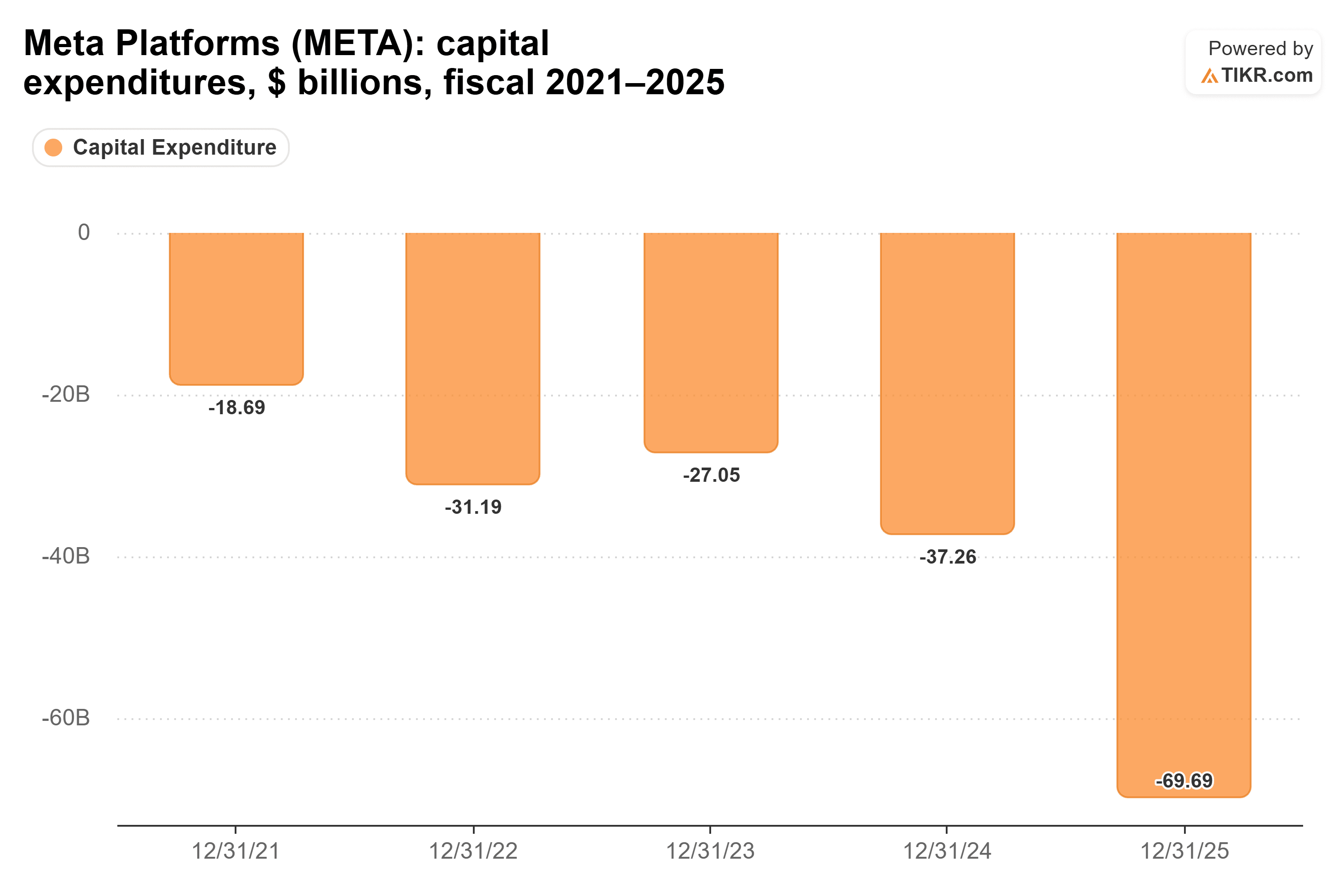
A ban on open releases wouldn’t leave those data centers sitting idle. But it would have forced Meta to rethink a strategy it has spent years and billions building, and this accord doesn’t ask Meta to do that.
But isn’t it just a pledge?
Fair question. The accord is voluntary. Wissner-Gross himself notes it “leaves a little caveat at the end” that the executive branch might regulate later, and he passes on Zuckerberg’s authorship as “the story” rather than something he saw firsthand. The cyber worry is real too: Coogan relayed SemiAnalysis’s view that open models have caught up with the frontier at finding “zero days,” the unknown security holes hackers exploit.
Cantor’s window is the next 6 to 12 months, though. In that window, the White House has just used its big AI-safety moment to choose self-policing, from a draft Meta’s CEO reportedly circulated. Coogan doesn’t expect a fast reversal either, because “the vast majority of people who are closest to Donald Trump have been evangelizing for open source.”
The market hasn’t paid for it
Even after September’s run, Meta trades at 22.6 times forward earnings. That’s basically in line with its three-year average of 22.9x and well below the 29.1x peak it reached in February 2025. Most of the rally has simply brought the multiple back from the 16.5x low it hit in late June.

So yes, Zuck comes out ahead here. The rules Meta now follows reportedly started with his own draft. They allow audits that Meta can handle internally, while leaving open models alone. I don’t see the market giving Meta much credit for that lower regulatory risk yet.
Of course, the accord is voluntary. One serious cyber incident involving an open model could put restrictions on open models right back on the table.
So what is Meta stock actually worth?
TIKR lets you forecast the future price of any stock in less than a minute. Just enter a few assumptions into TIKR’s valuation model and see what Meta could be worth. Start from Wall Street consensus estimates, or adjust the inputs to reflect your own view of the business. It’s free to use.
Disclaimer:
Please note that the articles on TIKR are not intended to serve as investment or financial advice from TIKR or our content team, nor are they recommendations to buy or sell any stocks. We create our content based on TIKR Terminal’s investment data and analysts’ estimates. Our analysis might not include recent company news or important updates. TIKR has no position in any of the stocks mentioned. Thank you for reading, and happy investing!


