


Key Takeaways
- Wells Fargo named Kleber Santos sole CEO of Consumer Banking and Lending and moved Saul Van Beurden into a dedicated enterprise AI role.
- Q3 EPS rose 13% to $1.87, but revenue of $21.9 billion missed the roughly $22.3 billion consensus.
- Net interest margin fell to 2.43% from 2.61% a year ago, so NII growth relied on balance sheet volume.
- Management reaffirmed roughly $50 billion of 2026 NII, and the January 14 report will show whether Q4 delivers it.
Most banks talk about AI in earnings decks. Wells Fargo (WFC) just gave it a full-time executive.
The bank named Kleber Santos sole CEO of Consumer Banking and Lending, ending the co-CEO setup it created in 2025. His former co-head, Saul Van Beurden, will now focus only on AI adoption across the company, working with technology chief Bridget Engle.
The move came the same week Axios reported that large U.S. banks, Wells Fargo among them, had found unauthorized AI agents inside customer accounts. So the new role covers defense as much as productivity.
Shares closed at $83 on Thursday, up 0.7%. They remain about 15% below their 52-week high.
Earnings grew, revenue lagged
The reshuffle follows a quarter that beat on profit and missed on the top line:
- EPS rose 13% to $1.87, just above the $1.85 estimate.
- Revenue rose 2% to $21.9 billion, short of roughly $22.3 billion expected.
- Net interest income grew 5% to $12.5 billion, below the $12.6 billion forecast. beinsure
Part of the EPS beat came from below the operating line. The tax bill included $170 million of discrete benefits, and expenses also came in lower. wellsfargo
CEO Charlie Scharf still described a quarter of “broad-based growth, higher earnings, and stronger returns.” The fee lines back him up in places, with M&A revenue up 30% and equity underwriting up 33%.
The bigger question sits in the spread business…
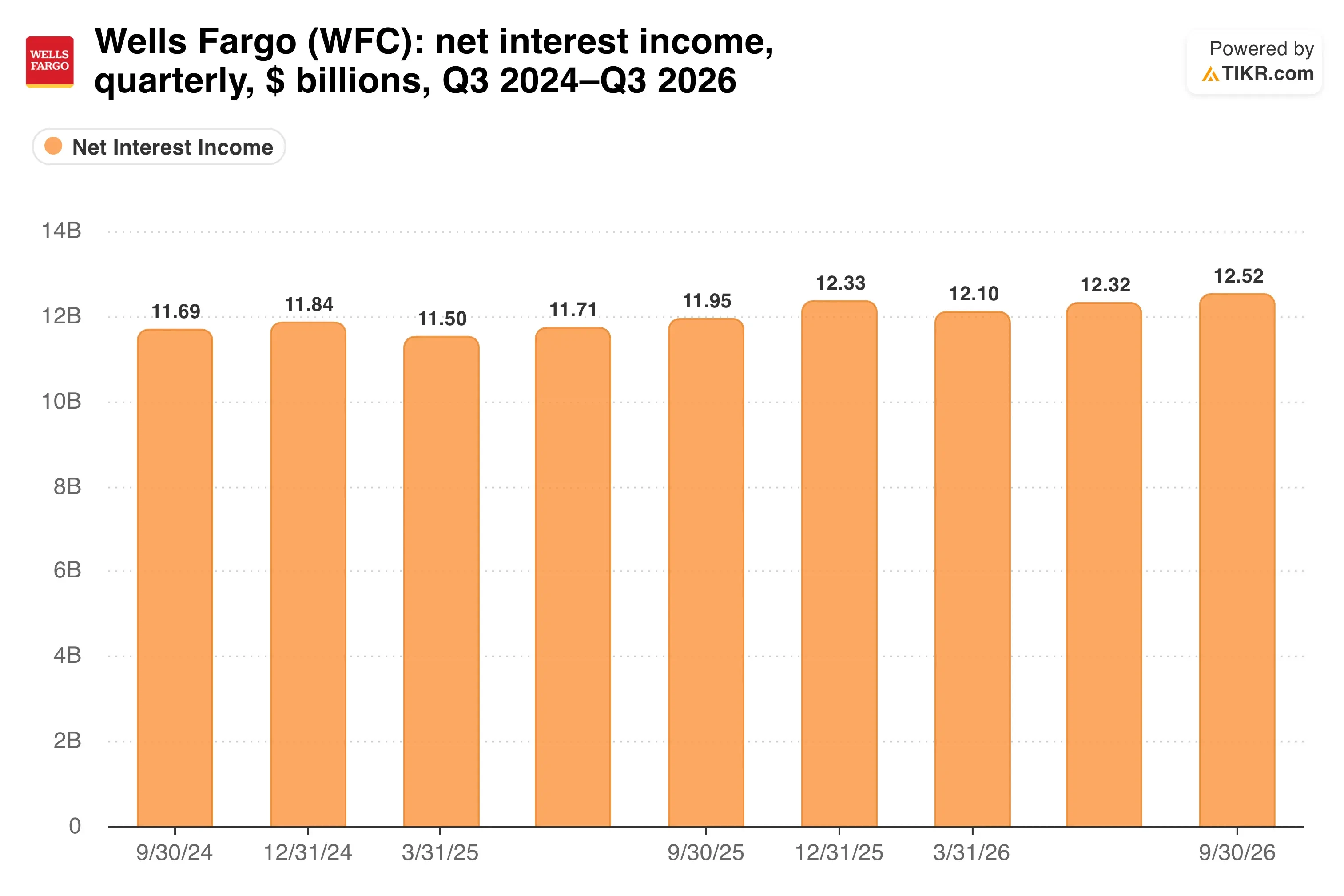
NII is growing again, but the margin behind it shrank from 2.61% to 2.43% in a year, so the gain came from volume.
Why AI gets its own seat
Wells needs operating leverage more than most peers. Revenue is barely growing, and profit gains have to come from costs. Headcount already fell to about 197,000 at the end of June from 201,000 in March.
AI is the obvious next tool. The bank also hired Cayetano Gea-Carrasco last week to run AI and data inside the consumer business, so the push now runs at both the enterprise and segment level.
Wealth is doing the cleanest work right now. Wealth and Investment Management revenue rose 12%, while client assets grew 11%.
Consumer Banking and Lending grew revenue 5%, and Santos now owns that franchise outright.
With revenue growth this modest, the profit math depends heavily on costs…

Consensus sees revenue compounding only about 5.4% a year over the next two years, which leaves AI efficiency to do the rest.
TIKR tracks 27 analysts on Wells Fargo. How many say “Buy”?
See the full breakdown of Buy, Hold, and Sell ratings on Wells Fargo, along with Wall Street’s revenue and earnings estimates, all in one place. More than 500,000 investors use TIKR to research stocks like this one. See Wells Fargo’s Analyst Ratings
Paying for a slower bank
Credit is the first thing to watch. The provision for credit losses rose to $1.03 billion, mostly to support growth as average loans reached $1.03 trillion.
Deposits come second. Average deposits grew to $1.48 trillion, yet higher costs on interest-bearing commercial deposits squeezed the margin. CFO Mike Santomassimo expects NII to rise in the fourth quarter on further loan and deposit growth. beinsure
Valuation sits mid-pack. Wells trades at 10.7x forward earnings, above Citigroup (C) at 10.0x and below Morgan Stanley (MS) at 13.8x. Its 12.9% return on equity trails the 17.8% at Goldman Sachs (GS).
The stock has returned 122.8% over three years. Has the market already priced in the turnaround?

The multiple has expanded since the asset cap lifted, so further gains need faster earnings growth.
My take: Giving AI a dedicated leader is a sensible move. Wells has largely fixed its regulatory problems, and its next challenge is growing earnings faster than revenue, which only works if costs keep falling. I would want to see the margin stabilize before paying up, because volume growth alone has limits.
The January 14 report is the next checkpoint. It will show whether Wells hit its roughly $50 billion NII target and whether the margin held near 2.43%.
So what is Wells Fargo stock actually worth?
TIKR lets you forecast the future price of any stock in less than a minute. Just enter a few assumptions into TIKR’s valuation model and see what Wells Fargo could be worth. Start from Wall Street consensus estimates, or adjust the inputs to reflect your own view of the business. It’s free to use.
Disclaimer:
Please note that the articles on TIKR are not intended to serve as investment or financial advice from TIKR or our content team, nor are they recommendations to buy or sell any stocks. We create our content based on TIKR Terminal’s investment data and analysts’ estimates. Our analysis might not include recent company news or important updates. TIKR has no position in any stocks mentioned. Thank you for reading, and happy investing!


