


Key Takeaways
- Citigroup won approval for a wholly owned China securities venture, becoming the seventh foreign firm with that license after a four-year wait.
- Third-quarter revenue rose 8% to $23.8 billion and net income jumped 40% to $5.2 billion, with EPS of $2.85 topping estimates.
- Credit costs rose to $2.6 billion on a $369 million reserve build, and the shares sit about 17% below their 52-week high.
- The next checkpoint is the Banamex IPO, targeted for January at more than $3 billion in proceeds.
Jane Fraser spent years shrinking Citi. This week she got a reason to expand again, and it came from Beijing.
Citigroup (C) won approval to run a wholly owned securities business in China. The license covers A-share brokerage, underwriting, research and principal trading. It also ends an application that dragged on for more than four years, and Citi becomes only the seventh foreign firm with that setup.
The approval lands ten days after Citi posted its best third-quarter revenue in a decade. Management also said it now expects to beat its 10% to 11% return on tangible common equity target for 2026.
Investors remain cautious, though. The stock closed at $122 on Thursday, down 1.1%, and sits about 17% below its 52-week high of $148.
Back in January, Fraser told staff it was time to drop “old, bad habits.” This quarter suggests a few of them are finally gone.
Forty percent with an asterisk
Citi beat on the lines that mattered most:
- Revenue rose 8% to $23.8 billion, ahead of roughly $23.7 billion expected.
- Net income jumped 40% to $5.2 billion, or $2.85 per share against a $2.65 estimate.
- Net interest income grew 14%, helped by 12% growth in average loans to $809 billion. sec
The asterisk is Banamex. The year-ago quarter carried a $714 million after-tax goodwill charge, so underlying profit growth was closer to 17%.
That is still a strong number. Wealth net income nearly doubled to $585 million, and Services revenue rose 15%. wealthbriefingasia
Here is how quarterly profit has moved over the past two years.
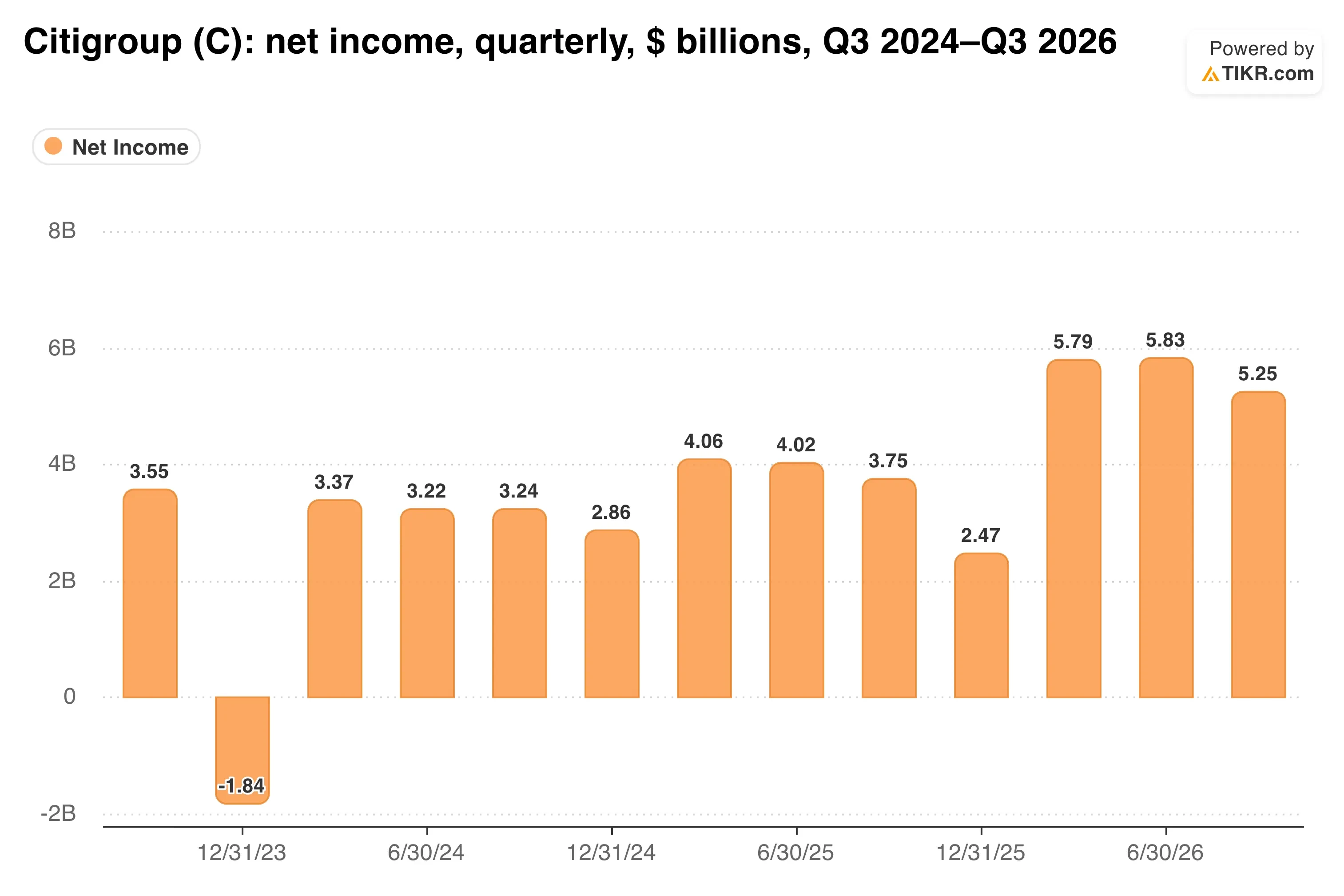
With the Banamex charge out of the comparison, the earnings base now sits at a visibly higher level.
China adds a fee engine
The license matters for one simple reason. Citi can now earn underwriting and trading fees in China without splitting them with a joint venture partner.
That fills a real gap. Non-interest revenue fell 4% last quarter, so spread income did most of the work. Citi plans to add several dozen staff onshore in the coming months, and it hosts its own China Conference from November 11 to 13.
Banamex is the other half of the reshaping. Earlier this year, Citi sold a further 24% stake to investors including Blackstone (BX) and General Atlantic, and it kept 51%. It now targets an IPO raising more than $3 billion, possibly in January.
Banamex also raised $900 million in loss-absorbing bonds, so it can stand on its own capital before listing.
Services is the business Fraser wants all of this to feed…

Services has been Citi’s steadiest grower, and China gives the bank a second fee franchise to build beside it.
TIKR tracks 23 analysts on Citigroup. How many say “Buy”?
See the full breakdown of Buy, Hold, and Sell ratings on Citigroup, along with Wall Street’s revenue and earnings estimates, all in one place. More than 500,000 investors use TIKR to research stocks like this one. See Citigroup’s Analyst Ratings
Credit and the book value gap
Credit explains much of the caution. The provision for credit losses was $2.6 billion, including a $369 million reserve build tied to a softer macro outlook. Net credit losses held flat at $2.2 billion, but U.S. Consumer Cards net income fell 8% to $851 million. sec
Valuation is the other side of the trade. Citi trades at 1.06x book value and 10.0x forward earnings, while Wells Fargo (WFC) trades at 1.57x book and Morgan Stanley (MS) at 2.71x.
So how wide has that gap stayed over time?
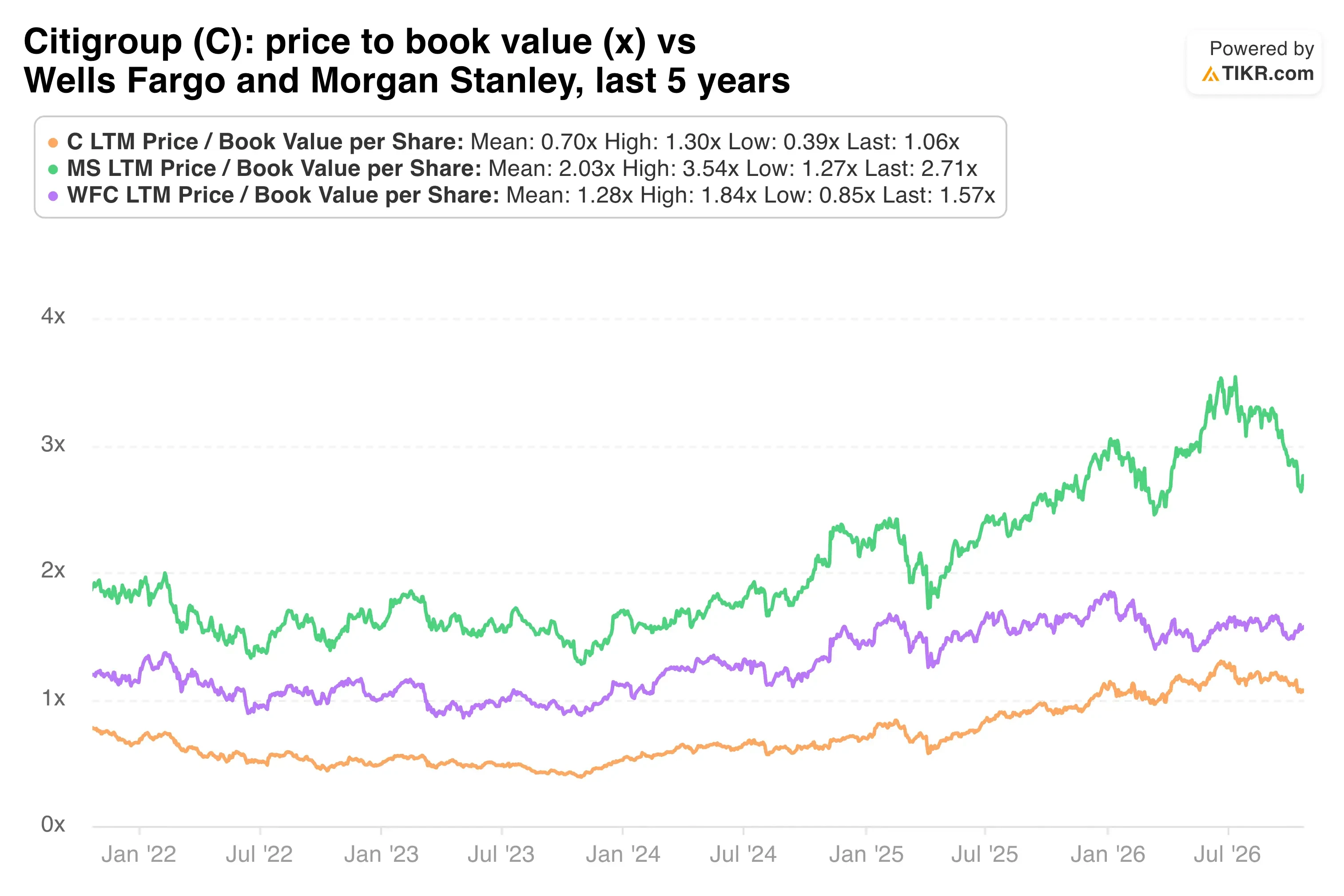
Citi has narrowed the discount, yet it still trades near book while returns climb toward 11%.
Analysts expect EPS to compound about 31.7% a year over the next two years. Their average price target of $151 implies roughly 23% upside.
My take: The China license is a small earnings driver for 2027. Its bigger value is the signal that Citi has moved from cleanup to expansion. If the bank lands in its 11% to 13% ROTCE range next year, a stock near book value looks too cheap, although a weaker card book could keep the discount in place.
The Banamex IPO is the next checkpoint, with a January listing in view. A strong pricing above $3 billion would show investors will pay up for the pieces Citi is carving out.
So what is Citigroup stock actually worth?
TIKR lets you forecast the future price of any stock in less than a minute. Just enter a few assumptions into TIKR’s valuation model and see what Citigroup could be worth. Start from Wall Street consensus estimates, or adjust the inputs to reflect your own view of the business. It’s free to use.
Disclaimer:
Please note that the articles on TIKR are not intended to serve as investment or financial advice from TIKR or our content team, nor are they recommendations to buy or sell any stocks. We create our content based on TIKR Terminal’s investment data and analysts’ estimates. Our analysis might not include recent company news or important updates. TIKR has no position in any stocks mentioned. Thank you for reading, and happy investing!


