
Key Stats for WEC Energy Stock
- Past-Week Performance: 4%
- 52-Week Range: $101 to $118
- Current Price: $114
What Happened to WEC Energy Stock?
WEC Energy Group (WEC) climbed to near its 52-week high of $118.2, trading at $115.2 on February 20, 2026, up 4% over the past week and sitting just 2.5% below its peak.
Microsoft received local approval in late January 2026 to expand its Wisconsin data center campus with 15 additional buildings, prompting WEC to add 500 megawatts to its demand forecast and $1 billion to its five-year capital plan, now totaling $37.5 billion.
The expansion reflects surging electricity demand across WEC’s territory, with the company now projecting 3.9 gigawatts of total electric demand growth through 2030, anchored by Microsoft’s 2.6 GW I-94 corridor footprint and Vantage Data Centers’ 1.3 GW Oracle and OpenAI complex north of Milwaukee.
WEC is increasingly re-rated from a traditional Midwest utility into a high-growth infrastructure play, with management guiding 7% to 8% compound annual EPS growth through 2030 and acceleration to the upper half of that range starting in 2028.
Scott Lauber, President and CEO, stated on the Q4 2025 earnings call that “there’s going to be a lot to come as we start thinking about 2031 in the future also,” grounding his outlook in Microsoft’s ongoing land acquisitions and the multiyear delivery timeline the tech giant itself confirmed publicly.
Wall Street’s median 12-month price target sits at $118.50, with 8 buy-rated analysts versus only 1 sell, reflecting broad conviction that WEC’s regulatory clarity in Illinois and its VLC tariff framework protect existing ratepayers while unlocking hyperscaler-driven upside.
The broader move signals that WEC has successfully positioned itself at the intersection of AI infrastructure build-out and regulated utility stability, with a 23-year dividend growth streak and 8% adjusted EPS growth in 2025 reinforcing that the growth story carries income credentials too.
Where is the WEC Stock Headed?
Microsoft’s latest campus expansion approval and the resulting $1 billion capital plan addition directly translate into a multi-year earnings growth runway that now stretches well beyond WEC’s current five-year forecast window.
The fundamental case centers on WEC’s 2026 estimated normalized EPS of $5.59, up 6.1% year over year, supported by EBITDA margins expanding to 44.1% and revenue growing to $10.12 billion, reflecting the early innings of data center load monetization.
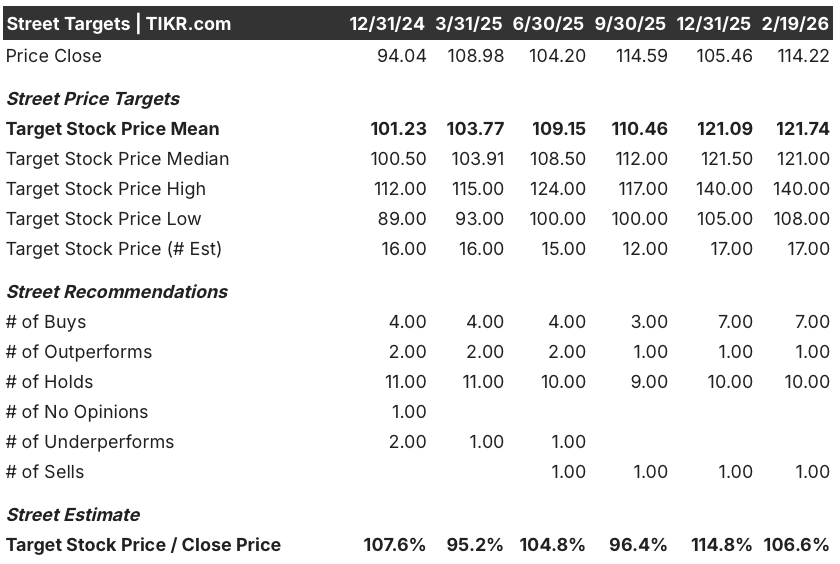
As of February 20, Wall Street’s mean price target for WEC Energy stock stands at $121.7 across 17 estimates, with 7 buys and 8 holds, placing the consensus roughly 6.6% above the current price of $114.22.
The target range spans from $108 on the low end to $140 on the high end, meaning even the most skeptical analysts see limited downside from current levels while believers price in meaningful hyperscaler-driven upside.

With Microsoft’s Wisconsin build-out accelerating and Vantage’s 1.3 GW Oracle and OpenAI complex breaking ground in December 2025, a mid-case valuation model targets WEC at $168 by December 2030, implying a 46.8% total return and an 8.2% annualized IRR from today’s price.
The core risk is P/E multiple compression, with the model projecting a -1.3% annual P/E CAGR in the mid case, meaning earnings growth must carry the entire return without any valuation re-rating support.
At $114 with a clear demand catalyst, expanding margins, and 23 consecutive years of dividend growth, WEC looks modestly undervalued for long-term investors willing to let the data center buildout compound over the next five years.
Value Any Stock in Under 60 Seconds (It’s Free)
With TIKR’s new Valuation Model tool, you can estimate a stock’s potential share price in under a minute.
All it takes is three simple inputs:
- Revenue Growth
- Operating Margins
- Exit P/E Multiple
From there, TIKR calculates the potential share price and total returns under Bull, Base, and Bear scenarios so you can quickly see whether a stock looks undervalued or overvalued.
If you’re not sure what to enter, TIKR automatically fills in each input using analysts’ consensus estimates, giving you a quick, reliable starting point.