
Key Stats for UPST Stock
- Past week’s performance: 6%
- 52-week range: $24 to $77
- Valuation model target price: $37
- Implied upside: 25.2% over 2.4 years
See what Upstart’s rebound could mean for your own return assumptions (It’s free) >>>
Upstart Returns to Profit as Loan Volume Hits a Record
Upstart (UPST) shares jumped after the fintech lender posted its first profitable quarter since 2021. Revenue rose 42% year over year to about $365 million, while net income more than doubled to $16.5 million. The results mark a meaningful shift for a company that had been losing money for years.
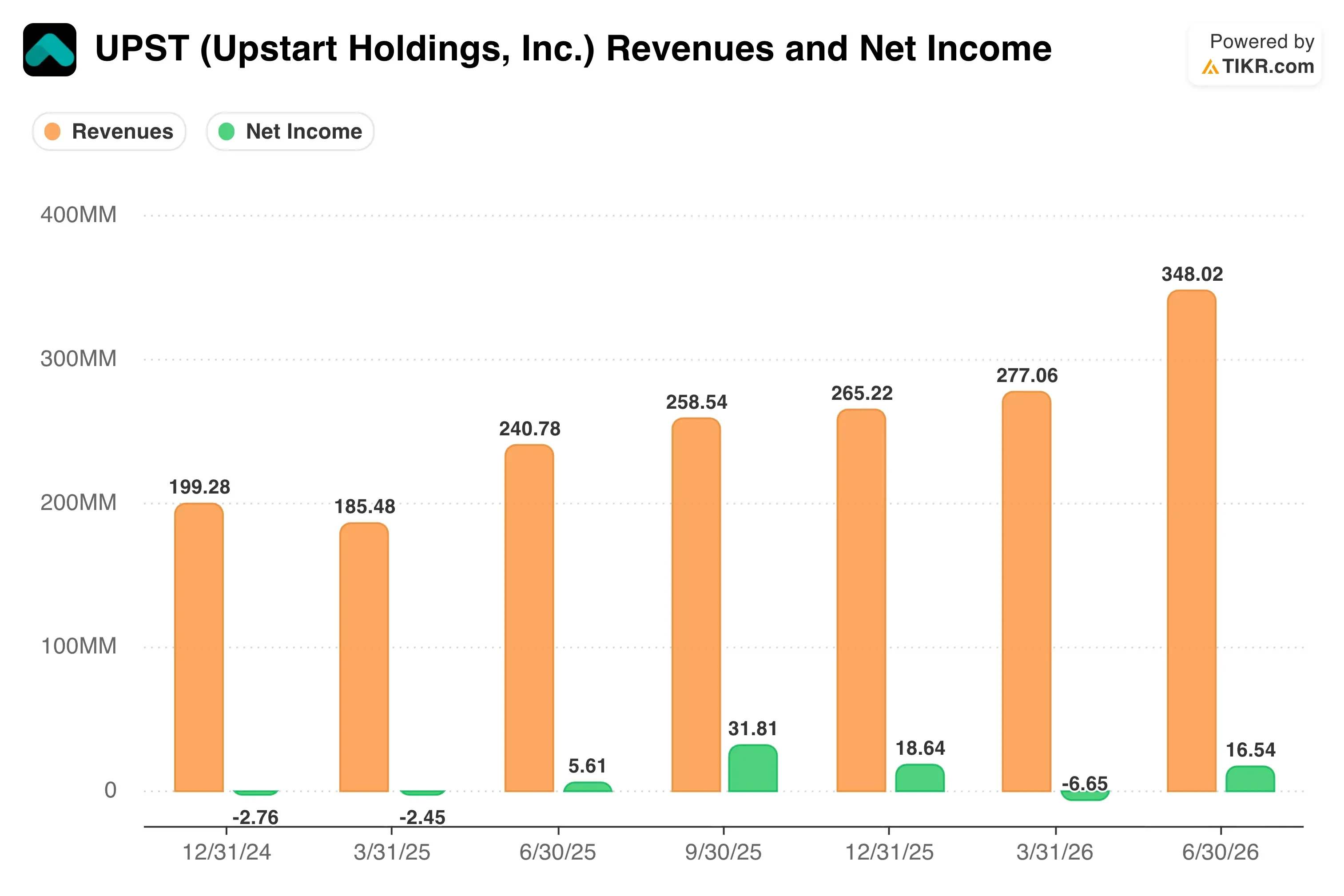
Loan originations were the real driver behind the beat. Upstart processed a record $4.2 billion in total originations, up 50% from a year earlier. Personal loan originations, its core business, grew 27% sequentially, and the company’s expansion into auto and home lending is also gaining traction.
Funding capacity has been one of Upstart’s biggest constraints, so a new agreement matters here too. The company signed a multi-year forward flow deal with Castlelake worth up to $4 billion, giving it more capital to fund the loans its AI models approve. Without funding partners like Castlelake, Upstart cannot convert loan demand into actual originations.
If this pace of growth continues, Upstart’s turnaround narrative could gain more credibility with investors. Management pointed to improving AI underwriting models and stronger loan demand as the reasons behind the rebound, while noting credit performance has remained stable even as volume scaled quickly.
Run your own scenario for Upstart’s recovery in under 60 seconds (It’s free) >>>
Is Upstart Stock Still Cheap After the Bounce?
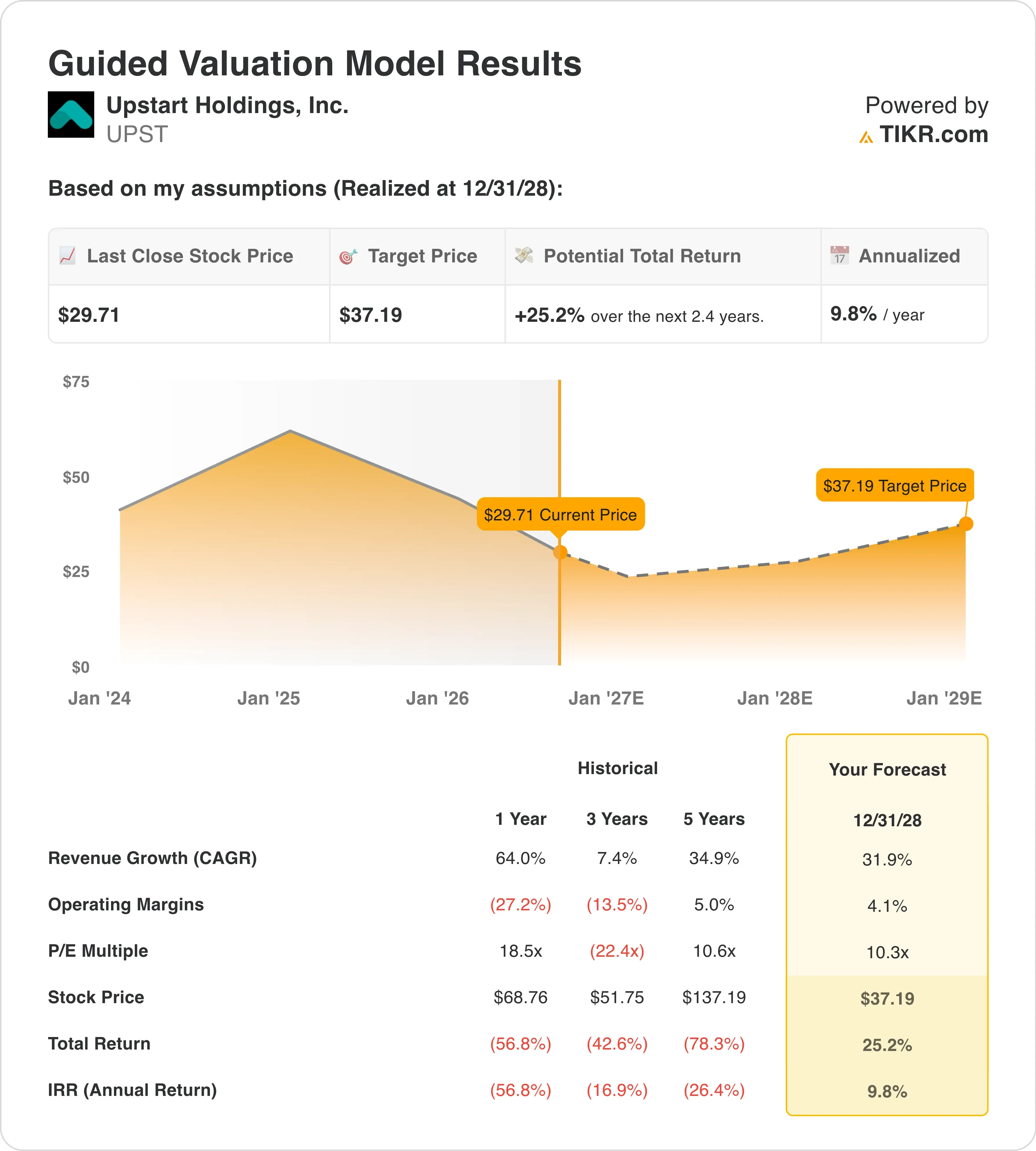
Under valuation model assumptions realized through 12/31/28, the stock is modeled using:
- Revenue Growth (CAGR): 31.9%
- Operating Margins: 4.1%
- Exit P/E Multiple: 10.3x
Based on these inputs, the model estimates a target price of $37, implying a 25.2% total return and a 9.8% annualized return over the next 2.4 years.
Upstart still trades far below its 52-week high, so the valuation reflects real skepticism about whether this quarter’s profitability sticks. The model assumes only a modest 4.1% operating margin, well below what mature lending platforms achieve, which suggests the market has priced in a cautious recovery rather than a full turnaround.
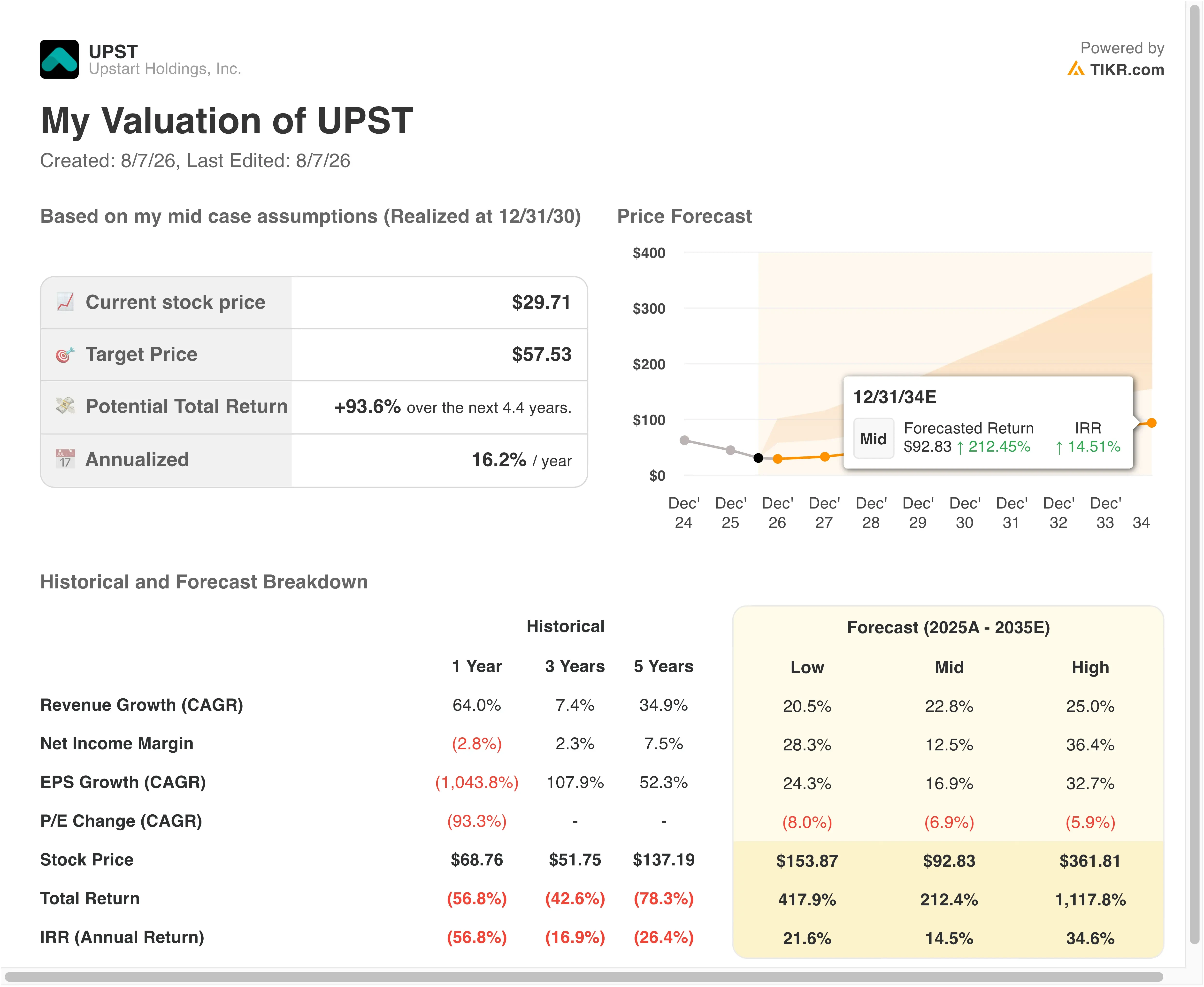
Growth assumptions here are aggressive but not unreasonable given the 50% jump in originations. If Upstart can keep expanding into auto and home lending while maintaining credit quality, revenue growth near 32% annually becomes more plausible over time.
Compared to its own history, Upstart traded above $60 as recently as three years ago, so today’s price still reflects a business investors are not yet fully trusting. The Castlelake funding deal and the conditional national bank approval both chip away at the risks that kept the stock depressed.
Estimate a company’s fair value instantly (Free with TIKR) >>>
Upstart vs SoFi and LendingClub in Consumer Lending
Upstart competes against a mix of fintech lenders, with SoFi (SOFI) and LendingClub (HAPN) as its closest publicly traded rivals in AI-driven and marketplace lending.
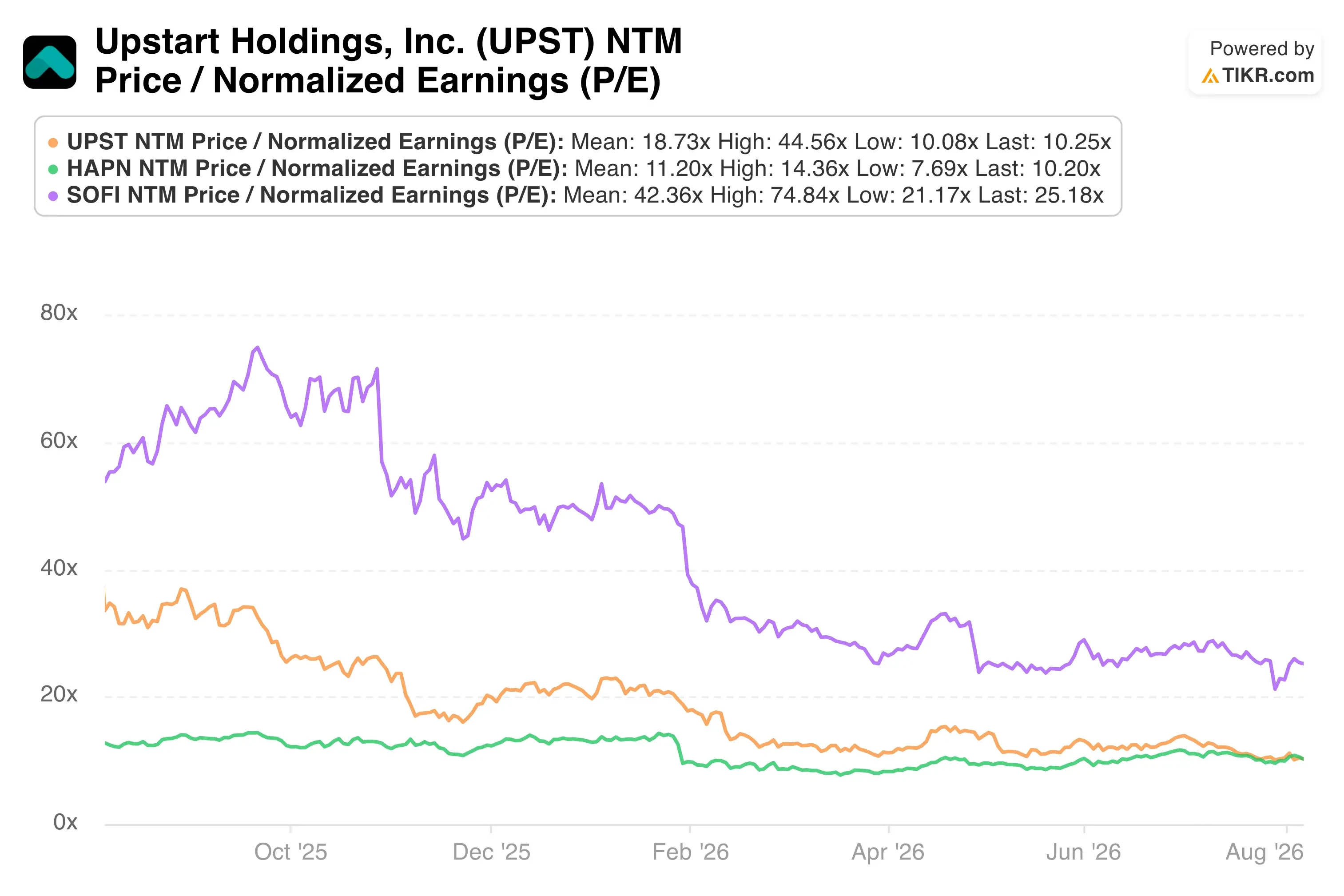
SoFi trades at a much higher forward P/E, often above 40x, reflecting its broader financial ecosystem beyond lending alone. SoFi’s revenue growth has been running in the 20% range, slower than Upstart’s most recent 42% jump, but SoFi carries far more stable profitability given its diversified banking business.
LendingClub, meanwhile, trades at a lower multiple, closer to 15x forward earnings, and its revenue growth has been in the single digits recently. Upstart’s growth rate outpaces LendingClub by a wide margin, though LendingClub’s profitability has been more consistent over recent quarters.
Upstart’s moat is its AI underwriting model, which the company claims approves more borrowers at similar default rates compared to traditional credit scoring. That technology edge is what funding partners like Castlelake are betting on when they commit billions in forward flow capital.
See how AI underwriting improvements could drive the next leg of loan-volume growth >>>
What’s Driving UPST Stock Going Forward?
The conditional national bank approval from the OCC is a longer-term catalyst worth watching closely. If finalized, it would let Upstart hold loans on its own balance sheet and reduce its reliance on third-party funding partners, which has historically limited how fast it can grow.
Funding capacity itself remains the near-term catalyst to track. The Castlelake deal adds up to $4 billion in capacity, and any additional forward flow agreements would further reduce the risk that strong loan demand outpaces available funding.
Monthly origination trends will also matter heading into year-end. July originations already totaled $1.4 billion, and continued growth there would reinforce that the Q2 rebound was not a one-time event.
If profitability holds through the back half of the year, Upstart’s valuation gap versus its own history could start to close. Investors should watch whether margins stay positive as origination volume keeps climbing.
See how Upstart’s funding capacity and AI models could shape its next few years >>>
Should You Invest in Upstart?
The only way to really know is to look at the numbers yourself. TIKR gives you free access to the same institutional-quality financial data that professional analysts use to answer exactly that question.
Pull up UPST, and you’ll see years of historical financials, what Wall Street analysts expect for revenue and earnings in the quarters ahead, how valuation multiples have moved over time, and whether price targets are trending up or down.
You can build a free watchlist to track UPST alongside every other stock on your radar. No credit card required. Just the data you need to decide for yourself.
Analyze UPST stock on TIKR Free→
Disclaimer:
Please note that the articles on TIKR are not intended to serve as investment or financial advice from TIKR or our content team, nor are they recommendations to buy or sell any stocks. We create our content based on TIKR Terminal’s investment data and analysts’ estimates. Our analysis might not include recent company news or important updates. TIKR has no position in any stocks mentioned. Thank you for reading, and happy investing!