


Key Takeaways
- TSMC’s gross margin expanded from 59% in the June 2025 quarter to 68% in June 2026, even as management guided the next quarter down to 66% on 2 nanometer ramp dilution, a step back that is small next to the year’s climb.
- Quarterly capital expenditure jumped to $15.59 billion in the June 2026 quarter, its highest level in the past eight quarters, about 42% above the prior quarter, as TSMC raised its 2026 CapEx budget for a third time this year.
- TSMC’s NTM price to normalized earnings multiple has compressed to 22x, close to its two year average and well off a 30x peak, after a September 14 selloff tied to AI industry safety warnings rather than anything specific to TSMC.
- Institutional 13F filings dated June 30, 2026 already show a split Street: Coatue and Situational Awareness added to their TSMC stakes while Lone Pine, SoftBank and Viking Global cut theirs, all before the July earnings call or the September selloff.
TSMC’s Gross Margin Just Hit a Record, and the Warning Still Stands
On the Q2 2026 earnings call, CFO Wendell Huang guided third quarter gross margin down 170 basis points to 66%, citing 3 to 4 percentage points of dilution from the steep ramp of TSMC’s 2 nanometer process. Read alone, that sounds like a company giving back margin.
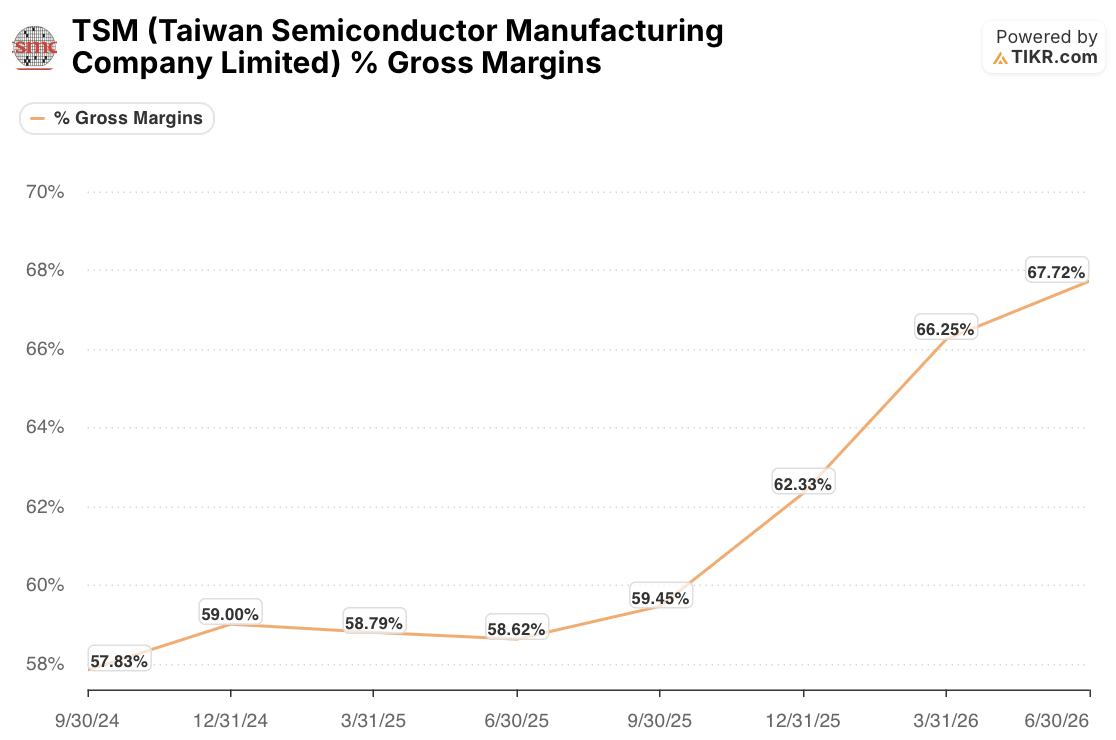
The margin data tells a different story. TSMC’s gross margin sat at 58.62% as recently as the June 2025 quarter. By March 2026 it had reached 66.25%, and by June 2026, the same quarter Huang was describing, it hit 67.72%, TSMC’s highest level in the past two years and consistent with the 67.7% figure CEO C.C. Wei cited on the call. The guided step down to 66% for the third quarter would still be TSMC’s second best margin in that window.
Huang was explicit about why the dilution has not derailed the trend: cost improvement efforts and a slightly higher capacity utilization rate offset most of the drag, and demand for TSMC’s leading edge technologies stayed strong enough to support it. The near term risk management flagged, N2 ramp dilution now and overseas fab dilution widening to 3 to 4 percentage points in later years, is real. But so far it looks like a risk to the slope of an uptrend, not evidence the uptrend has stopped.
TSMC Is Funding Its Biggest CapEx Year With Its Own Cash
TSMC has raised its 2026 capital budget three times this year: from $52 billion to $56 billion in January, to the high end of that range in April, and to $60 billion to $64 billion in July.
Wei added on the call that the next three years of CapEx will be even more significantly higher than the prior three, a phrase he had used the previous quarter about a smaller number. The commitment reached a new physical marker in June.
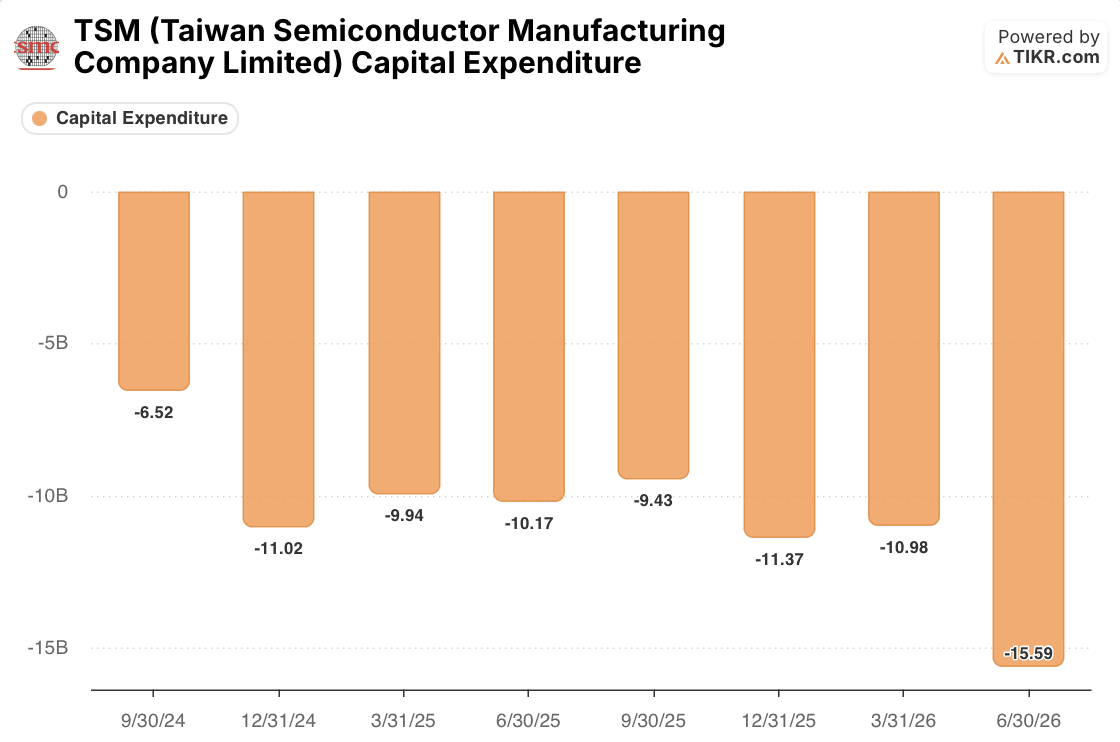
TSMC spent $15.59 billion on capital expenditure that quarter, its largest quarterly outlay in the past eight quarters and about 42% above the $10.98 billion spent the quarter before. Some of that money is going into construction that will not generate revenue for years: TSMC broke ground on September 21 on a Kaohsiung packaging validation park that will not begin operating until the fourth quarter of 2029, and the newly announced $100 billion in Arizona brings TSMC’s total US commitment to $265 billion with no firm build schedule attached.
Huang told analysts TSMC generated about $24.5 billion in operating cash flow that same quarter, enough to cover the $15.59 billion in CapEx and roughly $4.9 billion in dividends without new borrowing. That matters because it means TSMC’s spending is a bet on its own read of demand, not a company reaching for debt to keep pace with rivals.
Why TSMC Stock’s Multiple Fell Even as the Business Got Stronger
None of the margin expansion or the cash funded buildout explains the recent move in TSMC’s own multiple.

TSMC is trading at 22.46x forward normalized earnings as of the latest reading, close to its 22.41x two year average and well below the 29.65x high reached earlier in that range. The multiple fell sharply in mid September, the same window covered in the news wires here: on September 14, Anthropic’s Dario Amodei published an essay calling for AI companies to slow model development, Sam Altman said OpenAI would not pursue an IPO this year over safety concerns, and chip stocks across Taipei, Seoul and the Philadelphia semiconductor index sold off in sympathy, TSMC included, alongside a 13.2% drop in SoftBank. None of that news referenced TSMC’s own results.
Q2 revenue, reported separately on September 10, was up 53.3% year over year to roughly $16.1 billion. The 13F filings in this batch, all dated to the June 30, 2026 reporting period and filed before the July call or the September selloff, already show a split reaction: Coatue raised its TSMC stake 7.6% to 9.3 million ADRs and Situational Awareness lifted its position to 2.6 million shares, while Lone Pine cut its stake 92.7%, SoftBank cut 71.5%, and Viking Global cut 29%. That divergence predates the sentiment shock, which suggests some holders were already questioning the buildout’s payoff timeline before AI safety warnings gave the broader market a reason to sell.
The Multiple, Not the Margin, Is Where the Risk Sits
TSMC’s own numbers do not support the idea that AI capex is cracking under its own weight, at least not yet. Margins are the highest in the past two years, revenue is compounding at over 50% year over year, and the buildout is self funded rather than debt funded. The financial stability risk the Bank for International Settlements flagged in early September, opaque and debt heavy AI financing, is real, but it sits with TSMC’s customers and their financiers, not on TSMC’s own balance sheet.
The more concrete near term risk is already in TSMC’s own guidance: a 66% gross margin for the third quarter, a full percentage point below June’s actual, plus advanced packaging capacity C.C. Wei called very tight and a demand supply gap he called very big without putting a number on it.
If third quarter gross margin comes in at or above the 66% guide when TSMC reports in October, and the CapEx budget does not need a fourth raise this cycle, the case for the multiple re-rating back toward its 26x to 29x historical range gets stronger. If margin slips further, or the overseas dilution Huang flagged for later stages shows up sooner than guided, the funds that cut TSMC stakes in June will look early rather than wrong.
Should You Invest in Taiwan Semiconductor Manufacturing Company Limited?
The only way to really know is to look at the numbers yourself. TIKR gives you free access to the same institutional-quality financial data that professional analysts use to answer exactly that question.
Pull up TSM stock and you’ll see years of historical financials, what Wall Street analysts expect for revenue and earnings in the quarters ahead, how valuation multiples have moved over time, and whether price targets are trending up or down.
You can build a free watchlist to track Taiwan Semiconductor Manufacturing Company Limited alongside every other stock on your radar. No credit card required. Just the data you need to decide for yourself.
Access Professional Tools to Analyze TSM stock on TIKR for Free →
Looking for New Opportunities?
- See what stocks billionaire investors are buying so you can follow the smart money.
- Analyze stocks in as little as 5 minutes with TIKR’s all-in-one, easy-to-use platform.
- The more rocks you overturn… the more opportunities you’ll uncover. Search 100K+ global stocks, global top investor holdings, and more with TIKR.
Disclaimer:
Please note that the articles on TIKR are not intended to serve as investment or financial advice from TIKR or our content team, nor are they recommendations to buy or sell any stocks. We create our content based on TIKR Terminal’s investment data and analysts’ estimates. Our analysis might not include recent company news or important updates. TIKR has no position in any stocks mentioned. Thank you for reading, and happy investing!


