


Key Takeaways
- Axon stock fell about 22% in September, matching its full-year loss, after an 11% one-day drop on news of a $1.15 billion 0% convertible note offering that followed an earlier 14% slide when Q2 gross margin came in lower than expected.
- Cash on hand had already thinned to $600 million against $1.85 billion of total debt heading into the raise, the tightest cash position Axon has carried in over a year outside a brief trough in March.
- Free cash flow came in essentially flat for the quarter, but that fits a two-year pattern of low or negative free cash flow in the first half of the year followed by a fourth-quarter rebound, and management is guiding to $450 million of full-year free cash flow built mostly on that same Q4 recovery.
- Diluted shares outstanding have grown only about 5.7% since September 2024 despite two large convertible raises in 18 months, suggesting the capped call structure has kept actual dilution modest so far.
Axon Stock’s September Selloff Tells Two Different Stories
Axon Enterprise (AXON) closed at $452.06 on September 21, a quiet finish that covers a rough month. Shares dropped 11% on September 15 when Axon launched a $1 billion offering of 0% convertible senior notes due 2031, later upsized to $1.15 billion after underwriters exercised their option. The notes carry a conversion price of $652.06, a 47.5% premium to the $442.08 close the day before pricing, and roughly $100 million went toward capped call transactions at a $1,049.94 strike, meant to blunt dilution if the stock ever gets that high. The rest is earmarked for general corporate purposes, including growth investments and potential acquisitions. Through the announcement, Axon was down roughly 22% in September, matching its loss for the full year, while the S&P 500 Industrials sector was still up mid-single digits year to date.
That drop landed on an already bruised stock. On August 5, Axon reported second-quarter revenue of $904 million, up 35% year over year and above the roughly $877 million analysts expected, with adjusted earnings per share of $1.88 versus a $1.85 estimate. But adjusted gross margin fell 40 basis points year over year to 62.9%, with the software and services segment’s margin down 380 basis points to 75.1% as a heavier mix of lower-margin professional services and new product scaling weighed on results. Shares fell as much as 14% the following session. Two setbacks in six weeks, one about margin quality and one about a capital raise, are why Axon enters late September down double digits despite guidance management actually raised, not cut.
What Axon’s Balance Sheet Looked Like Before the Bond Sale
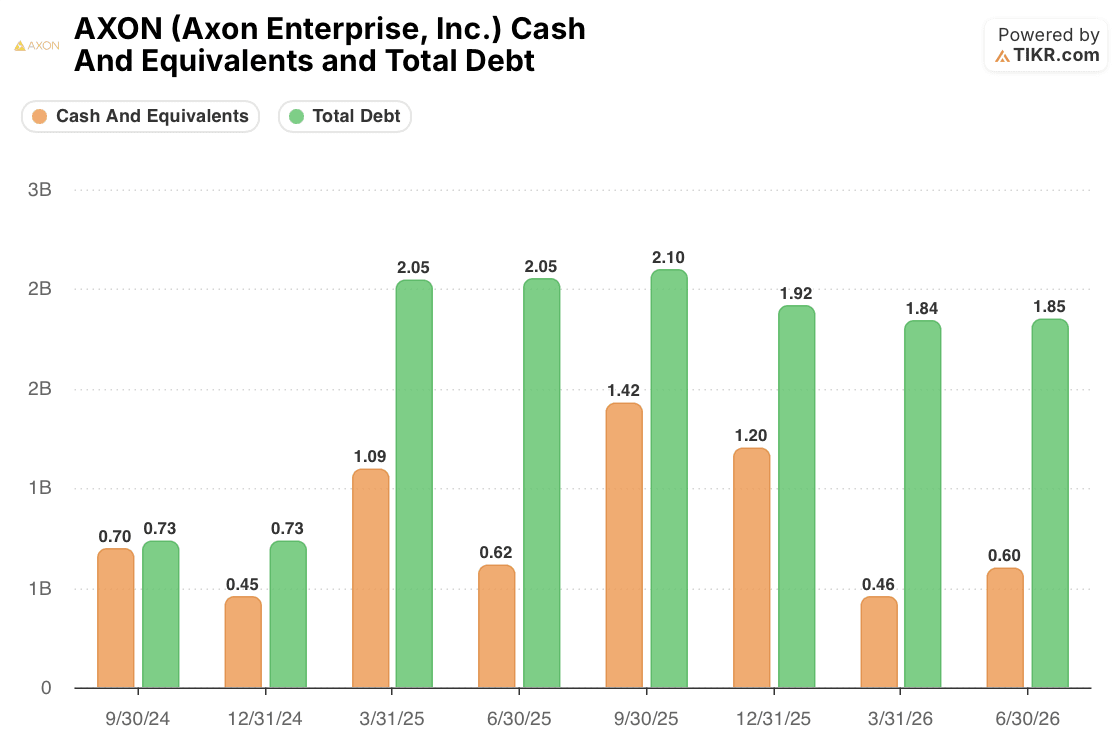
The convertible offering did not appear out of nowhere. At the end of the second quarter, on June 30, 2026, Axon held $600 million in cash and equivalents against $1.85 billion in total debt, its lowest cash position in over a year apart from a brief $460 million trough three months earlier. That is meaningfully thinner than the $1.42 billion in cash Axon carried as recently as September 2025, or the $1.2 billion it held at the end of last year. The $1.85 billion of existing debt traces back to a similar convertible raise in the first quarter of 2025, when total debt jumped from around $730 million to roughly $2.05 billion in a single quarter. This is Axon’s second large convertible raise in roughly 18 months, not an isolated event.
That context shapes how to read the September notes. A company sitting on a comfortable cash pile that suddenly issues $1.15 billion in convertible debt looks opportunistic, locking in cheap financing while its stock still commands a premium valuation. A company whose cash has drifted down to $600 million while its CFO, Brittany Bagley, says on the Q2 2026 earnings call that Axon is still making substantial inventory investments to support customer demand and reduce supply chain risk, looks like it is replenishing a cushion it was drawing down. The evidence sits closer to the second description, which changes the framing from a purely opportunistic raise to one with a real liquidity purpose behind it.
Axon’s Free Cash Flow Swings Are a Known Pattern, Not a New Alarm

Free cash flow came in at negative $1 million for the second quarter, matching almost exactly what Bagley disclosed on the earnings call. Viewed in isolation, a company burning cash while its balance sits near a one-year low could look alarming. Viewed across two years of quarters, it looks familiar. Free cash flow swung from $225 million in the fourth quarter of 2024 down to negative $115 million by mid-2025, back up to $155 million by year end, and down again to negative $55 million in the first quarter of this year before landing near breakeven in the second. Axon has consistently run negative or flat free cash flow in the first half of the year and made most of it back in the fourth, exactly the seasonality management cited when it reaffirmed guidance of roughly $450 million in full-year free cash flow, with strong seasonality expected in the fourth quarter.
The zero-coupon structure of the new notes matters here too. Axon owes no interest until conversion, faces no issuer call option until September 2029 and only then if the stock trades 30% above the conversion price, and holders cannot put the notes back before March 2031. That gives Axon roughly five years of runway before the debt becomes a genuine cash obligation, time that lines up with when management expects long-term free cash flow conversion to improve as this year’s inventory investment phase moderates.
The Real Test Is Whether Q4 Delivers What Management Promised
None of this proves the September selloff was irrational. Total debt of $1.85 billion against $600 million of cash is a real number, and a business investing this heavily in inventory while gross margin faces a stated headwind from rising memory costs in the third quarter carries genuine execution risk.

Diluted shares outstanding have grown only from 78.1 million to 82.5 million, about 5.7%, since September 2024 despite two convertible raises, suggesting the capped calls have done their job protecting shareholders from dilution so far, but that record depends on the stock staying below the conversion price or the capped calls paying out as designed.
The more useful read is that this month’s drop looks like a reflexive reaction, dilution worries layered onto an already nervous post-earnings stock, rather than evidence of a structurally different Axon than the one that raised full-year revenue guidance to 32% to 34% growth and grew future contracted bookings 40% to $15.1 billion.
The real test arrives with third-quarter results, where investors should watch two things: whether gross margin stabilizes once the flagged memory cost pressure passes, and whether free cash flow trends back toward the fourth-quarter strength Axon has delivered the past two years. If that seasonal rebound shows up on schedule, the convertible raise will look like exactly what management called it, growth funding raised on favorable terms. If it doesn’t, the thin cash position that preceded it will look less like a timing choice and more like a warning sign investors caught early.
Should You Invest in Axon Enterprise, Inc.?
The only way to really know is to look at the numbers yourself. TIKR gives you free access to the same institutional-quality financial data that professional analysts use to answer exactly that question.
Pull up AXON stock and you’ll see years of historical financials, what Wall Street analysts expect for revenue and earnings in the quarters ahead, how valuation multiples have moved over time, and whether price targets are trending up or down.
You can build a free watchlist to track Axon Enterprise, Inc. alongside every other stock on your radar. No credit card required. Just the data you need to decide for yourself.
Access Professional Tools to Analyze AXON stock on TIKR for Free →
Looking for New Opportunities?
- See what stocks billionaire investors are buying so you can follow the smart money.
- Analyze stocks in as little as 5 minutes with TIKR’s all-in-one, easy-to-use platform.
- The more rocks you overturn… the more opportunities you’ll uncover. Search 100K+ global stocks, global top investor holdings, and more with TIKR.
Disclaimer:
Please note that the articles on TIKR are not intended to serve as investment or financial advice from TIKR or our content team, nor are they recommendations to buy or sell any stocks. We create our content based on TIKR Terminal’s investment data and analysts’ estimates. Our analysis might not include recent company news or important updates. TIKR has no position in any stocks mentioned. Thank you for reading, and happy investing!


