Key Takeaways
- Tesla’s Cybercab costs about $25,000 to produce, against upward of $100,000 for each of Alphabet’s Waymo vehicles, according to Prof G Markets’ Dan Chiolan.
- That gap lets Tesla put about four robotaxis on the road for the price of one of Waymo’s current cars, an edge that shrinks against Waymo’s cheaper new Ojai but doesn’t disappear.
- Waymo still drives about seven times Tesla’s weekly miles, though investor Jason Calacanis expects Tesla to take more of the market than Waymo or Uber.
- Tesla trades at 190x forward earnings, well above its three-year average of 136x, so the stock already prices in a lot of robotaxi success.
Elon Musk doesn’t think Tesla (TSLA) has been in a robotaxi race at all.
When Jason Scharf posted on X that “the battle for Autonomous Austin might already be over,” Musk replied: “It was never a real contest.”
That’s a bold thing to say about Alphabet (GOOG), whose Waymo gives more than 500,000 paid rides a week and is still well ahead by almost any measure. But on the Oct. 28 episode of Prof G Markets, Dan Chiolan pointed to the one edge that could make Musk right:
“those Tesla Cybercabs cost about $25,000 to produce, whereas Waymo’s cost upward of $100,000.”
So Tesla can put about four robotaxis on the road for the price of one of Waymo’s current cars.
(October was a good month for the stock, too: Tesla rose 13% in October, the best in the Magnificent Seven, on SpaceX merger talk and a Barclays upgrade that also pointed to growing Robotaxi activity. It’s still down for the year, though, the worst in the group.)
Waymo Still Has the Miles
Chiolan was clear that Tesla is behind. “Waymo does about seven times the amount of miles that Tesla does weekly,” he said. Waymo now runs paid rides in 15 U.S. cities, he noted.
Tesla now runs its Robotaxi without safety monitors in six cities. On Sept. 3, it started putting Cybercabs on the road in Austin: its purpose-built robotaxi, with no steering wheel or pedals. And its cumulative unsupervised Robotaxi miles reached nearly 2 million by the end of the third quarter.
That design has drawn federal scrutiny. NHTSA opened an investigation in early September into how Tesla certified the Cybercab without those controls, and Tesla’s sworn answers were due Oct. 30. A bad outcome could slow the rollout the cost math depends on.
So “never a real contest” is a stretch, at least on miles. But Waymo built that lead with expensive cars. Chiolan puts the price gap down to Waymo’s much heavier load of sensors, which also makes its cars harder and slower to build. Waymo is working on that: its new Ojai van uses 42% fewer sensors than the Jaguar it replaces, and Waymo has said the new hardware costs under $20,000 per car. Outside estimates for the whole Ojai run from about $50,000 to $125,000, and Waymo hasn’t confirmed a total. Against that range, Tesla still gets two to five Cybercabs for every Ojai.
TIKR Tracks 45 Analysts on Tesla. How Many Say “Buy”?
See the full breakdown of Buy, Hold, and Sell ratings on Tesla, along with Wall Street’s revenue and earnings estimates, all in one place. More than 500,000 investors use TIKR to research stocks like this one. See Tesla’s Analyst Ratings
Four Cars for the Price of One
Tesla has spent at least $6.5 billion a year on capex since 2021, peaking at $11.3 billion in 2024…
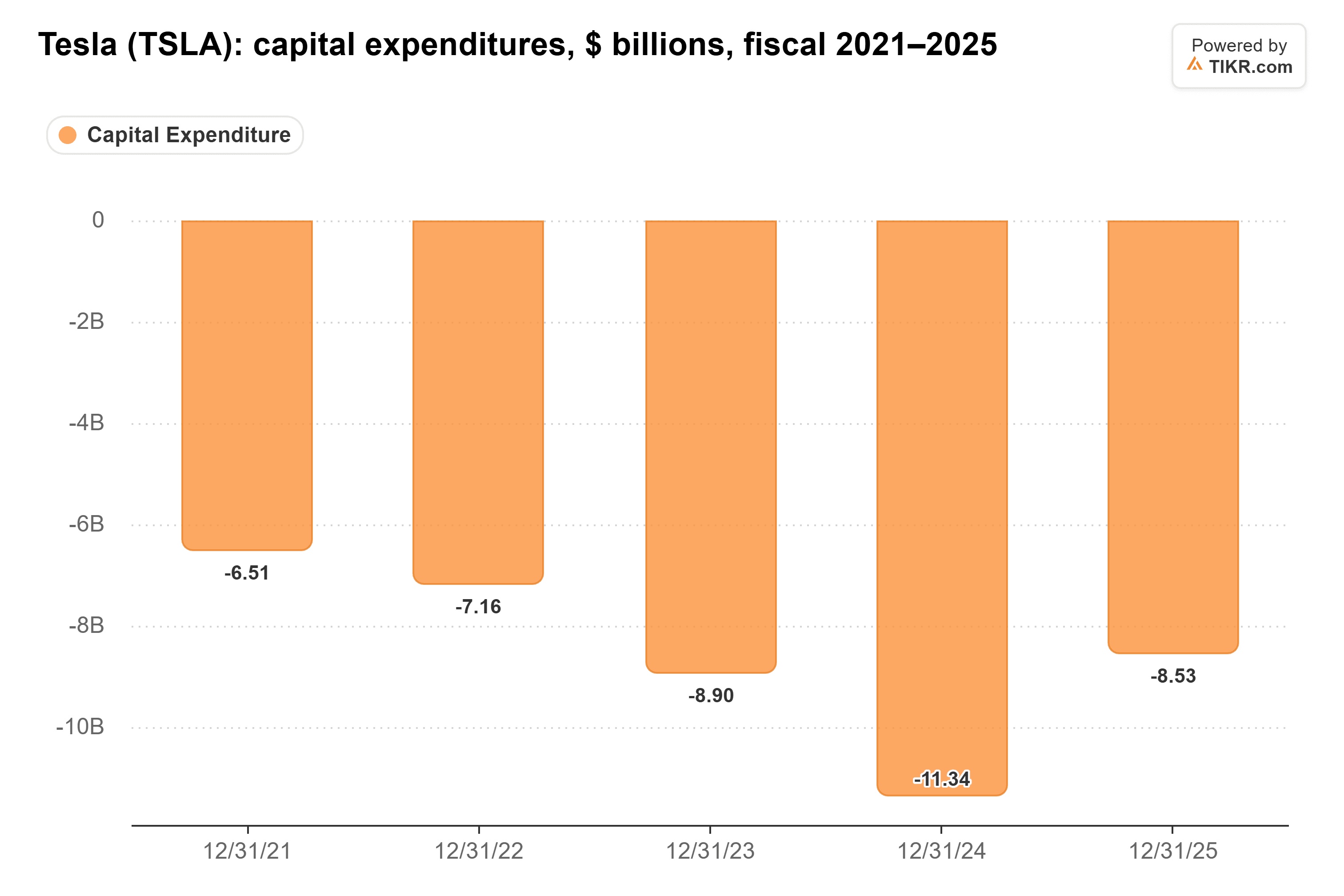
And on its Oct. 21 call, management cut its 2026 capex guidance to about $20 billion, still more than twice 2025’s $8.5 billion.
Tesla’s Q3 update lists capacity for more than 125,000 Cybercabs a year. At $25,000 apiece, a full year at that capacity comes to about $3.1 billion, a bit more than a third of what Tesla spent on capex in all of 2025, and about 16% of its 2026 plan. The same 125,000 cars at the $100,000 Chiolan cites for Waymo would cost $12.5 billion. (That’s just the cars. Charging, cleaning and parking a fleet cost extra, for everyone. And Tesla is nowhere near that pace yet, though it’s speeding up: Texas had authorized 169 Cybercabs for commercial use as of Oct. 2, and Tesla said it had a little over 300 in Austin by the Oct. 21 call.)
And a cheaper car means cheaper miles, which is how a robotaxi fleet wins on price.
Cheap Cars Could Reshuffle the Market
If the cars get that cheap, the fight turns to who fills them with riders. Uber doesn’t build its own self-driving tech. It books driverless rides through partners like Waymo, in five cities so far, Chiolan said.
On X, someone asked angel investor Jason Calacanis whether Tesla’s robotaxi plans worried him about Uber. He laid out how he sees the market splitting: Tesla with “40% of all AVs,” Uber “with 20 partners” at 35%, and Waymo at 15%.
That’s one investor’s forecast. But it follows the cost math: the cheapest car takes the biggest share, and the priciest one comes last.
Tesla Investors Are Already Paying for It
Tesla’s stock prices in a lot of this already. It traded at 190x forward earnings on Oct. 27, well above its three-year average of 136x, though still below its 243x peak in December 2025…

And analysts expect normalized EPS of $3.30 in 2028, still below 2022’s $4.07. So that multiple rests on robotaxi profits that aren’t in the estimates yet.
Tesla Has the Cheaper Car. Now It Needs the Miles
Waymo has a big problem. Its lead in miles is real, but Tesla can buy about four cars for every one in Waymo’s current fleet, and at least two even against the cheaper Ojai. That kind of edge closes a gap quickly. It’s the best reason I can see to pay up for Tesla’s robotaxi story, as long as the Cybercab clears NHTSA’s review.
Of course, the cheap car still has to earn its keep. Management said on the same call that Tesla hasn’t yet hit its target operating cost of $0.30 a mile, and AI VP Ashok Elluswamy said Cybercab rides start in Dallas in November. Musk expects Robotaxi to start making a noticeable difference to Tesla’s finances around the second quarter of 2027, and that’s the number to watch.
So What Is Tesla Stock Actually Worth?
TIKR lets you forecast the future price of any stock in less than a minute. Just enter a few assumptions into TIKR’s valuation model and see what Tesla could be worth. Start from Wall Street consensus estimates, or adjust the inputs to reflect your own view of the business. It’s free to use.
Disclaimer:
Please note that the articles on TIKR are not intended to serve as investment or financial advice from TIKR or our content team, nor are they recommendations to buy or sell any stocks. We create our content based on TIKR Terminal’s investment data and analysts’ estimates. Our analysis might not include recent company news or important updates. TIKR has no position in any of the stocks mentioned. Thank you for reading, and happy investing!