Key Stats for Seagate Technology Stock
- Past-Week Performance: ~5.7%
- 52-week Range: $63 to $332
- Valuation Model Target Price: $312
- Implied Upside: ~2.5% over 2.5 years
- Current Price: ~$304/share
What Happened?
Seagate Technology Holdings plc (STX) stock climbed about 5.7% over the past week, closing at $304/share and moving back toward the upper end of its recent range.
Data storage stocks have been rallying as AI drives a surge in hardware spending, and peers like Western Digital have also seen their shares jump, showing this is a broader industry move rather than a one-off story.
Analysts point to strong demand for hard disk drives and a much healthier supply-demand balance across the industry as the main drivers.
Morgan Stanley recently raised its price target on Seagate to $337 from $270 and reiterated its Overweight rating. Cantor Fitzgerald went even further, setting a new $400 price target.
The move appears tied to renewed confidence in data center and AI infrastructure spending. Investors rotated back into hardware names as expectations firmed around hyperscaler demand and enterprise storage upgrades. As one of the largest suppliers of high capacity storage, Seagate benefited directly from that shift.
See analysts’ growth forecasts and price targets for Seagate Technology (It’s free) >>>
Why the Market Is Pricing STX Tightly
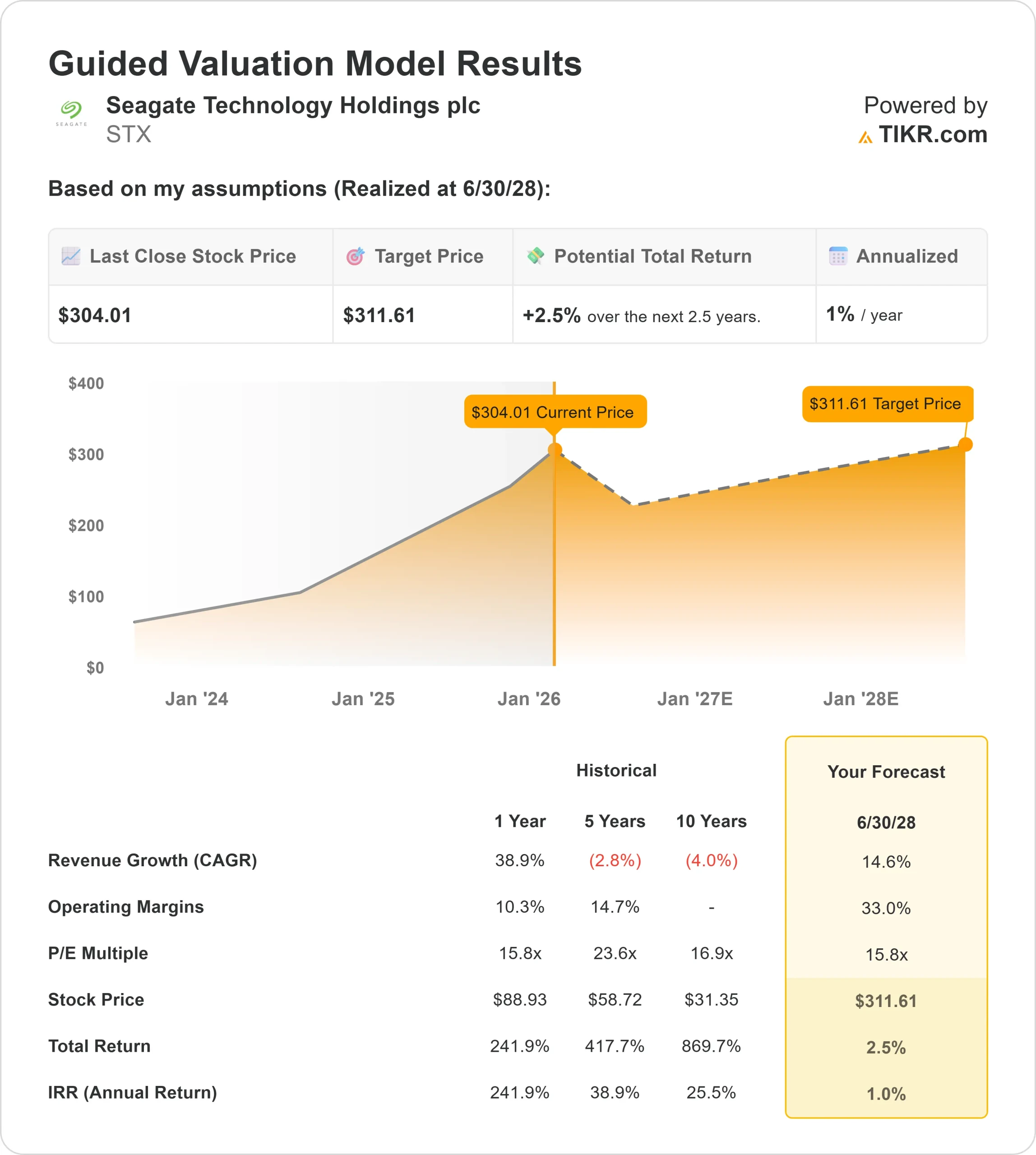
Seagate is trading at a valuation that already reflects strong operating performance over the next few years. Under valuation model assumptions realized through the next ~2.5 years, the stock is modeled using:
- Revenue Growth (CAGR): ~14.6%
- Operating Margins: ~33.0%
- Exit P/E Multiple: ~15.8x
Based on these inputs, the model estimates a fair value of $311.61/share, implying just ~2.5% total upside from the current price of ~$304/share, or roughly ~1% per year.
Seagate’s performance from here hinges on how effectively AI driven data center spending translates into sustained demand for high capacity nearline HDDs, where cost per terabyte advantages matter most for hyperscalers.
Execution around next generation drive ramps and continued supply discipline across the industry remains central, as tighter supply supports pricing and margin stability even if unit volumes fluctuate.
Over the next 12 months, results will be shaped by hyperscaler capex pacing, the pace of enterprise inventory normalization, and whether shipments continue to skew toward higher capacity, higher margin products that reinforce earnings visibility.
Estimate a company’s fair value instantly (Free with TIKR) >>>
Value Any Stock in Under 60 Seconds (It’s Free)
With TIKR’s new Valuation Model tool, you can estimate a stock’s potential share price in under a minute.
All it takes is three simple inputs:
- Revenue Growth
- Operating Margins
- Exit P/E Multiple
From there, TIKR calculates the potential share price and total returns under Bull, Base, and Bear scenarios so you can quickly see whether a stock looks undervalued or overvalued.
If you’re not sure what to enter, TIKR automatically fills in each input using analysts’ consensus estimates, giving you a quick, reliable starting point.
See a stock’s true value in under 60 seconds (Free with TIKR) >>>