Key Takeaways
- Apple is expected to launch its first smart home hub on Oct. 13, and Scott Galloway predicts it will be the top smart display by revenue within 18 months.
- Galloway’s case is that Apple makes its money by arriving late with a better product and a premium price, the way it built its biggest businesses.
- Apple’s revenue grew about 7.6% a year over the last decade, while its gross margin rose every year from fiscal 2019 to fiscal 2025, from 37.8% to 46.9%.
- At 36.2 times forward earnings, against a five-year average of 28.8 times, the stock already prices in a lot of success.
Apple (AAPL) is late to AI, and Scott Galloway thinks that’s the whole point.
Apple’s first smart home hub is expected to launch on Oct. 13, according to Forkast News, and Apple’s store is already showing a “PRE-ORDER 10.16” banner. (Apple still hasn’t confirmed the price.)
On Monday’s episode of the Prof G Markets podcast, co-host Scott Galloway summed up the strategy in five words:
“Apple wins by showing up late.”
Then he put a date on it:
“Apple One becomes the number one smart display by revenue within 18 months and turns a $350 device into a $1,000 household purchase because of its brand equity and luxury positioning.”
(Galloway calls the hub “Apple One.” Reports have been calling it the HomePad.)
That’s a bold call, and we’ll know by April 2028 whether he was right.
Test whether Apple’s premium valuation holds up under your own iPhone assumptions (It’s free) >>>
Apple, the ultimate second mouse
Galloway’s line is that “Apple is the ultimate second mouse.” In other words, the first mouse springs the trap, and the second one gets the cheese.
His evidence: Apple didn’t invent the MP3 player, the smartphone, the smartwatch, or wireless earbuds. “It showed up three to five years late and took the entire profit pool.”
Smart displays fit the pattern. Amazon (AMZN) and Alphabet (GOOGL) have had the category to themselves for years, which Galloway calls “a decade of Amazon and Google beta testing on Apple’s behalf.”
The same logic carries over to AI. Alex Kantrowitz, host of the Big Technology Podcast, said on Monday that Apple “could win and probably will win AI by default,” because the new Siri comes built into billions of devices. Apple doesn’t need the best model if its assistant is already on the phone in your pocket.
Slow growth, fat margins
Of course, showing up late costs you growth. Apple’s revenue went from $216 billion in fiscal 2016 to $416 billion in fiscal 2025 (the year to September 2025). That works out to about 7.6% a year, with sales falling in both 2019 and 2023…
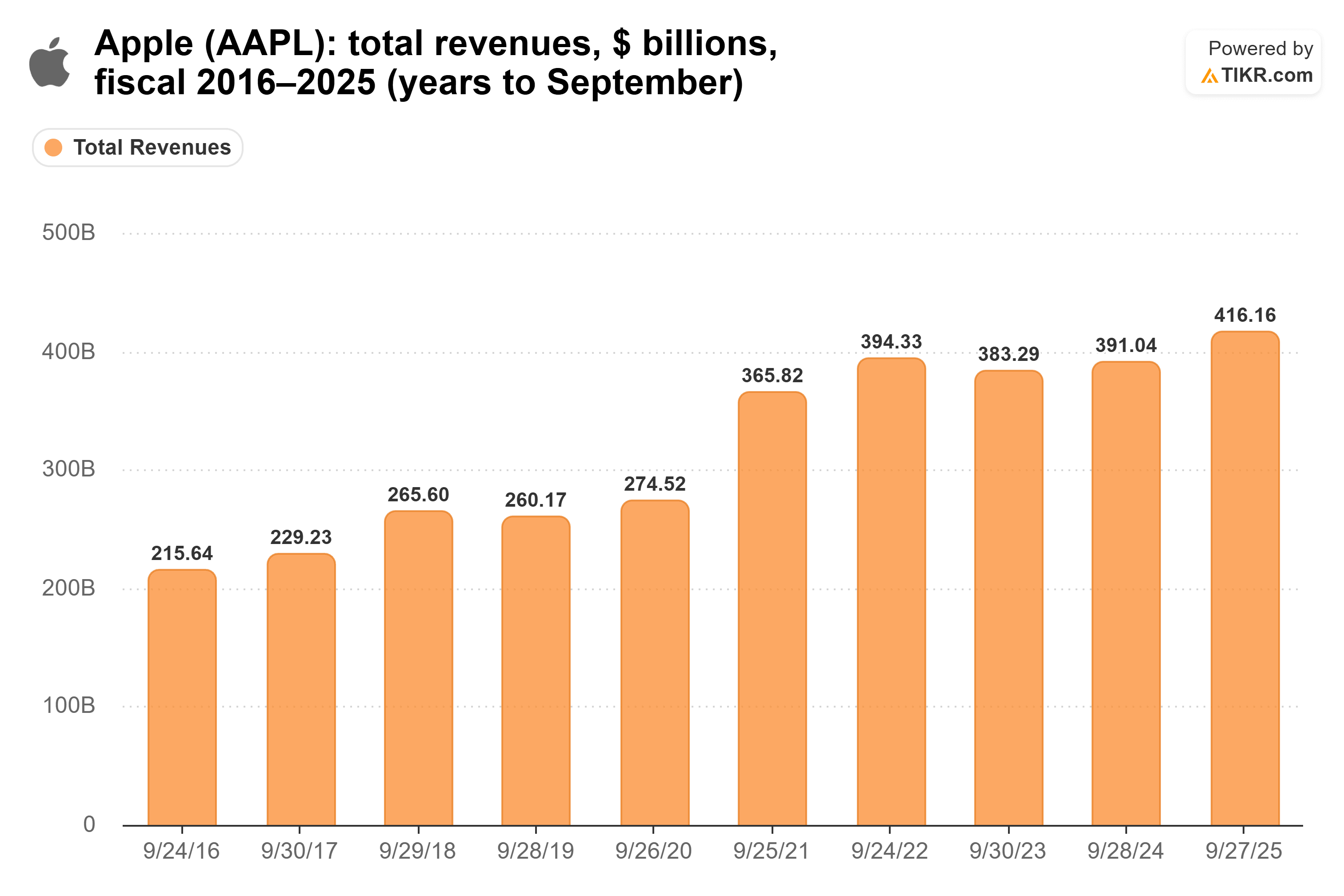
The biggest jump came in fiscal 2021. Since fiscal 2022, sales are up just 5.6% in total.
What Apple lacks in growth, it makes up for in pricing. Gross margin is the share of each sales dollar left over after paying to make the product. Apple’s has risen six years in a row, from 37.8% in fiscal 2019 to 46.9% in fiscal 2025…
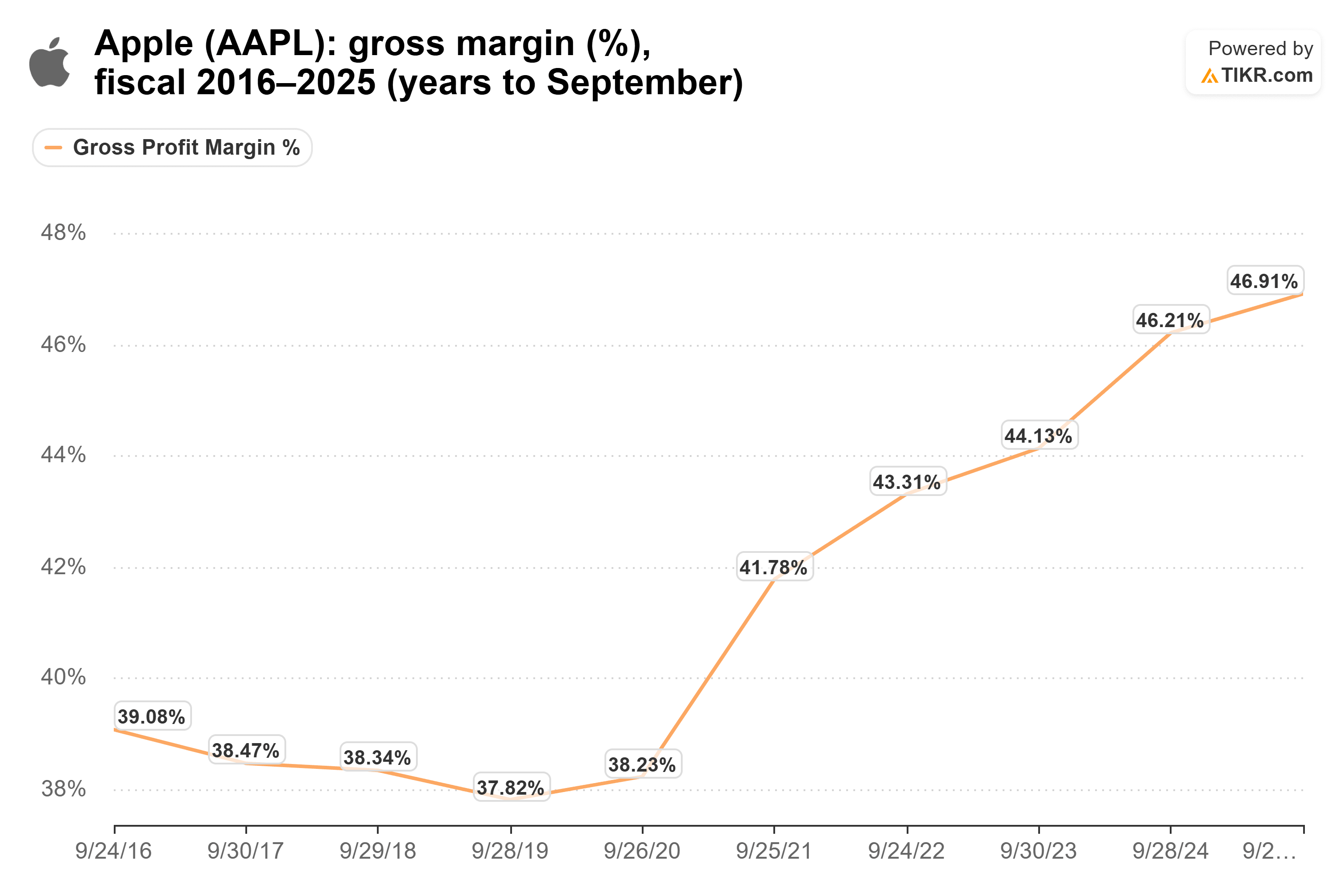
That pricing power is what Galloway is counting on to make a $350 device into a $1,000 purchase.
His co-host, Ed Elson, isn’t convinced. He pointed out that Apple “grew 16% last quarter and NVIDIA by comparison grew more than 100% last quarter,” a comparison with Nvidia (NVDA) that he used to argue Apple needs a big new product. On the hub, he was blunt: “I don’t think anyone’s going to care about the Apple Smart Hub.”
Galloway also admits that a company Apple’s size “has a metabolism problem.” Every layer of management adds caution, and caution leaves room for disruptors. (That’s why he likes the new CEO’s push to cut layers and costs, which TIKR covered here.)
Review Apple’s growth by iPhone, Mac, and Services before the next earnings report (It’s free) >>>
Can a $350 hub move the needle?
Let’s test it. Apple’s fiscal 2025 revenue was $416 billion, so 1% of it is $4.16 billion. At $350 a hub, that’s about 12 million hubs a year. At Galloway’s $1,000 per home, it’s about 4.2 million households.
As for how a home gets to $1,000, this is pure speculation, but I read it as more than one hub per house: one in the kitchen, one in the bedroom, maybe one by the front door.
Either way, that’s a lot of hardware for 1% of sales. On revenue alone, Elson has a point.
Here’s the thing: the counter is the prize
Galloway isn’t really making a hardware call. His bigger claim is this one:
“Whoever owns the kitchen counter owns the household AI relationship, and this is how Apple begins to play the deeper-pocketed hyperscalers off of each other and get some crazy Google-like licensing fee.”
The “Google-like” part refers to the fees Google pays Apple to be the default search engine on its devices. Galloway’s idea is that AI companies could end up competing and paying to power the assistant in every Apple home.
There’s one catch. Kantrowitz says the biggest problem with the new Siri is that “you just forget that it’s actually good now,” after more than a decade of it not working. A screen that sits on the counter all day, built around Siri, is a good way to remind people.
The price of showing up late
Investors are already paying for this. Apple trades at 36.2 times forward earnings, close to its five-year high of 37.3 times in July and well above its five-year average of 28.8 times…
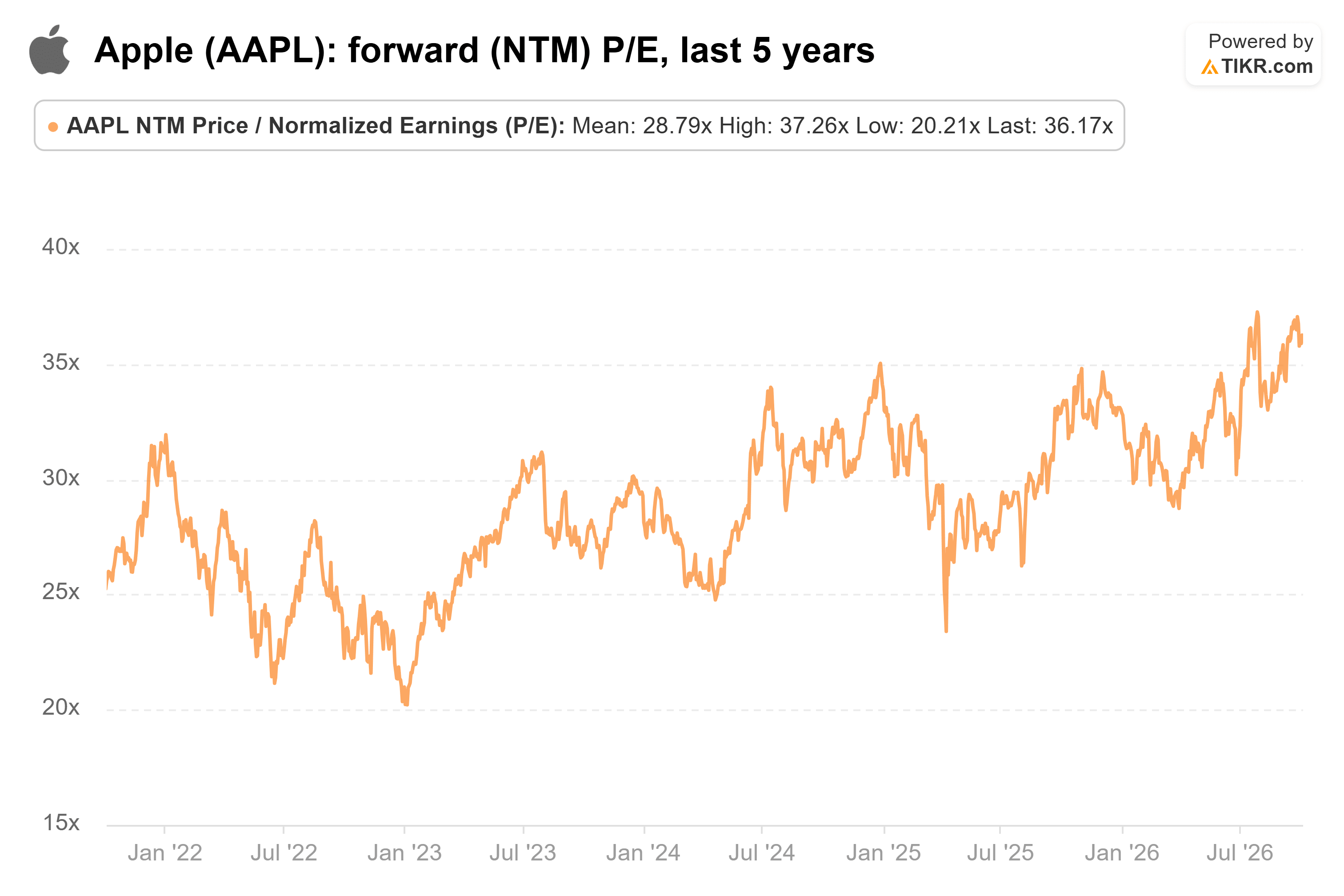
That’s about 26% more than investors usually pay for Apple’s earnings.
I think Galloway has the strategy right: Apple’s best businesses came from arriving second and charging more, and the margin chart shows that pricing power is still growing. The hub doesn’t have to become a big product line. It only has to make Siri the default assistant in the home, which is a test you can check in 18 months. Second mouse, again.
Of course, Apple hasn’t confirmed the price, and OpenAI is reportedly working on its own speaker for 2027. At 36 times earnings, the stock leaves little room for the hub to flop.
So what is Apple stock actually worth?
TIKR lets you forecast the future price of any stock in less than a minute. Just enter a few assumptions into TIKR’s valuation model and see what Apple could be worth. Start from Wall Street consensus estimates, or adjust the inputs to reflect your own view of the business. It’s free to use.
Disclaimer:
Please note that the articles on TIKR are not intended to serve as investment or financial advice from TIKR or our content team, nor are they recommendations to buy or sell any stocks. We create our content based on TIKR Terminal’s investment data and analysts’ estimates. Our analysis might not include recent company news or important updates. TIKR has no position in any of the stocks mentioned. Thank you for reading, and happy investing!