Key Stats for ORCL Stock
- Past week’s performance: 3.6%
- 52-week range: $115 to $346
- Valuation model target price: $226
- Implied upside: 53.4% over 2.8 years
Oracle just landed a major government contract after a brutal stock slide. See what recovery could be worth >>>
Oracle Fights Back With New AI Wins
Oracle Corporation (ORCL) has been climbing back after a punishing stretch that saw the stock lose more than half its value from its 52-week high of $346. The rebound has been fueled by a string of fresh AI-related deals landing in quick succession.
Oracle’s biggest catalyst was a 10-year Pentagon software contract worth up to $6.99 billion. Such contracts provide revenue visibility as Oracle relies heavily on debt to fund its AI infrastructure.
Oracle expanded its Google Cloud partnership, bringing Gemini AI models to Fusion Applications and NetSuite. That integration could encourage enterprises to adopt embedded AI tools, gradually boosting cloud consumption.
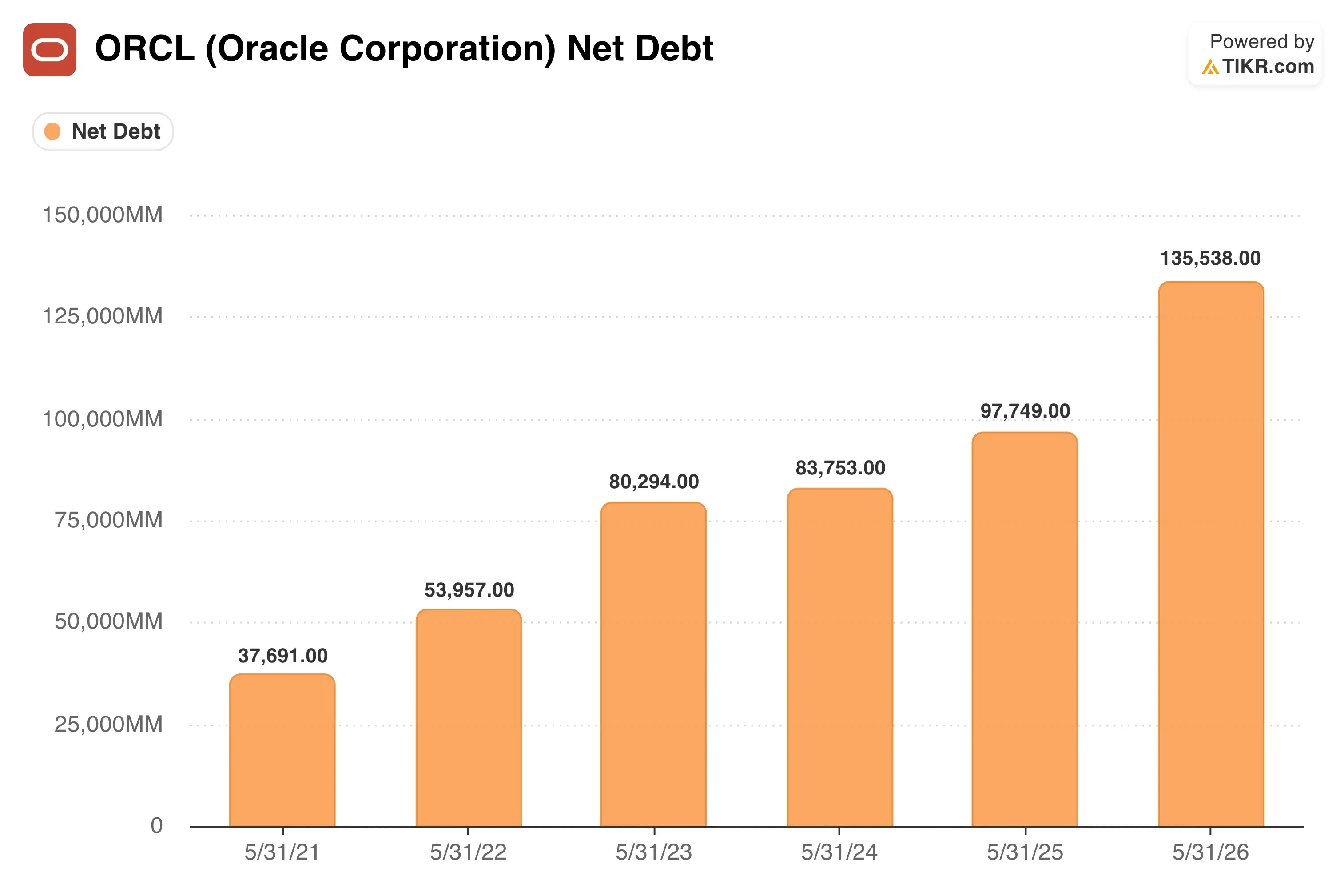
Behind the recovery sits a real financing challenge, though. Oracle carried roughly $130 billion in debt as of its last fiscal year-end, with capital expenditures surging 162% to nearly $56 billion as the company races to build data centers. Free cash flow ran negative during the period, since Oracle is spending well ahead of where its AI revenue currently sits.
If Oracle keeps winning contracts like the Pentagon deal, the market may start giving the company more credit for converting its enormous $638 billion order backlog into actual cash flow rather than just future promises.
Management has acknowledged the tension directly. On the recent earnings call, co CEO Clay Magouyrk pointed to the strength of contracted demand while also emphasizing the company’s focus on disciplined execution as it scales up its AI infrastructure buildout.
See analysts’ growth forecasts and price targets for ORCL (It’s free) >>>
Is ORCL Stock Undervalued?

Under valuation model assumptions realized through 5/31/29, the stock is modeled using:
- Revenue Growth (CAGR): 18.0%
- Operating Margins: 38.0%
- Exit P/E Multiple: 18.3x
Based on these inputs, the model estimates a target price of $226, implying 53.4% total upside and a 16.4% annualized return over the next 2.8 years.
A 16.4% annualized return clears the 15% threshold that typically signals a genuinely undervalued stock, and Oracle’s steep drawdown from $346 to $147 helps explain why the math looks this attractive now.

The model’s exit multiple of 18.3x sits well below where Oracle traded earlier this year, since the stock’s collapse reset expectations sharply lower even as the underlying cloud backlog kept growing. Oracle’s own NTM P/E of 18.26x confirms the market has already priced in significant caution.
The core risk baked into this setup is financing. Oracle’s negative free cash flow means it must keep raising debt and equity to fund its AI buildout, and any disruption to that financing plan could delay the backlog conversion the model assumes. Investors buying here are essentially betting the Pentagon and Google deals are early signs that conversion is starting.
See how Oracle’s backlog conversion could reshape its valuation (Free with TIKR) >>>
Oracle Trades at a Discount to Its Hyperscaler Rivals
Oracle competes most directly against Microsoft (MSFT) and Amazon (AMZN) in cloud infrastructure, even though both rivals are far larger and financially stronger. That size gap shows up clearly in how each stock gets valued.

Microsoft trades at a significant premium to Oracle, typically in the low 30s on forward earnings, supported by strong free cash flow generation from its Azure cloud business and steady double-digit revenue growth. Oracle’s own NTM P/E of 18.26x reflects the market’s discount for its heavier debt load and negative free cash flow.
Amazon trades similarly rich to Microsoft on a forward earnings basis, benefiting from AWS’s scale advantages and diversified revenue streams beyond just cloud infrastructure. Both rivals generate the kind of consistent free cash flow that lets them self-fund AI data center expansion, something Oracle currently cannot do.
Oracle’s edge lies in its backlog. At $638 billion, Oracle’s remaining performance obligations represent 9.5 times its expected annual revenue, a far higher ratio than either Microsoft or Amazon carries. If Oracle can convert even a portion of that backlog into recognized revenue without further financing stress, the valuation gap versus its larger rivals could narrow meaningfully.
What’s Driving ORCL Stock Going Forward?
The clearest near-term catalyst is backlog conversion. Investors will watch closely for signs that Oracle’s massive $638 billion in remaining performance obligations is turning into recognized cloud revenue rather than sitting as unfulfilled commitments.
Financing developments remain critical. Oracle has guided toward capital spending as high as $95 billion for fiscal 2027, and how the company funds that, through customer prepayments, debt, or equity, will shape investor confidence in the AI buildout.
Additional contract wins like the Pentagon deal and the Google Gemini partnership could keep supporting sentiment. Each new large-scale agreement adds revenue visibility and helps offset concerns about Oracle’s balance sheet.
Credit rating trends deserve attention too. S&P downgraded Oracle’s rating earlier this year, putting it just one level above junk status, and any further downgrade could raise Oracle’s borrowing costs at a time when it needs cheap capital most.
Estimate a company’s fair value instantly (Free with TIKR) >>>
Should You Invest in Oracle?
The only way to really know is to look at the numbers yourself. TIKR gives you free access to the same institutional-quality financial data that professional analysts use to answer exactly that question.
Pull up ORCL, and you’ll see years of historical financials, what Wall Street analysts expect for revenue and earnings in the quarters ahead, how valuation multiples have moved over time, and whether price targets are trending up or down.
You can build a free watchlist to track ORCL alongside every other stock on your radar. No credit card required. Just the data you need to decide for yourself.
Analyze ORCL stock on TIKR Free→
Disclaimer:
Please note that the articles on TIKR are not intended to serve as investment or financial advice from TIKR or our content team, nor are they recommendations to buy or sell any stocks. We create our content based on TIKR Terminal’s investment data and analysts’ estimates. Our analysis might not include recent company news or important updates. TIKR has no position in any stocks mentioned. Thank you for reading, and happy investing!