Key Takeaways
- Oracle stock fell 12% in the past month (through Monday’s close), mostly on three days of AI debt fears, while the S&P 500 rose 0.6%.
- Nothing changed at the company, which still expects at least $90 billion of revenue in fiscal 2027, but investors are now pricing its $169.1 billion of debt.
- S&P rates Oracle BBB-, the lowest investment-grade rating, and a downgrade to junk is the main risk to watch.
- At 15x forward earnings, well below its 5-year average of 21x, Oracle looks like a buy for investors who can live with that credit risk.
Oracle (ORCL) stock is down 12% in the past month (through Monday’s close), while the S&P 500 rose 0.6%.
Almost none of that came from Oracle itself. The scare started in the bond market at CoreWeave (CRWV), down 25% over the same stretch, and spread to the company with far more debt riding on AI.
A credit scare that started at CoreWeave
On Thursday, Oct. 8, Oracle fell 5.5% as AI stocks sank on new details of OpenAI’s revenue. That morning, Oracle was reportedly in talks with Apollo Global Management (APO) and Goldman Sachs (GS) to finance a big AI chip purchase, which put its debt back in the spotlight.
The worst day was Wednesday, Oct. 14, down 8.8%. September’s inflation came in hot at 3.7%, reviving bets on Fed rate hikes, and one of CoreWeave’s bonds yielded close to 15%.
On Thursday, the cost of insuring CoreWeave’s debt against default hit a record, according to ICE Data Services. Some of its bonds slipped into distressed territory on Friday, and Oracle fell another 4.6%.
Oracle’s debt is the whole story
Over the five fiscal years to May 2025, Oracle’s total debt climbed to $109 billion while its cash fell from $46.6 billion to $11.2 billion.

And by August 2026, debt was up to $169.1 billion, against $37.1 billion of cash.
In the August quarter, capex hit $28.5 billion, free cash flow was negative $5 billion, and Oracle sold $20 billion of new stock to help pay for the build. Interest expense rose 55% to $1.43 billion, outpacing the 31% growth in non-GAAP operating income, so rates now reach Oracle’s earnings.
S&P cut Oracle to BBB- in July, the lowest investment-grade rating. That’s what separates it from CoreWeave, whose bonds are high-yield. But Oracle’s credit default swaps are priced more like BB and B credit, CNBC reported Monday.
The business hasn’t flinched
Meanwhile, the business is humming. In the August quarter, revenue rose 30% to $19.3 billion, cloud infrastructure revenue jumped 121%, and the contracted backlog hit $664 billion. Management still expects at least $90 billion of revenue and $8.10 of non-GAAP EPS in fiscal 2027.
The catch is who that backlog comes from. As Steve Eisman, the investor made famous by The Big Short, said on Friday’s episode of The Compound and Friends: “half of Oracle’s backlog is just OpenAI.”
He’s about right. OpenAI’s reported $300 billion contract is about 45% of it, and it doesn’t start until 2027.
Cheap if the funding holds
Oracle now trades at 15.1x forward earnings, well below its 5-year average of 21.4x.

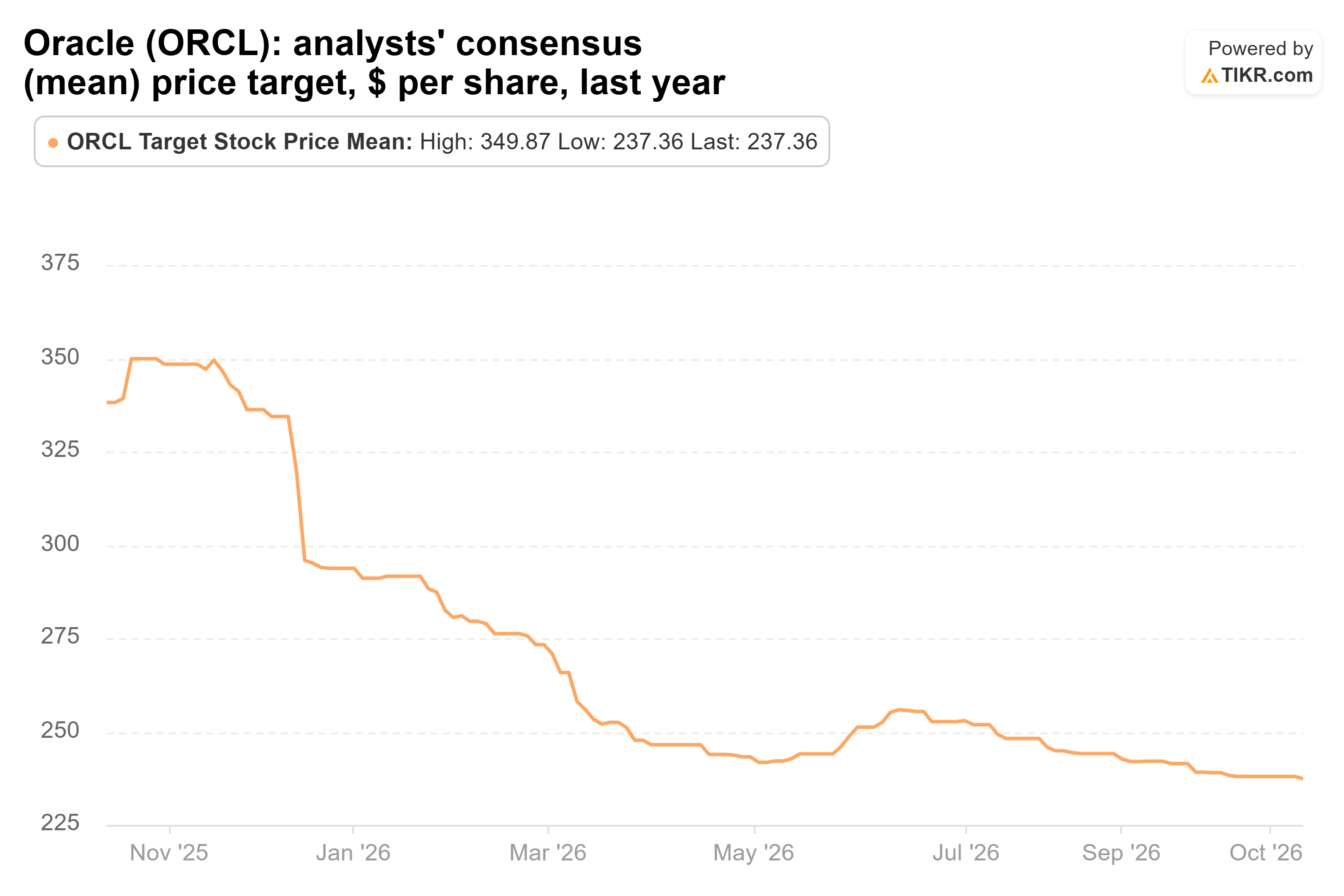
Analysts cut their targets, but far less than the stock fell. The consensus target is $237, down from $338 a year ago and still more than 80% above Monday’s close.
A model built after the Oct. 14 drop, with revenue growing about 26% a year through fiscal 2032, net margin easing to 25% from 30%, and a slowly shrinking multiple, gets Oracle to about $351 by May 2031. That’s roughly 24% a year from here, and its $318 low case still more than doubles the stock.
My take: Load up, if you can stomach the credit risk. At 15x forward earnings, the market is pricing in a funding crunch that hasn’t shown up in Oracle’s results.
The next test is the fiscal second-quarter report in mid-December, with guidance for 30% to 34% revenue growth and non-GAAP EPS of $1.85 to $1.93. Watch the terms of the Apollo and Goldman deal, too. Of course, a downgrade to junk would change the math in a hurry.
So what is Oracle stock actually worth?
TIKR lets you forecast the future price of any stock in less than a minute. Just enter a few assumptions into TIKR’s valuation model and see what Oracle could be worth. Start from Wall Street consensus estimates, or adjust the inputs to reflect your own view of the business. It’s free to use.
Disclaimer:
Please note that the articles on TIKR are not intended to serve as investment or financial advice from TIKR or our content team, nor are they recommendations to buy or sell any stocks. We create our content based on TIKR Terminal’s investment data and analysts’ estimates. Our analysis might not include recent company news or important updates. TIKR has no position in any of the stocks mentioned. Thank you for reading, and happy investing!