


Key Stats for Netflix Stock
- 52-Week Range: $65.08 – $126.71
- Street Mean Target: ~$93
- Market Cap: ~$334B
- LTM EBIT Margin: 29.7%
- LTM ROE: 49.5%
- Fwd 2-Yr Revenue CAGR: ~12%
- 2026 Full-Year Revenue Guidance: $51.0B – $51.4B
Model Netflix’s next five years of growth with TIKR’s free Valuation Model (It’s free) >>>
The Cash Flow Machine That Wall Street Forgot
Netflix (NFLX) has spent most of 2026 being treated like a company in trouble. The stock peaked near $127 in January, then spent the next seven months sliding on light guidance, leadership transitions, and a broader rotation out of media names.
By July 20, shares had fallen 37% from that high. What makes the selloff genuinely puzzling is that the underlying business hasn’t missed a beat.
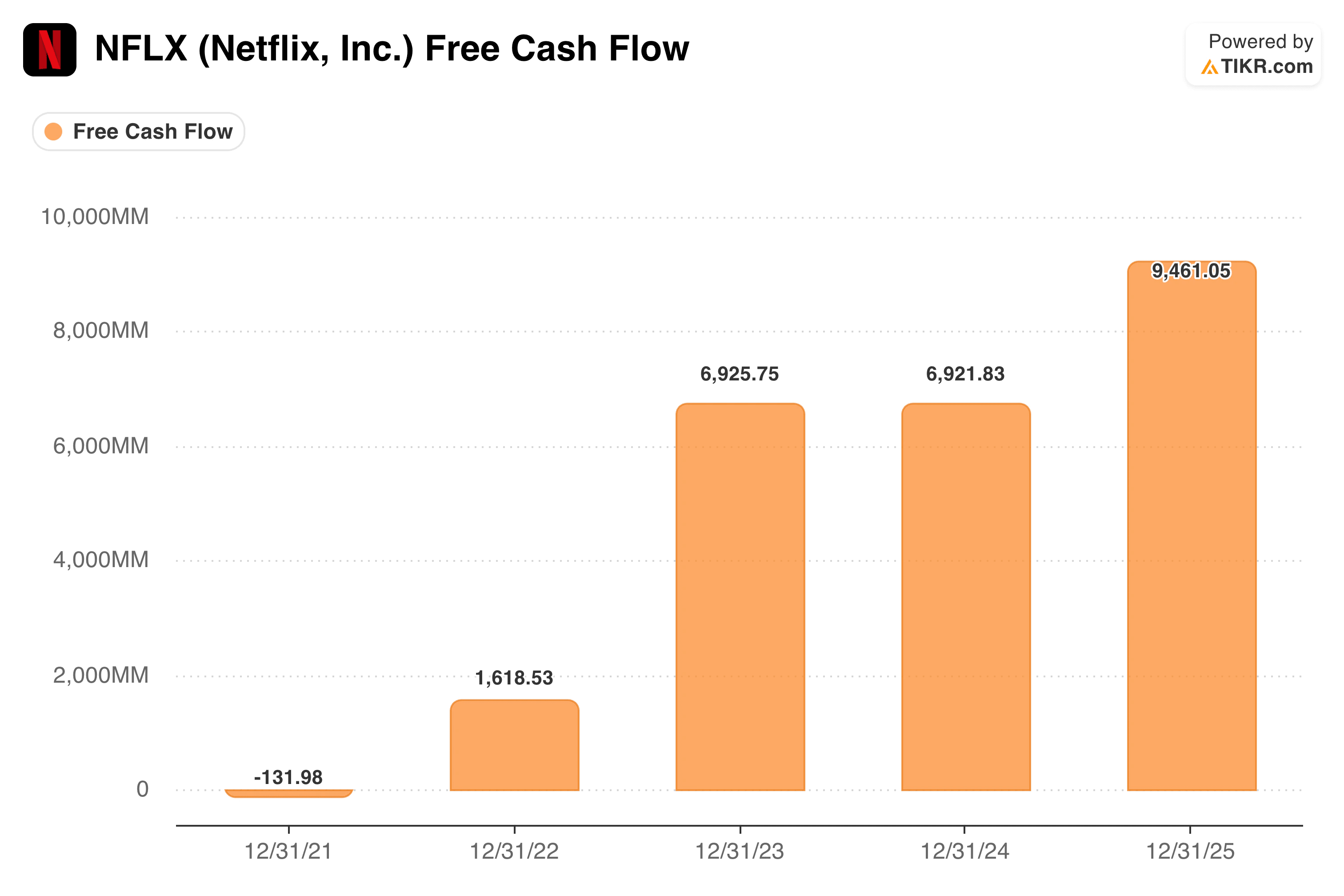
The free cash flow picture tells a story that gets buried beneath subscriber count debates and guidance squabbles. Not long ago, Netflix was burning cash. FCF was negative in 2021, sitting around -$132 million as the company poured money into original programming.
The turnaround since then has been dramatic. Free cash flow climbed to $1.6 billion in 2022, jumped to nearly $6.9 billion in 2023, and then accelerated to $9.5 billion in 2025. Management has since raised its 2026 FCF forecast to approximately $12.5 billion.
Co-CEO Greg Peters described the company’s monetization approach on the Q1 call as a “virtuous cycle,” explaining that better content drives engagement, engagement attracts advertisers, and ad revenue funds even better content.
Netflix now works with more than 4,000 advertisers, up 70% year over year, and the ad-supported tier accounts for over 60% of new sign-ups where available. Advertising revenue is on track to reach roughly $3 billion in 2026, nearly double the prior year.
See historical and forward estimates for Netflix stock (It’s free!) >>>
What Actually Caused the 2026 Selloff
The drawdown chart captures the year in a single image. Netflix started 2026 with modest pullbacks, briefly touching around 15% below its highs in February before recovering.
The real damage began in May, when the stock entered a sustained decline that carried into late July. The max drawdown hit 37.29% on July 20, the day after Q2 earnings landed with a slight revenue miss and softer-than-expected Q3 guidance.

The Q2 report was actually fairly solid on its own merits. Revenue came in at $12.56 billion, up 13% year over year, with EPS of $0.80 beating consensus.
The frustration centered on Q3 guidance coming in roughly $140 million below analyst models and Netflix’s decision to reduce the frequency of its public viewership reports. The stock dropped more than 11% at the open the following day.
Since then it has recovered partially to around -25.58% from the high, helped in part by Bill Ackman’s Pershing Square disclosing a new position and declaring that Netflix has “effectively won the streaming wars.”
Read our full take on Netflix’s earnings, margins, and valuation upside >>>
What the Valuation Model Says About Netflix Stock
Stepping back from the quarterly noise, the fundamental picture looks considerably more attractive than the stock price implies. Netflix trades at roughly 23 times forward earnings, a meaningful compression from where it spent much of 2024 and 2025.
The business generates nearly $10 billion in annual free cash flow, maintains a manageable net debt position, and competes in a category with no rival operating at comparable scale. Disney+, Max, and Peacock are still fighting for profitability, while Netflix is already returning capital through buybacks.
TIKR’s valuation model targets around $164 per share on mid-case assumptions, implying roughly 104% total return from current levels over approximately four and a half years.
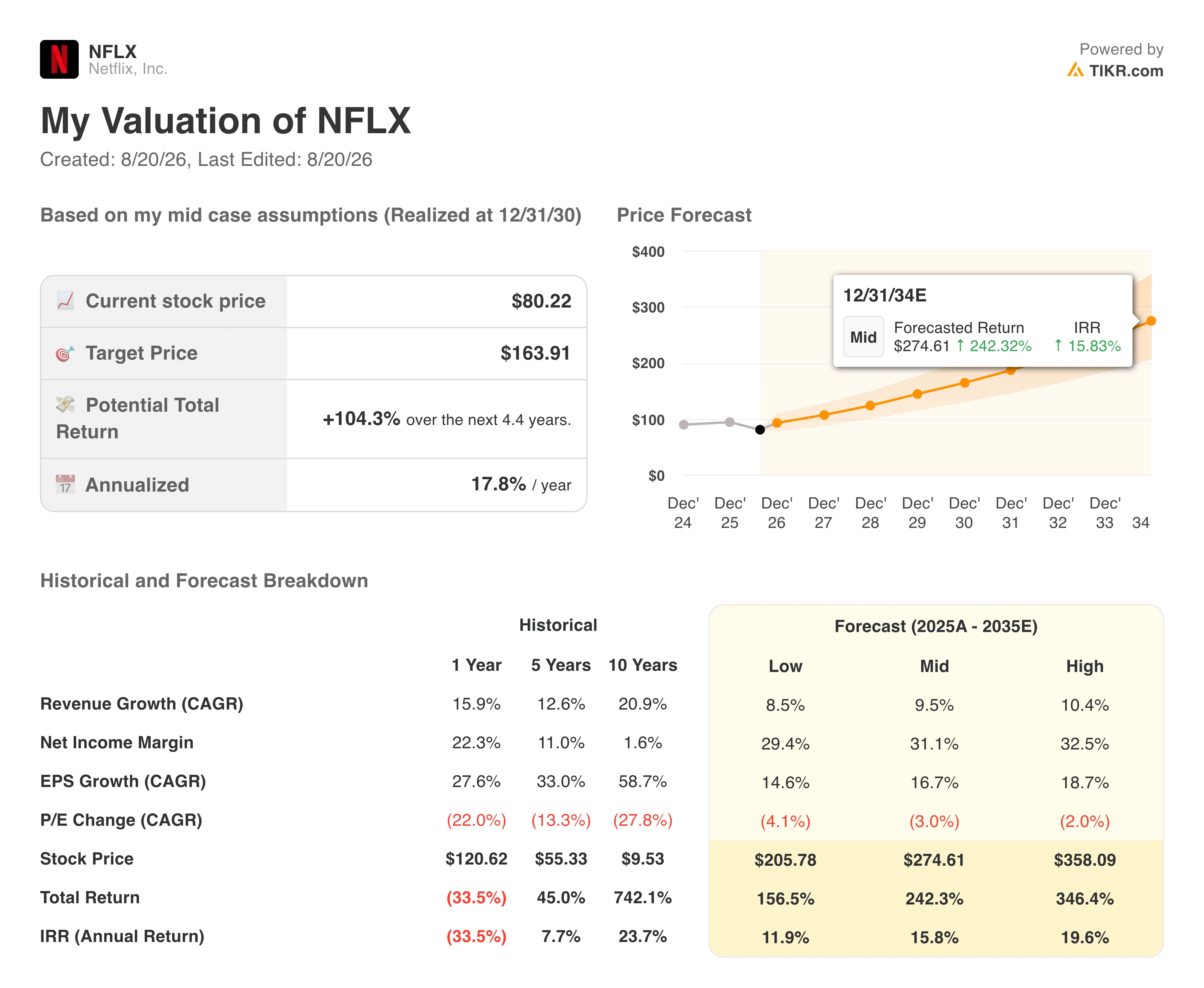
The annualized return works out to around 18% per year, consistent with management’s own revenue trajectory and where the advertising business appears to be heading. A more extended scenario running to 2034 puts the mid-case price near $275 at roughly a 16% annualized IRR.
Should You Buy Netflix Stock?
Netflix’s core business is as durable as it has ever been. The ad tier is scaling faster than most expected a couple of years ago, live events are driving member acquisition in ways the company has flagged will only expand, and free cash flow is compounding at a rate few large-cap media companies can match.
At around $80, the stock offers a meaningfully different entry point than it did at $127 in January, and the Street’s mean target near $93 implies roughly 17% upside on a 12-month view alone.
The risks are worth taking seriously. Viewing hour growth came in at just 2% in the first half of 2026, raising real questions about engagement ceiling effects in mature markets. Competition for live sports rights is intensifying and costly, and the gap between ad-tier revenue per user and standard subscription revenue has not fully closed.
A Q3 disappointment in October could renew selling pressure quickly. Investors with a genuine multi-year horizon are getting a better entry point today than they have seen in a long time.
See analysts’ growth forecasts and price targets for Netflix stock (It’s free!) >>>
Looking for New Opportunities?
- See which stocks billionaire investors are buying to follow the smart money.
- Analyze stocks in as little as 5 minutes with TIKR’s all-in-one, easy-to-use platform.
- The more rocks you overturn… the more opportunities you’ll uncover. Search 100K+ global stocks, global top investor holdings, and more with TIKR.
Disclaimer:
Please note that the articles on TIKR are not intended to serve as investment or financial advice from TIKR or our content team, nor are they recommendations to buy or sell any stocks. We create our content based on TIKR Terminal’s investment data and analysts’ estimates. Our analysis might not include recent company news or important updates. TIKR has no position in any of the stocks mentioned. Thank you for reading, and happy investing!


