Key Takeaways for Upstart Holdings Stock as of August 2026
- Year-Long Slide: Upstart stock has fallen 50% over the past year even as Q2 revenue climbed 42% YoY to $365M and the company returned to GAAP profitability with $17M in net income.
- Perception Gap: CEO Paul Gu told investors the divide between how Upstart views its own business and how the market prices it has never been wider in the company’s history as a public company.
- Analyst Split: Coverage stands at 6 buys, 2 outperforms, 6 holds, and 1 underperform among 15 analysts, with a mean target of $41 sitting 33% above the current price.
- Model Target: TIKR’s mid-case model values Upstart stock at $151 by December 2030, implying 394% total return and 44% annualized over 4.4 years.
Why Upstart Stock Is Down 50% Despite a Return to Profit
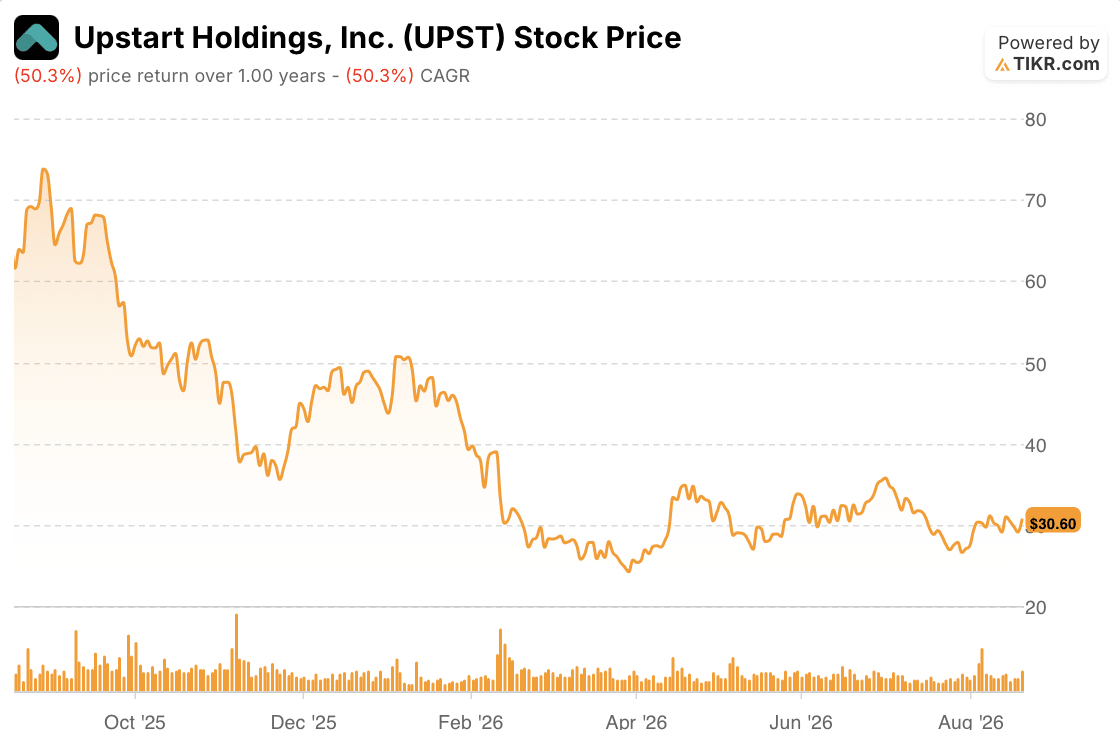
Upstart Holdings (UPST) stock has dropped 50% over the past year, a decline that runs directly against a second quarter in which the company beat revenue estimates, posted its highest contribution profit ever, and swung back to GAAP net income. The AI lending marketplace reported $365 million in revenue on August 4, up 42% year over year, alongside $17 million in net income and $0.16 in diluted earnings per share, more than double the prior year’s profit.
Core personal loan originations grew 27% sequentially, a $526 million jump that management called more than three and a half times the combined growth of the prior three quarters. Contribution profit hit $193 million, an all-time high that topped the previous peak set back in 2021, when interest rates sat near zero and consumer defaults were running at historic lows. Upstart cleared that bar in 2026’s tighter credit environment instead.
None of that has moved the stock much. CEO Paul Gu addressed the disconnect directly during Upstart’s Bank of America SMID Cap conference appearance on August 11: “There just really has never been a bigger gap between like how we saw ourselves at Upstart and how the rest of the market saw us.” He pointed to stronger technology, deeper committed capital relationships, and traction in newer products like Home and Auto as durable wins the market has largely ignored.
Part of the skepticism traces to rising operating costs, which climbed nearly 30% year over year, and to lingering questions about how much equity capital the business needs to fund its growth. Add a modest uptick in Upstart’s Macro Index, the company’s own gauge of default risk, and the result is a stock still priced for doubt even as the underlying numbers improved. That gap between execution and price is the entire story behind Upstart stock’s year.
Street Analysts Target Reflects a Cautious Reset
Upstart stock currently carries 6 buy ratings, 2 outperforms, 6 holds, and 1 underperform, with 15 analysts publishing price targets. The mean target sits at $41, which is 33% above the current price of $31.
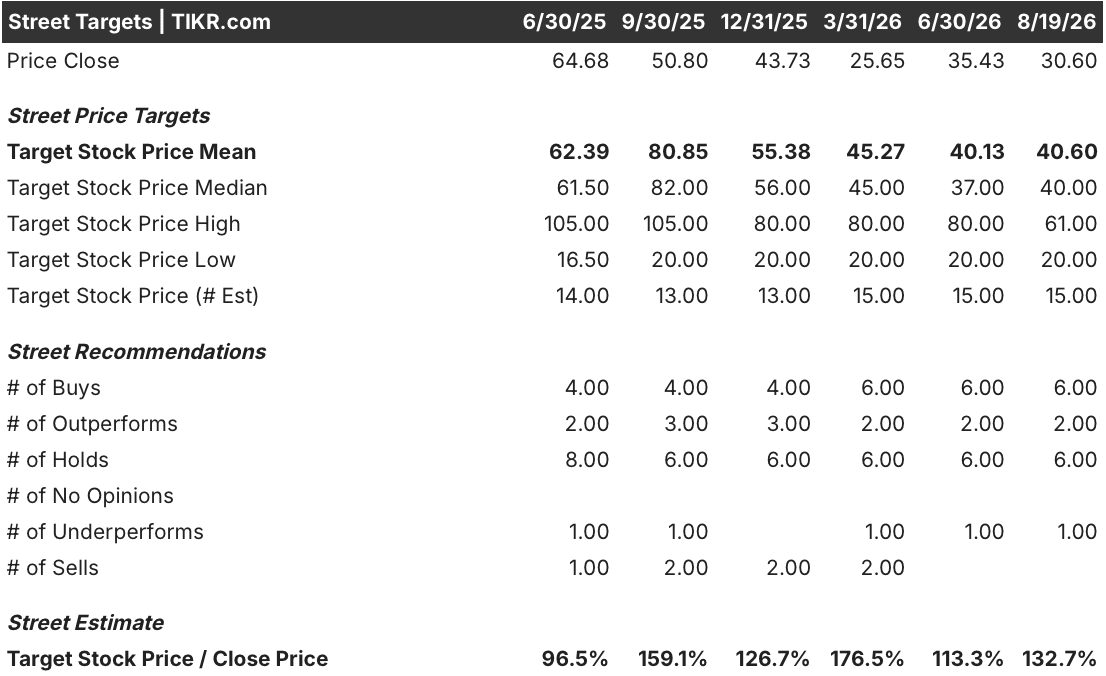
That gap has moved around sharply over the past year. In June 2025, when Upstart stock traded near $65, the mean target of $62 actually sat below the price. As the stock collapsed toward $26 by March 2026, the mean target only fell to $45, stretching the implied upside to 77%, the widest gap in the period shown. Analysts have been consistently slower to cut targets than the stock has been to fall, and as Upstart stock recovered into the summer, that gap narrowed back toward its current 33%.
Coverage has also grown, from 14 target-setting analysts a year ago to 15 today, and the two sell ratings on the stock in September 2025 have since disappeared entirely.
TIKR Values Upstart Stock at $151, Pricing In a Multiyear Recovery
TIKR’s mid-case model values Upstart stock at $151 by December 2030, implying 394% total return from the current price of $31, or 44% annualized over 4.4 years.
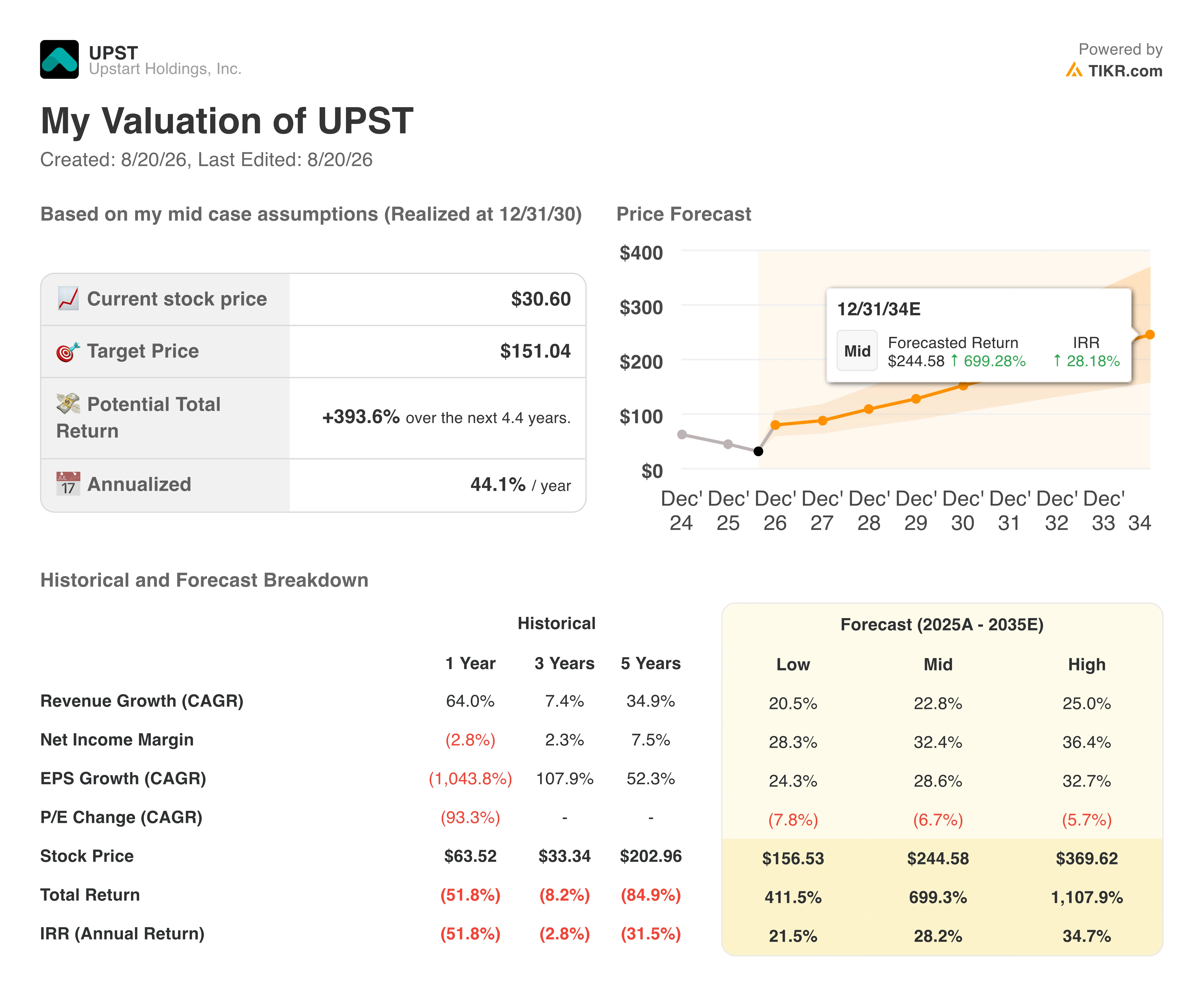
That annualized return sits well above what most software or fintech names offer even in bullish scenarios, reflecting how far Upstart stock has fallen relative to the growth the business is now delivering.
The model’s case rests on the same execution gap Gu described: continued reacceleration in core personal loans, secured products reaching contribution profit breakeven by the fourth quarter, and a Street that has historically lagged the stock’s moves in both directions and may still be underpricing the recovery already visible in Upstart’s numbers.
Should You Invest in Upstart Holdings, Inc.?
The only way to really know is to look at the numbers yourself. TIKR gives you free access to the same institutional-quality financial data that professional analysts use to answer exactly that question.
Pull up Upstart Holdings, Inc. stock and you’ll see years of historical financials, what Wall Street analysts expect for revenue and earnings in the quarters ahead, how valuation multiples have moved over time, and whether price targets are trending up or down.
You can build a free watchlist to track Upstart Holdings, Inc. alongside every other stock on your radar. No credit card required. Just the data you need to decide for yourself.
Access Professional Tools to Analyze UPST stock on TIKR for Free →
Looking for New Opportunities?
- See what stocks billionaire investors are buying so you can follow the smart money.
- Analyze stocks in as little as 5 minutes with TIKR’s all-in-one, easy-to-use platform.
- The more rocks you overturn… the more opportunities you’ll uncover. Search 100K+ global stocks, global top investor holdings, and more with TIKR.
Disclaimer:
Please note that the articles on TIKR are not intended to serve as investment or financial advice from TIKR or our content team, nor are they recommendations to buy or sell any stocks. We create our content based on TIKR Terminal’s investment data and analysts’ estimates. Our analysis might not include recent company news or important updates. TIKR has no position in any stocks mentioned. Thank you for reading, and happy investing!