Key Takeaways
- On Oct. 7, the FCC approved SpaceX to launch up to 15,000 satellites that connect straight to phones, and Elon Musk says they’ll have more than 100 times the bandwidth of SpaceX’s current system.
- The FCC also waived a rule that would have required SpaceX to lease airwaves from a carrier, so SpaceX can now compete directly with Verizon and AT&T.
- Satellite beams share their capacity across wide areas, and the full network isn’t due until 2035, so the first pressure lands on rural and roaming customers.
- What to watch: the FCC’s Oct. 29 vote on auctioning spectrum for satellite-to-phone service, and whether SpaceX starts launching on schedule in late 2027.
SpaceX (SPCX) just got the go-ahead to compete with Verizon (VZ) and AT&T (T) from space.
On Wednesday, the FCC approved SpaceX to launch and operate up to 15,000 next-generation Starlink Mobile satellites that connect straight to ordinary phones. SpaceX has about 650 mobile satellites in orbit today.
Elon Musk’s response on X? “Starlink Mobile (direct-to-cell) V2 satellites are incredible. This @SpaceX constellation will enable more than 100 times the bandwidth of our current V1 system!”
SpaceX says the new network will reach 5G speeds of up to 150 Mbps per user, using spectrum from T-Mobile (TMUS) and spectrum it bought from EchoStar (SATS).
That’s a lot more than a fix for dead zones.
Can 100x reach the city?
Start with the math. Going from about 650 satellites to 15,000 means about 23 times as many. If Musk’s 100x holds, each new satellite carries about four times the bandwidth of today’s, on average (100 ÷ 23 ≈ 4.3).
That’s a big jump. Still, 150 Mbps is a peak speed. A satellite beam covers a wide area and shares its capacity with everyone under it, so nobody has shown what each user gets when the network is busy. A dense city puts a lot of phones under one beam.
The timeline is long, too. Launches begin in late 2027. SpaceX can’t use the EchoStar spectrum commercially until the later stage of that deal closes, which is expected by Nov. 30, 2027. Half the constellation has to be in orbit by Oct. 7, 2032, and all of it by Oct. 7, 2035.
Even FCC Chairman Brendan Carr described the goal as “leveraging this cutting-edge tech to end cell phone dead zones.”
So for years, the city customers who carry the carriers’ profits look safe. The pressure starts with rural customers and roaming.
Here’s the thing: SpaceX doesn’t need a carrier anymore
The biggest part of the order may be a waiver.
Satellite-to-phone rules assumed the satellite operator would lease airwaves from a carrier. That made the carrier the gatekeeper. SpaceX now owns about 65 MHz of spectrum, bought from EchoStar in two deals totaling about $19.6 billion, so the FCC waived the leasing rule. It said the grant promotes competition in retail wireless service for American consumers.
In other words, SpaceX can sell phone service without a carrier’s sign-off. (T-Mobile, SpaceX’s current direct-to-cell partner, loses the most leverage here.)
And SpaceX President Gwynne Shotwell said the new spectrum “has terrestrial components, so we definitely intend to build out terrestrial.”
If I owned Verizon or AT&T, that’s the line I’d watch. Pure speculation, but a rival with its own spectrum, satellites overhead and someday a network on the ground could compete well beyond the rural edges.
SpaceX also has a fast-growing business to pay for all this. Analysts expect its revenue to more than quadruple, from $45.1 billion in fiscal 2026 to $200 billion in fiscal 2028.

The new satellites don’t start launching until late 2027, so I wouldn’t expect this approval to move those estimates much yet.
The carriers seem to have seen this coming. AT&T, Verizon and T-Mobile set up a satellite-to-phone joint venture on Oct. 2, but it still needs another company’s satellites. And Verizon’s and AT&T’s current satellite deals rely on AST SpaceMobile (ASTS), whose network isn’t built yet. AST fell about 4% on the news.
AT&T has little growth to give up
This matters most for AT&T, because its sales have gone nowhere. Total revenue was $126 billion in fiscal 2025, down from $134 billion in fiscal 2021 and only a little above the $121 billion of fiscal 2022.
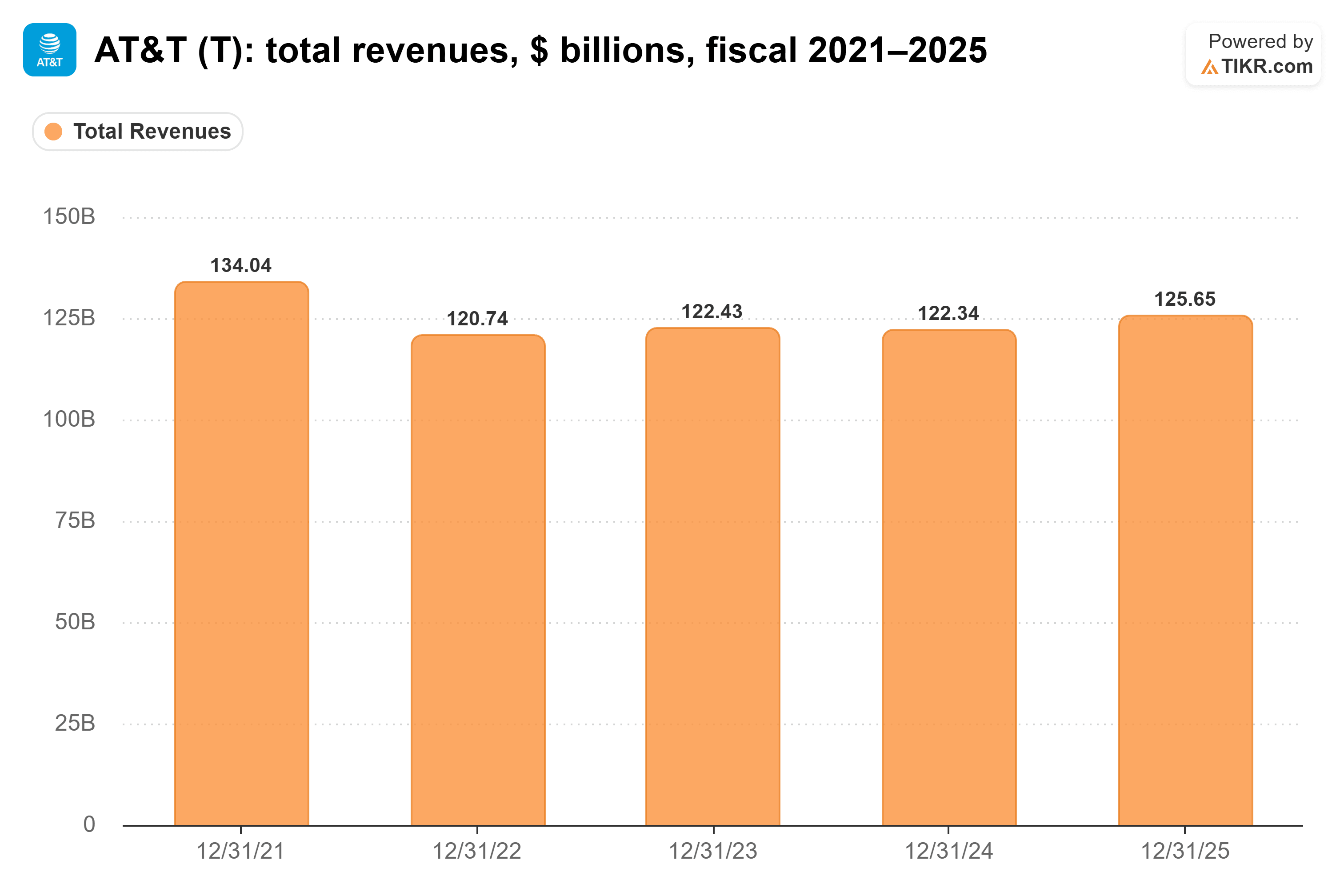
When revenue is that flat, even losing a slice of rural and roaming business will show.
Investors don’t seem worried yet. Verizon and AT&T barely moved on the news, and Verizon trades at 9.0x forward earnings. That’s right around its five-year average of 8.8x and below the 10.5x it reached in March.

The upshot
Does Musk’s “100 times the bandwidth” raise the stakes for Verizon and AT&T? It does. For years, the satellites alone look like a rural and roaming problem. The bigger shift is that SpaceX can now sell service on its own spectrum, has a fast-growing business to pay for it, and plans to build on the ground too. AT&T, with revenue that has barely grown, should take that seriously long before 2035.
Of course, a license is only a license. The order came from an FCC bureau rather than the full commission, so it can still be reviewed. On Oct. 29, the FCC votes on auctioning 25 MHz of spectrum for direct-to-device service. If the carriers’ joint venture wins that, SpaceX’s lead narrows. And if launches haven’t started by the end of 2027, all that bandwidth stays on paper.
So what is SpaceX stock actually worth?
TIKR lets you forecast the future price of any stock in less than a minute. Just enter a few assumptions into TIKR’s valuation model and see what SpaceX could be worth. Start from Wall Street consensus estimates, or adjust the inputs to reflect your own view of the business. It’s free to use.
Disclaimer:
Please note that the articles on TIKR are not intended to serve as investment or financial advice from TIKR or our content team, nor are they recommendations to buy or sell any stocks. We create our content based on TIKR Terminal’s investment data and analysts’ estimates. Our analysis might not include recent company news or important updates. TIKR has no position in any of the stocks mentioned. Thank you for reading, and happy investing!