


Key Takeaways
- Chip stocks fell on Thursday even though Taiwan Semiconductor Manufacturing reported third-quarter sales up 51%, on worries that debt-funded AI spending is near its peak.
- SemiAnalysis’s Dylan Patel says US capex will be about $2 trillion next year, which points to at least one more year of growth for NVIDIA.
- Analysts expect NVIDIA’s revenue to reach $692 billion in the year to January 2028, up from the $412 billion expected for the current year.
- NVIDIA trades at 19.6x forward earnings, about half its five-year average, and the hyperscalers’ third-quarter capex figures are the next test.
Wall Street has decided the AI spending boom behind NVIDIA (NVDA) is about to peak, and it isn’t letting good news change its mind.
On Thursday, Taiwan Semiconductor Manufacturing (TSM), or TSMC, reported sales that put its third-quarter revenue up 51% from a year earlier. Chip stocks fell anyway, as Brent crude jumped 4% to $104 and the 10-year Treasury yield rose to 5.33%, on worries that the debt-funded AI boom may be fading.
Jim Cramer, host of CNBC’s Mad Money, called it on X: “Oil/rates convenient excuses to say that data center spend is peaking so sell the semis…”
He has a point. And the people who count AI chips for a living think the peak is further off than the market does.
“People’s numbers are too low”
On Wednesday’s episode of the Big Technology Podcast, host Alex Kantrowitz asked Dylan Patel, founder and CEO of the research firm SemiAnalysis, how big the AI buildout really is. Patel’s first reaction to the popular estimates: “people’s numbers are too low.”
Then he gave his own. Next year, he said, “CapEx across the US will be on the order of $2 trillion.” That’s “not just data centers and chips, but also all the rest of the supply chain that people are investing in.”
That doesn’t sound like a peak to me.
Still growing at triple digits
The spending isn’t slowing down yet, either. Kantrowitz pointed to a figure from the research of Jordan Nanos, author of SemiAnalysis’s ClusterMax 3.0 rankings of GPU clouds: for hyperscaler capex, “in the third quarter of 2026, the growth is at 116%.”
You can see that money landing further down the supply chain. TSMC’s revenue more than doubled from NT$1.59 trillion in 2021 to NT$3.81 trillion in 2025, with just one down year along the way.
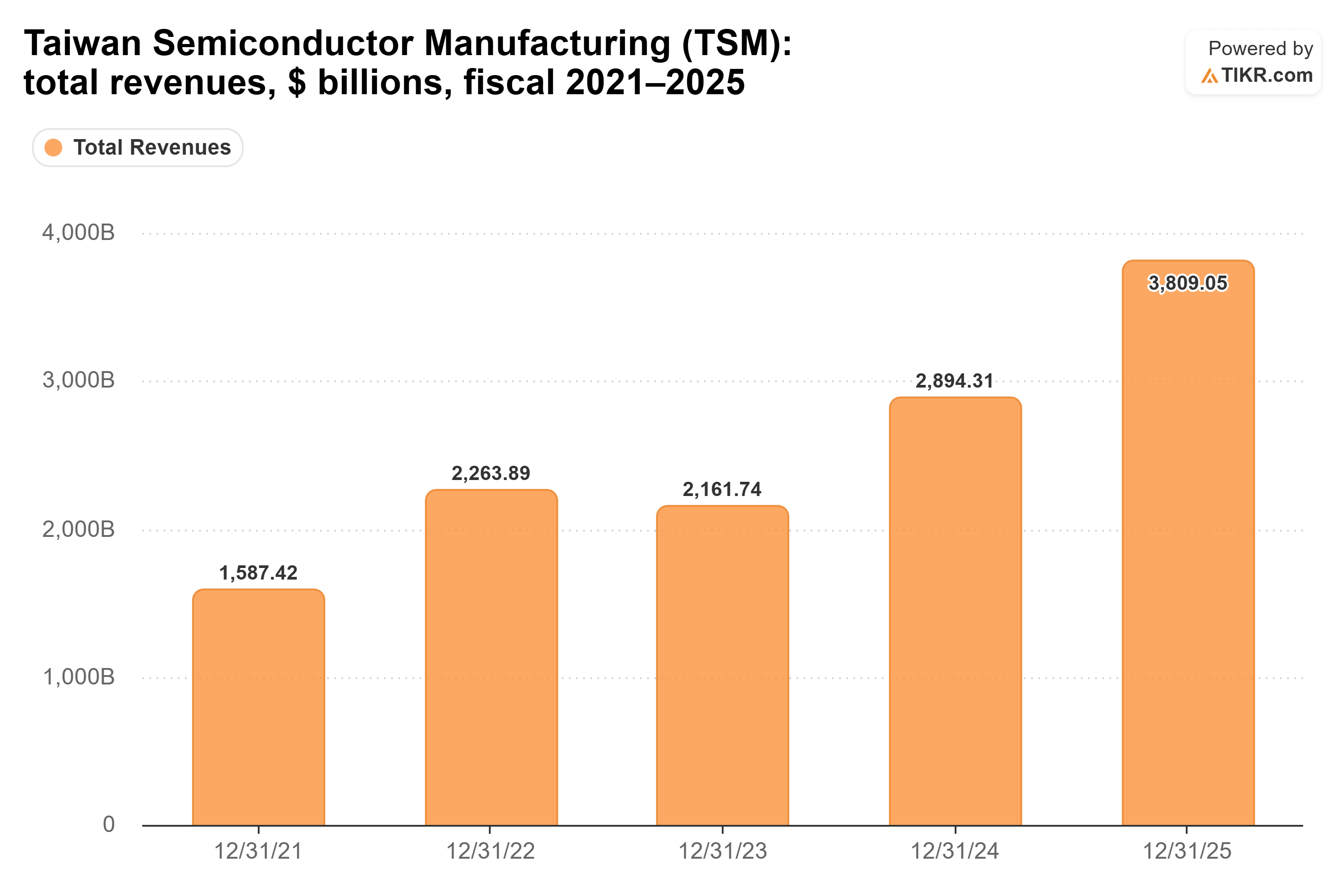
…and 2026 is running faster still. TSMC’s sales from January through September came to NT$3.90 trillion. That’s up 41% from a year earlier and already more than all of 2025.
What “$2 trillion” means for NVIDIA
Analysts expect NVIDIA’s revenue to nearly double, from $216 billion in the year to January 2026 to $412 billion this year. Then they see it climbing another 68% to $692 billion in the year to January 2028, which lines up with Patel’s “next year”…

Here’s a simple check on that $692 billion. Divide it by Patel’s $2 trillion, and NVIDIA’s expected sales come to about a third of the spending he sees. (This is rough math: NVIDIA sells worldwide, while Patel’s figure covers US capex only, including buildings and everything else.)
For those estimates to hold, Patel’s $2 trillion has to show up, and he says it will. Nothing in Thursday’s selloff gives analysts a reason to cut, either: TSMC, which makes NVIDIA’s chips, just grew sales 51%.
Priced for a peak that hasn’t come
On Wednesday, before Thursday’s drop, NVIDIA traded at 19.6x forward earnings. That’s barely half its five-year average of 36.5x and not far above the 17.5x low it hit on Sept. 14…

…so the market is already pricing in the end of the boom.
Of course, the best argument for the bears comes from SemiAnalysis itself. When Kantrowitz asked whether growth would slow from here, Nanos said: “I think we’re definitely going to hit limits towards the end of next year.” With the 10-year yield above 5.3%, investors may simply be pricing in that peak early.
But the end of next year is the tail end of the $2 trillion year Patel describes. A stock at 19.6x forward earnings is priced as if those limits had already arrived.
The only number that matters
So for NVIDIA, the number that matters is $2 trillion. If that spending shows up, analysts’ $692 billion for the year to January 2028 looks reachable, and the stock looks cheap against its own history. Oil and rates will move the shares day to day, and Cramer is right to call them excuses.
Of course, Nanos’s limits could come sooner than he expects. The first check on that 116% comes when the hyperscalers report their own third-quarter results in the coming weeks.
So what is NVIDIA stock actually worth?
TIKR lets you forecast the future price of any stock in less than a minute. Just enter a few assumptions into TIKR’s valuation model and see what NVIDIA could be worth. Start from Wall Street consensus estimates, or adjust the inputs to reflect your own view of the business. It’s free to use.
Disclaimer:
Please note that the articles on TIKR are not intended to serve as investment or financial advice from TIKR or our content team, nor are they recommendations to buy or sell any stocks. We create our content based on TIKR Terminal’s investment data and analysts’ estimates. Our analysis might not include recent company news or important updates. TIKR has no position in any of the stocks mentioned. Thank you for reading, and happy investing!


