Key Takeaways
- A United Launch Alliance Vulcan rocket failed on Nov. 15 and destroyed 40 of Amazon’s Leo satellites, and Elon Musk then called SpaceX’s lead in space “a monopoly.”
- SpaceX flies most of the world’s launches and its own Starlink satellites on most of them, while Leo depends on other companies’ rockets.
- AST SpaceMobile’s satellites have waited since September for a SpaceX launch, and Rocket Lab’s Neutron has slipped into 2027.
- SpaceX’s launch lead pays off through Starlink’s operating profit and through compute, with analysts expecting revenue of $338 billion in 2028.
Amazon (AMZN) lost 40 of its Leo internet satellites on Sunday, when United Launch Alliance’s Vulcan rocket failed on its way to orbit.
At the New York Times’ DealBook Summit on Wednesday, Andrew Ross Sorkin told Elon Musk the mishap leaves SpaceX (SPCX) with “a monopoly on space at the moment.”
Musk didn’t disagree exactly, saying “we’ve just made a system that is much better than anyone else’s.”
Hard to disagree. And that’s a real problem for anyone who needs a ride to orbit, from Amazon to AST SpaceMobile (ASTS), since the rockets built to compete with Falcon 9 aren’t flying yet. Neutron from Rocket Lab (RKLB) is one of them.
SpaceX sets the launch calendar
Falcon 9 flew 165 times in 2025, more than half of all orbital launches worldwide. Most of those rides go to SpaceX itself: 23 of its 35 launches in the third quarter were its own. Some of its satellite rivals are launch customers too, so they fly when SpaceX has room.
AST SpaceMobile shows what that looks like. AST said in its Nov. 9 release that BlueBirds 14, 15 and 16 shipped to Cape Canaveral in September and are waiting for a SpaceX launch date. It’s aiming for about 45 BlueBirds in orbit by mid-2027, so its service business can only start as fast as it gets rides. That’s also why AST is building its own rocket, Blacklift, for late 2028.
TIKR tracks 40 analysts on SpaceX. How many say “Buy”?
See the full breakdown of Buy, Hold, and Sell ratings on SpaceX, along with Wall Street’s revenue and earnings estimates, all in one place. More than 500,000 investors use TIKR to research stocks like this one. See SpaceX’s Analyst Ratings
Leo rides on someone else’s rocket
Amazon is in the same boat, with a much bigger fleet to fill. Sunday’s failure also disrupted Amazon’s plans for a second Vulcan launch within weeks. So Amazon has 40 satellites to replace, and it has to wait for a rocket it doesn’t control to fly again.
Starlink has no such wait. SpaceX says Starlink made up about 75% of the world’s active maneuverable satellites as of March 31.
Copying a rocket takes years
Musk’s defense is that SpaceX hasn’t stood in anyone’s way. “I encourage people to copy our rockets and to copy our satellites,” he told Sorkin.
Even with the blueprints, a rocket takes years to build, and the rivals keep slipping. Rocket Lab pushed Neutron’s first launch into 2027 after finding a problem with its first-stage tank. Starlink keeps launching in the meantime.
The payoff shows up in Starlink and compute
On this week’s episode of 20VC, one of the hosts noted that SpaceX’s launch business is now “sub 10% of the SpaceX market cap.” Scale Venture Partners’ Rory O’Driscoll explained why the rockets still matter: “the rockets, which are amazing, unique, and differentiated, make the Starlink.”
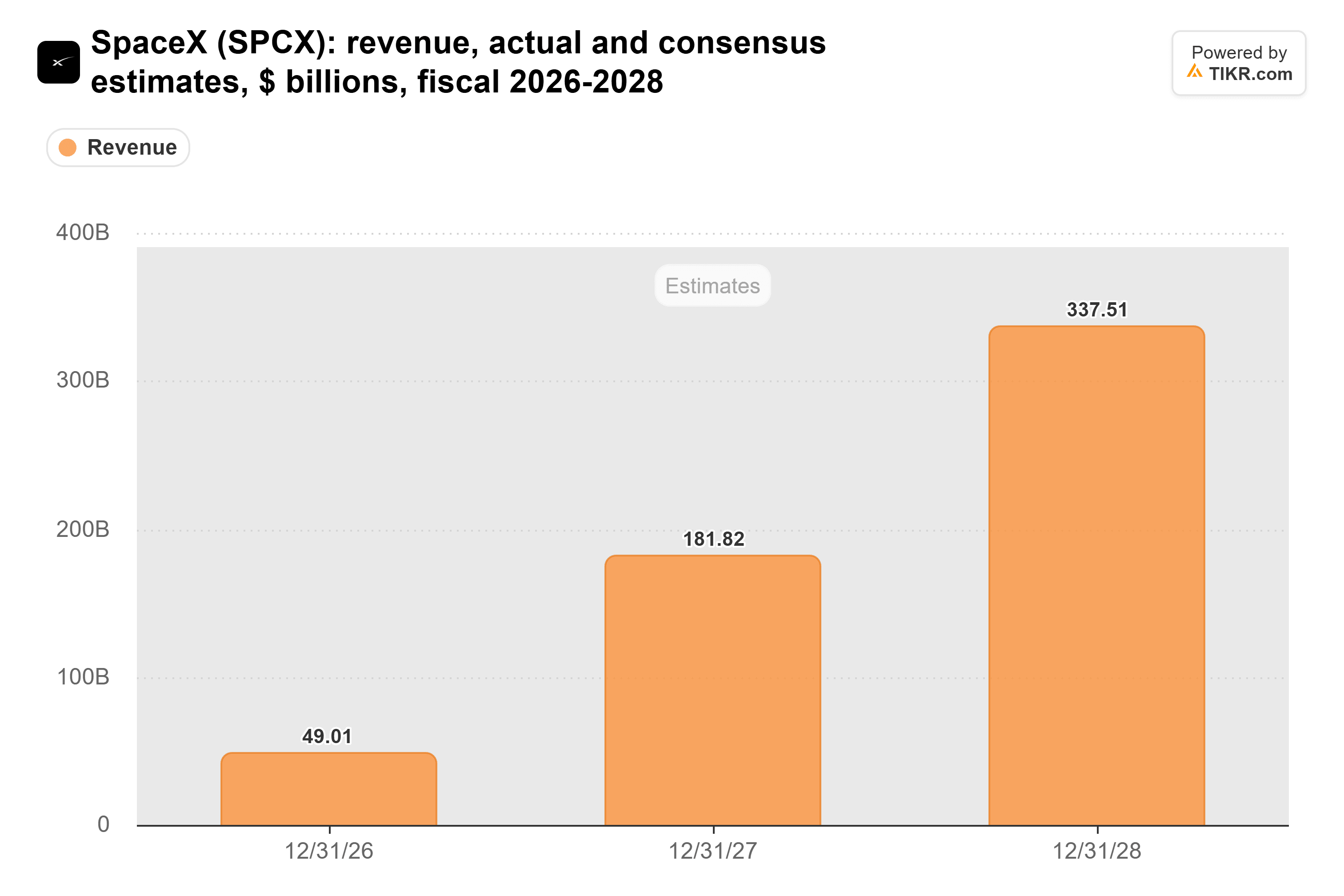
Analysts expect SpaceX’s revenue to climb from $49.0 billion this year to $338 billion in 2028:
Compute is already doing much of that lifting. It brought in $7.56 billion of SpaceX’s $14.6 billion of third-quarter revenue.
Starlink, meanwhile, earns the profit. You won’t see that in SpaceX’s company-wide operating margin, which swung from 5.3% in 2024 to -11.1% in 2025:
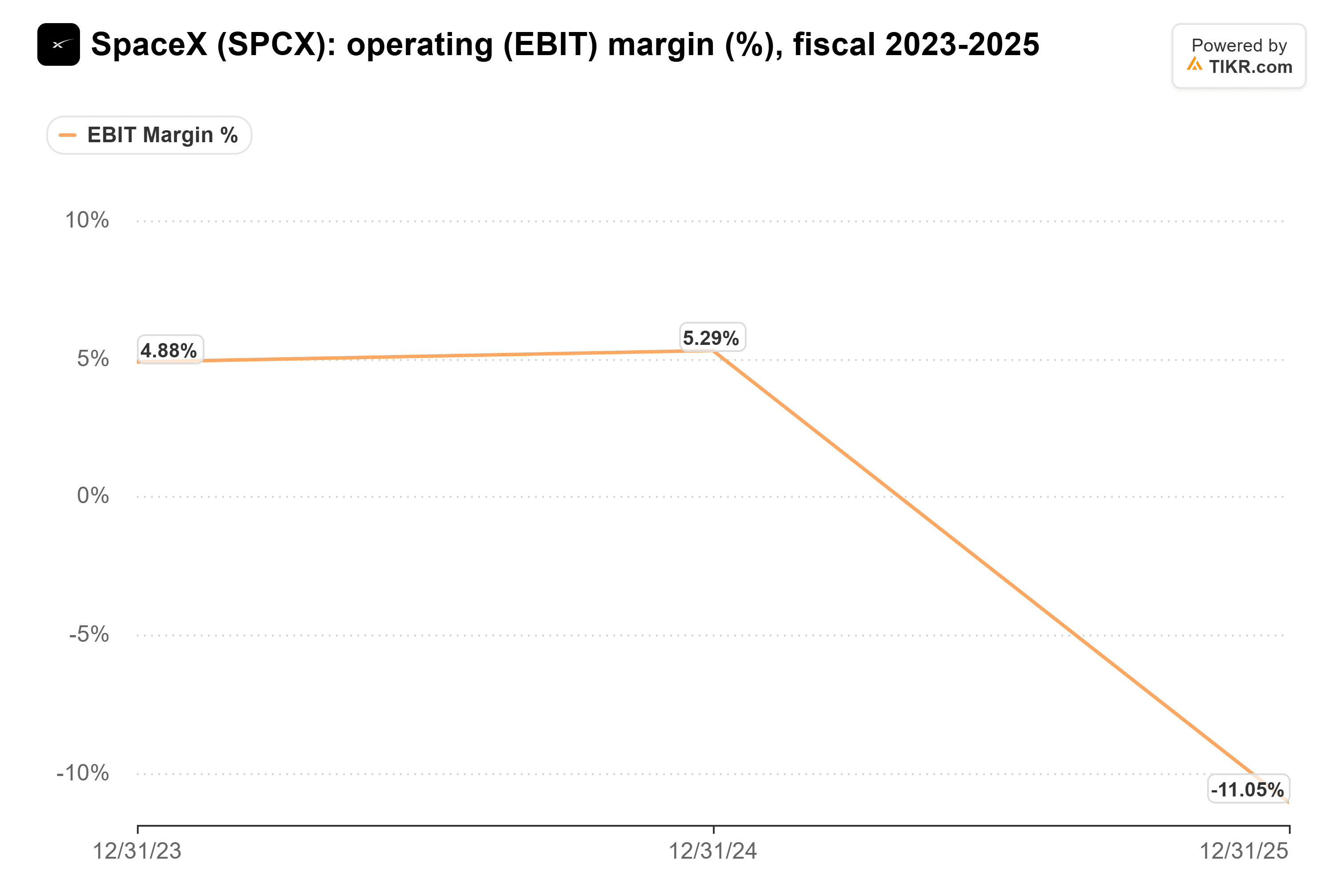
The AI business lost $6.4 billion from operations in 2025, and Starship development cost $3.0 billion. Starlink’s Connectivity segment more than doubled its operating income to $4.4 billion that year. It earned a 40.7% operating margin in the first nine months of 2026.
Leo is catching up on SpaceX’s schedule
That’s bad news for Amazon’s Leo. At Sept. 30, Starlink had 13.6 million consumer subscribers and more than 3,800 aircraft equipped. Every batch Leo loses pushes its catch-up further out.
The way I see it, SpaceX’s launch lead is worth far more than its launch revenue suggests, because it lets SpaceX decide how fast Starlink grows and how fast anyone can chase it. Of course, that edge lasts only until someone else flies at scale. The dates to watch are Vulcan’s return to flight with Amazon’s next Leo batch, Rocket Lab’s new Neutron date after its first-quarter testing, and the launch of AST’s BlueBirds 14 to 16.
There’s just one problem…
Calling SpaceX “a monopoly” pretty much begs the government to get involved. (Especially with a future administration that is less, uh, supportive of Musk than Trump has been.) This is an industry with high barriers to entry and one dominant player that has seemingly unlimited funding. Any lawyer with a background in antitrust probably has their antennae going off right now. We’ve seen this play out before, and it may not be pretty for SpaceX.
So it might be wise for SpaceX to see its market share in space decline just a bit so they reduce the likelihood of a government intervention (up to and even including a possible breakup).
Which of course begs the biggest question…
So what is SpaceX stock actually worth?
TIKR lets you forecast the future price of any stock in less than a minute. Just enter a few assumptions into TIKR’s valuation model and see what SpaceX could be worth. Start from Wall Street consensus estimates, or adjust the inputs to reflect your own view of the business. It’s free to use.
Disclaimer:
Please note that the articles on TIKR are not intended to serve as investment or financial advice from TIKR or our content team, nor are they recommendations to buy or sell any stocks. We create our content based on TIKR Terminal’s investment data and analysts’ estimates. Our analysis might not include recent company news or important updates. TIKR has no position in any of the stocks mentioned. Thank you for reading, and happy investing!