Key Takeaways
- Cameco swung to a C$2 million adjusted net loss in the third quarter after a longer Key Lake mill outage cut production and raised costs.
- Uranium segment adjusted EBITDA fell 19% to C$179 million, while Cameco’s share of Westinghouse adjusted EBITDA rose 15% to C$143 million.
- Operating cash flow dropped to C$3 million, and a new US$1 billion share sale program opens the door to dilution in a weaker year.
- Fourth-quarter results, expected in February, will show whether Key Lake is back on schedule and whether costs have eased.
Cameco (CCJ) warned investors that 2026 would be an uneven year. Its third quarter, reported October 30, showed just how uneven.
The uranium miner swung to a C$2 million adjusted net loss, from C$32 million of adjusted net earnings a year earlier. Shares came under pressure the same day.
The cause was planned. Cameco stretched its annual maintenance shutdown at the Key Lake mill to install new infrastructure and repair existing equipment, so production fell and costs rose.
Yet the quarter carried a second story. Westinghouse, the reactor company Cameco owns 49% of, kept growing while the uranium business shrank.
Key Lake ate the quarter
Revenue barely moved, rising to C$619 million from C$615 million. Profit told a different story:
- Adjusted EBITDA fell 14% to C$267 million.
- Uranium segment adjusted EBITDA dropped 19% to C$179 million.
- Net earnings came in at C$43 million, or C$0.10 per share.
Cameco also narrowed 2026 production guidance to 19.5 million to 20.5 million pounds, from a previous top end of 21.5 million. Delivery guidance tightened to 29.5 million to 30.5 million pounds.
So where did the earnings power go?
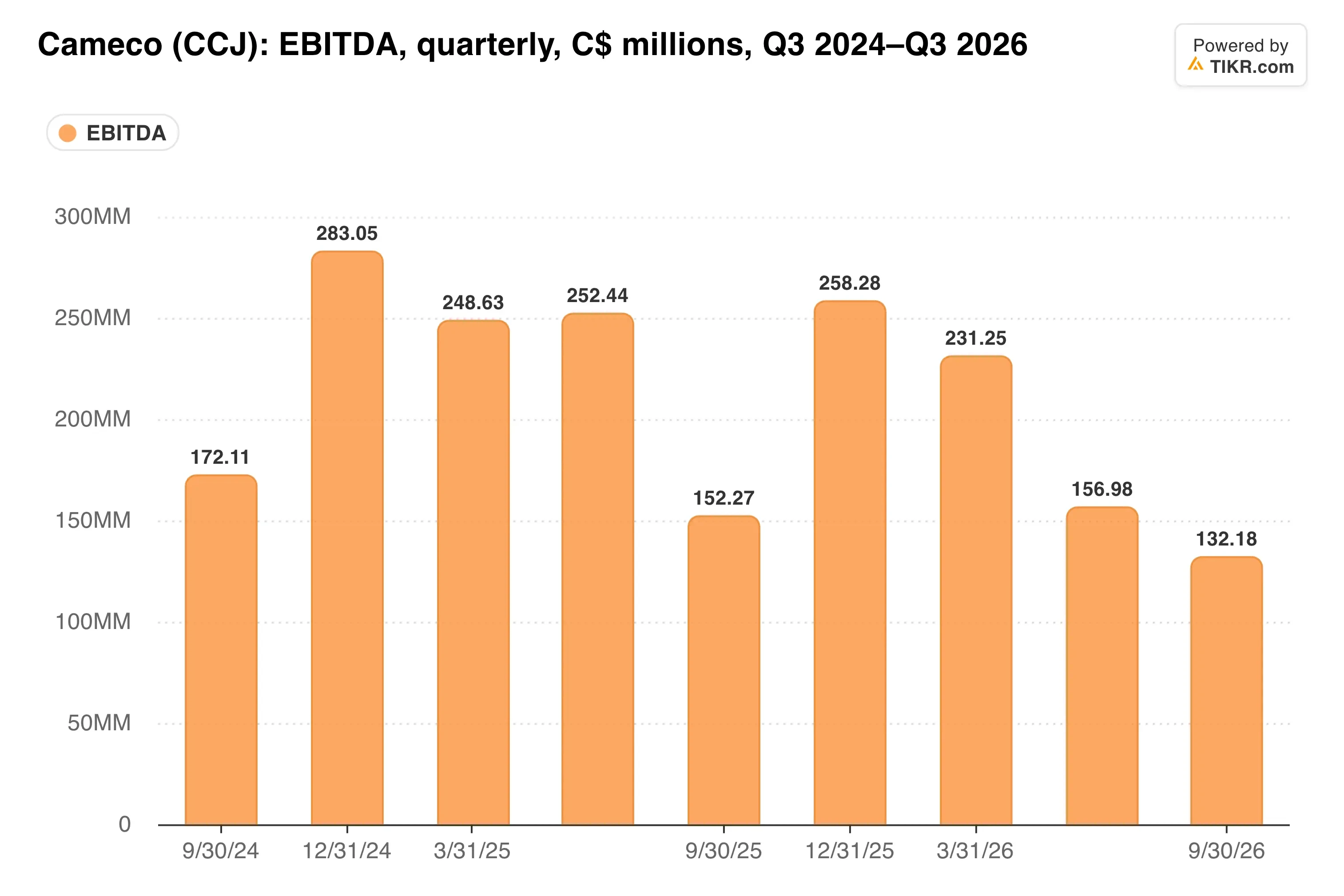
Most of the drop sits in uranium. Fuel services adjusted EBITDA held steady at C$24 million, against C$25 million last year.
Westinghouse carries the growth case
Cameco’s share of Westinghouse adjusted EBITDA rose 15% to C$143 million in the quarter. Its share of the net loss also narrowed, to C$24 million from C$32 million.
The nine-month figure looks weaker, at C$427 million versus C$569 million. However, 2025 included a large one-time payment tied to the Dukovany project in the Czech Republic.
Management clearly sees new reactors as the bigger lever. Grant Isaac, Cameco’s president, told The Northern Miner that “the greatest growth potential for Westinghouse is the Energy Systems Division,” which handles new builds.
Cameco now expects 40% to 45% of spending on a new AP1000 project to flow to Westinghouse, up from 25% to 40%. Meanwhile, a non-binding U.S. and South Korea framework from September 30 envisions up to $120 billion for as many as eight American reactors, including six AP1000s.
Here’s what analysts expect the top line to do from here…
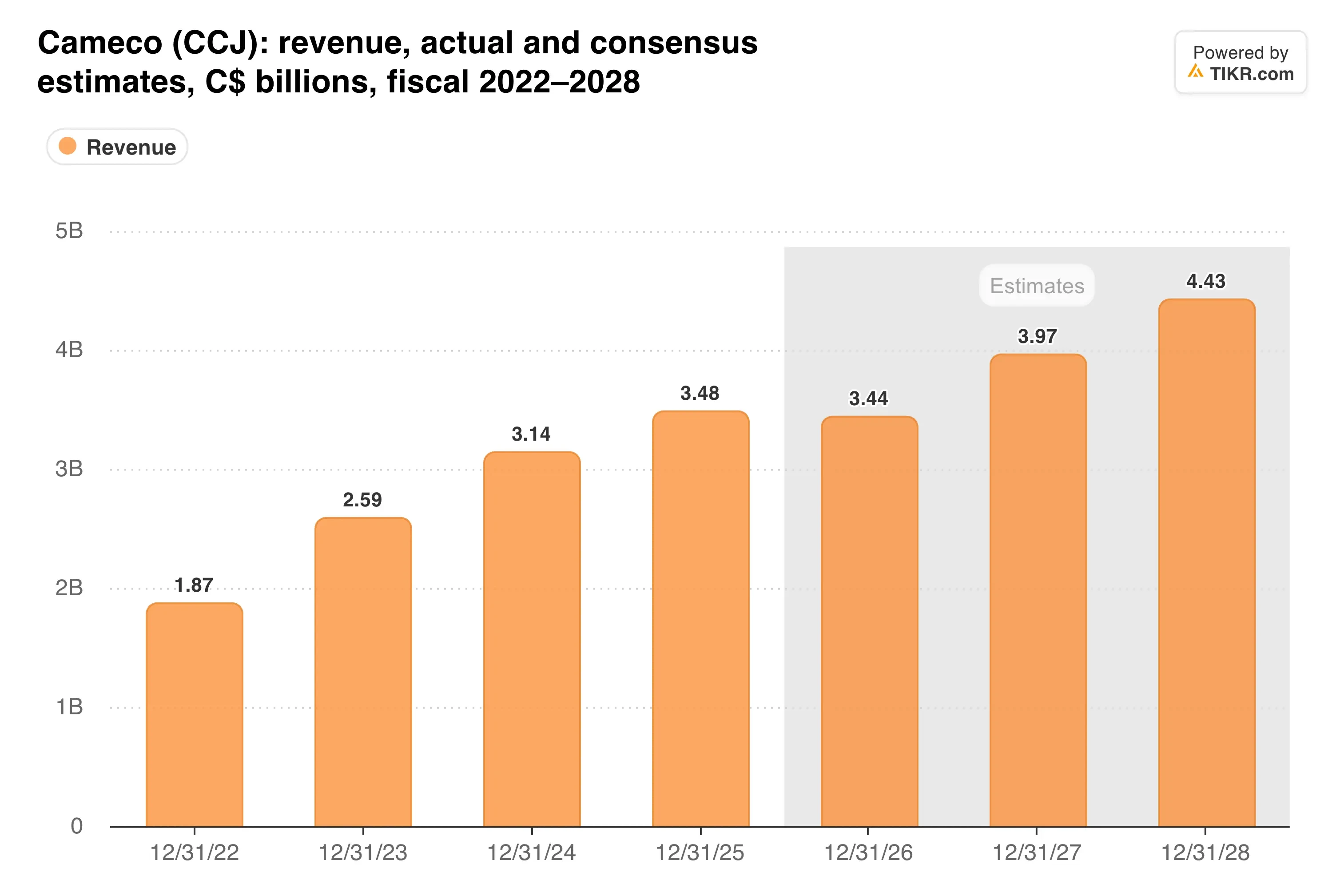
None of those reactors is a firm order yet, and the framework still needs definitive agreements.
TIKR tracks 21 analysts on Cameco. How many say “Buy”?
See the full breakdown of Buy, Hold, and Sell ratings on Cameco, along with Wall Street’s revenue and earnings estimates, all in one place. More than 500,000 investors use TIKR to research stocks like this one. See Cameco’s Analyst Ratings
Cash is the harder part
Operating cash flow fell to C$3 million in the quarter, from C$156 million a year earlier. Through nine months, it reached C$112 million against C$731 million in 2025.
Compare that with the prior two years.
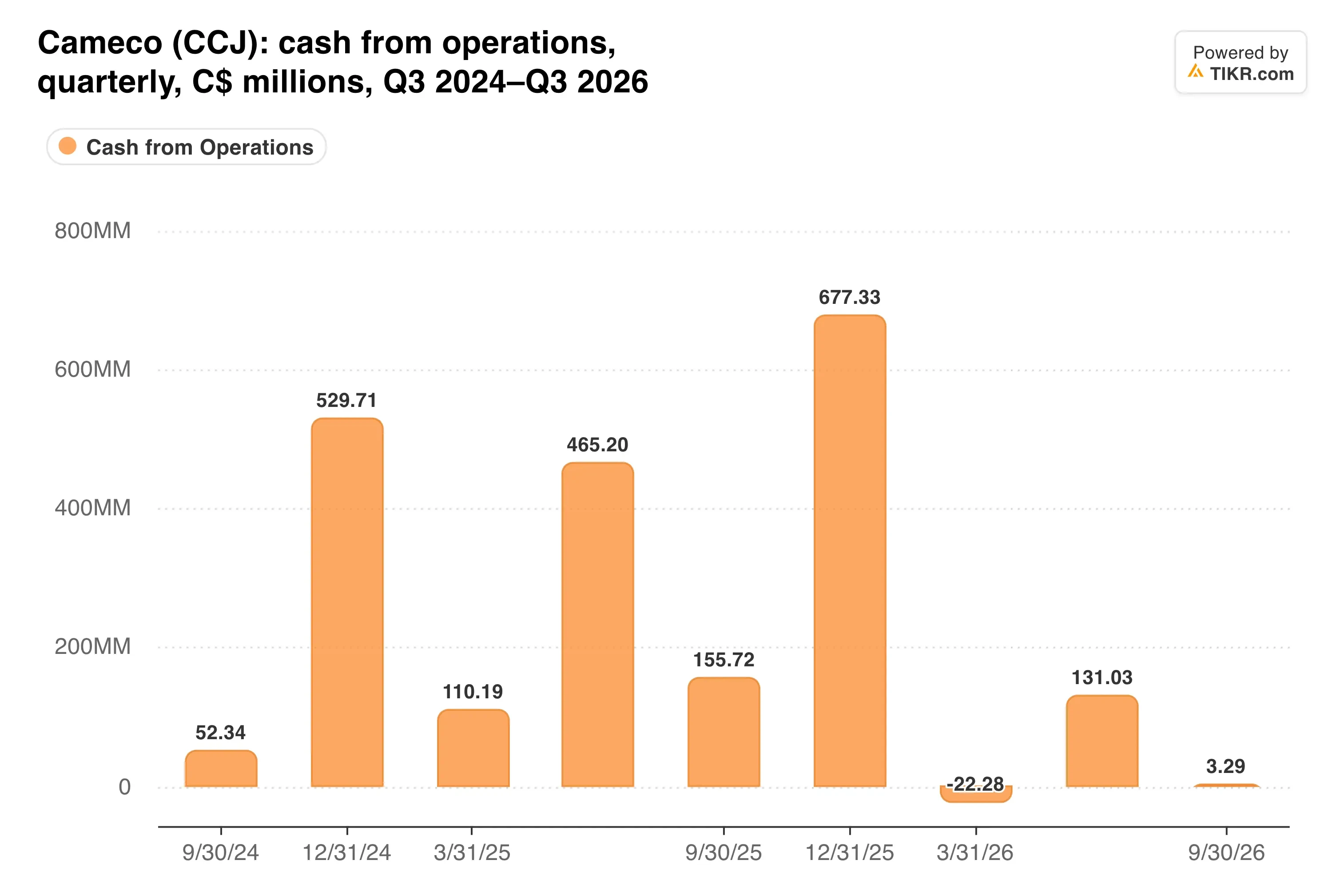
The balance sheet still looks fine. Cameco ended September with C$860 million of cash, C$1.0 billion of debt, and an undrawn C$1.0 billion credit facility.
In early November, though, it signed a new at-the-market agreement to sell up to US$1 billion of shares. That agreement only authorizes sales, yet it opens the door to dilution in a year when earnings are already down.
The dividend stays at C$0.24 per share, payable December 15. Separately, CFO Heidi Shockey plans to retire at the end of the first quarter of 2027.
My take: The market is punishing Cameco for a quarter management largely telegraphed, and Westinghouse is quietly improving. Even so, a near-zero cash quarter plus a fresh share program makes me want proof before buying the dip. I’d rather see costs normalize first.
Cameco says Key Lake has restarted and should be back on schedule in the fourth quarter. Results expected in February will show whether that happened, and whether deliveries land inside the narrowed range.
So what is Cameco stock actually worth?
TIKR lets you forecast the future price of any stock in less than a minute. Just enter a few assumptions into TIKR’s valuation model and see what Cameco could be worth. Start from Wall Street consensus estimates, or adjust the inputs to reflect your own view of the business. It’s free to use.
Disclaimer:
Please note that the articles on TIKR are not intended to serve as investment or financial advice from TIKR or our content team, nor are they recommendations to buy or sell any stocks. We create our content based on TIKR Terminal’s investment data and analysts’ estimates. Our analysis might not include recent company news or important updates. TIKR has no position in any stocks mentioned. Thank you for reading, and happy investing!