Key Takeaways
- Mistral CEO Arthur Mensch says energy is about 10% of AI compute’s cost and won’t be the bottleneck until 2029 or 2030.
- Mensch was talking about Europe, but Vistra’s CEO sees Texas power prices getting back on track on a similar 2029-2030 timeline.
- Vistra’s outlook assumes no power-price recovery beyond what current forward curves already imply.
- Chips are what’s scarce today, and NVIDIA’s 75% gross margin shows it.
Power stocks just had a rough week. Constellation Energy (CEG) and Vistra (VST) fell 8% and 14% on November 4, after Democrats’ midterm sweep raised fears about data center demand.
Then, on Monday’s 20VC podcast, Mistral CEO Arthur Mensch went after the idea behind the AI power trade: “energy is around 10% of the bill in the total cost of ownership of compute.” He added: “There is excess of energy. It’s not the bottleneck today. It will become the bottleneck in 29, 2030.”
If he’s right, the scarce thing today is chips, and NVIDIA (NVDA) is the company getting paid for it. That’s not what power bulls wanted to hear this week.
Power Is a Tenth of the Bill
Speaking about Europe, where he says France and the Nordics have spare energy today, Mensch said builders worry about other costs first: “What matters is the cost of the chips and what matters is the cost of capital.” NVIDIA’s revenue rose 106% to $96.2 billion in the quarter ended July 26, at a 75.0% gross margin. A power producer selling into a market with spare energy can’t charge anything like that.
There’s a bull case in there: a buyer spending 10% on power can pay far more once it’s scarce. Mensch puts that point in Europe around 2029 or 2030. In the US, power stocks have traded as if scarcity is already here, and Vistra’s own call suggests Texas isn’t there yet.
Vistra Isn’t Counting on Scarcity Either
Texas isn’t short of power right now either. On Vistra’s third-quarter call on November 6, CEO Jim Burke said “we have seen some depression in ERCOT forwards,” blaming slower load growth. Asked about adjusted free cash flow before growth reaching about $24 a share by 2030, a figure management’s outlook implies with roughly $3 billion a year of buybacks, Burke said: “We are not making any assumptions about power price recoveries.” He expects ERCOT to end up in a similar place by 2029 or 2030, close to the window Mensch gives for Europe.
Analysts expect Vistra’s normalized EPS to roughly double from $4.76 in 2025 to $9.46 in 2027, then reach $10.44 in 2028.
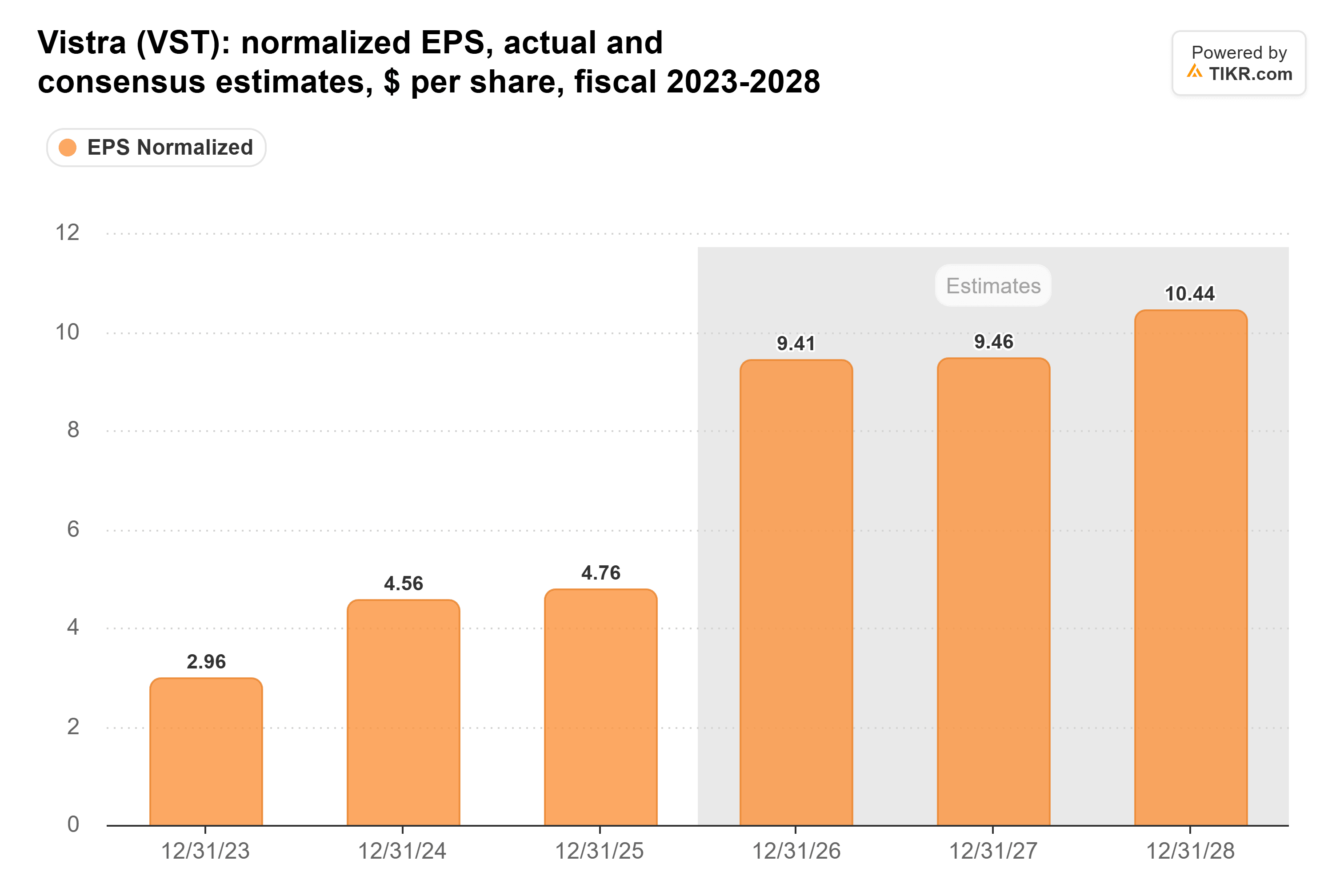
Vistra had about 98% of its expected 2027 generation hedged by October 30, so those estimates don’t need Mensch to be wrong.
TIKR Tracks 24 Analysts on Vistra. How Many Say “Buy”?
See the full breakdown of Buy, Hold, and Sell ratings on Vistra, along with Wall Street’s revenue and earnings estimates, all in one place. More than 500,000 investors use TIKR to research stocks like this one. See Vistra’s Analyst Ratings
Constellation Stock Still Carries Some of the Premium
Constellation’s forward P/E has fallen from a 38x peak on October 29, 2025, to 21x on November 6, below its three-year average of 26x. But it’s still well above the 16x it traded at in December 2023.
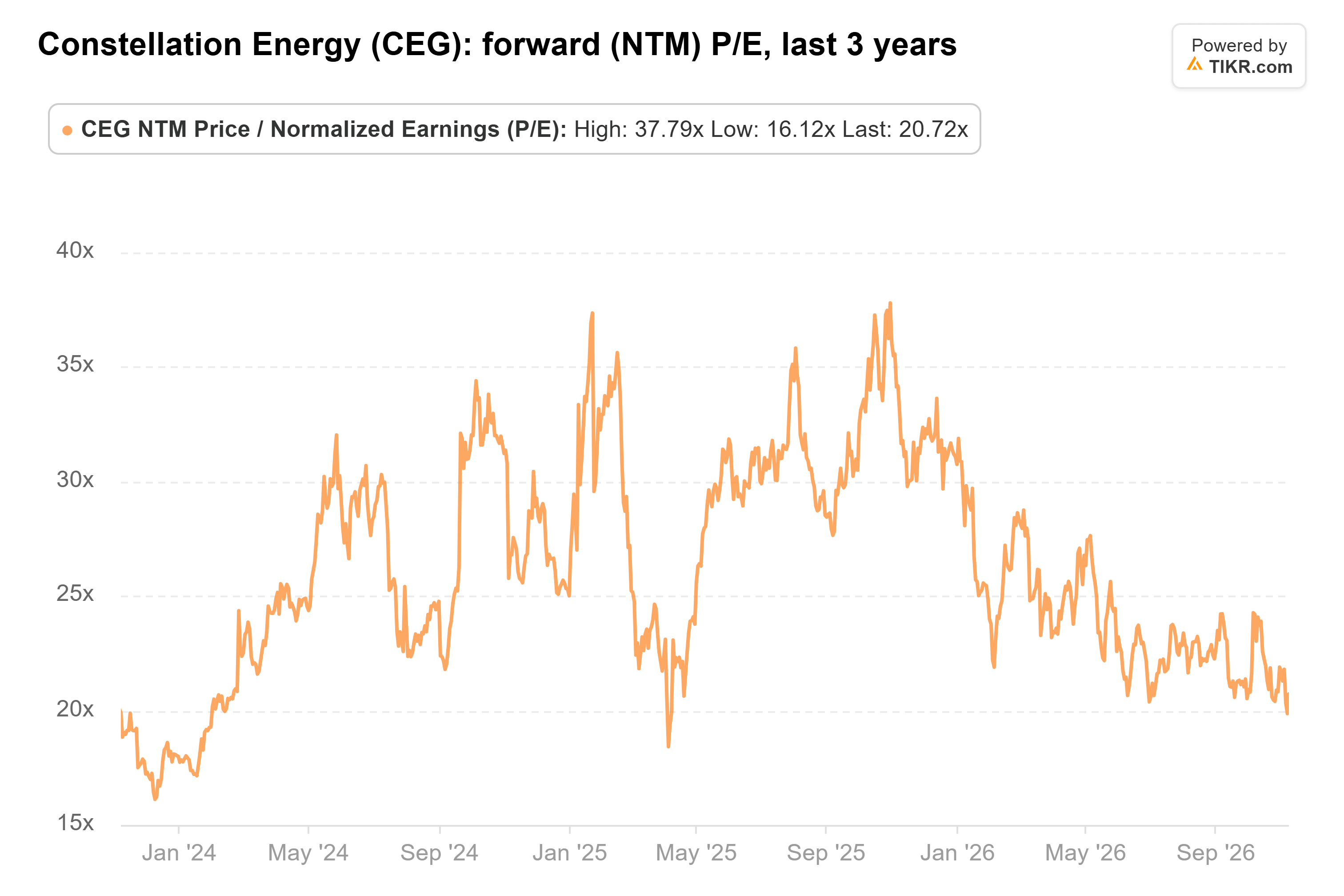
Constellation’s earnings base has changed since 2023, so not all of that gap is a scarcity bet. Part of it, though, looks like a bet on stronger future power prices. Mensch was talking about Europe and Burke about Texas, so neither puts a date on that for Constellation’s own markets.
The Other Bottleneck Is the Plug
Data center suppliers do see a power problem today. On Navitas Semiconductor’s third-quarter call, CEO Chris Allexandre said adding capacity requires “breaking the power wall.” Burke said “there is load that’s approved to energize, but it has not been allowed to energize.” Gov. Greg Abbott froze grid approvals for new data centers on August 3 pending an audit, with ERCOT’s queue above 474 GW, mostly data centers. Gov.-elect Gina Hinojosa, who wants an immediate halt to new data center projects, takes office in January.
Where That Leaves Vistra and Constellation Stock
Mensch gave power bulls a date for Europe, and Burke points to a similar one for Texas. Until then, I’d value power producers on their hedges and current forward curves, with no extra price upside, which is how Vistra builds its outlook. At 21x, I’d want to see stronger pricing in Constellation’s own markets before paying that premium, and neither Mensch nor Burke has put a date on it. The risk to that cautious view is Texas: Burke thinks ERCOT could beat the curves if waiting load gets hooked up sooner, so the audit and Hinojosa’s first moves in January matter most.
So What is Vistra Stock Actually Worth?
TIKR lets you forecast the future price of any stock in less than a minute. Just enter a few assumptions into TIKR’s valuation model and see what Vistra could be worth. Start from Wall Street consensus estimates, or adjust the inputs to reflect your own view of the business. It’s free to use.
Disclaimer:
Please note that the articles on TIKR are not intended to serve as investment or financial advice from TIKR or our content team, nor are they recommendations to buy or sell any stocks. We create our content based on TIKR Terminal’s investment data and analysts’ estimates. Our analysis might not include recent company news or important updates. TIKR has no position in any of the stocks mentioned. Thank you for reading, and happy investing!