Key Takeaways
- Vistra’s CFO sees about 70% growth in adjusted free cash flow before growth per share from 2027 to 2030.
- The outlook only includes contracts Vistra has already signed and today’s forward power prices. It assumes no new data center deals.
- A large part of the per-share growth comes from an assumed $3 billion a year of buybacks, and Texas power prices have been falling.
- Vistra trades at 13x forward earnings, below its five-year average of 15x, so investors aren’t paying anything extra for AI upside.
Vistra (VST) traded like a pure bet on Texas data centers during election week.
Shares fell 14% after Texans elected Gina Hinojosa governor. She has pledged a moratorium on new data centers. (Gov. Greg Abbott had already frozen grid-connection approvals for data centers in August.)
But on Vistra’s third-quarter call on Nov. 6, CEO Jim Burke said “the pacing was already being impacted ahead of the election, but our plans have always had a more conservative view of the AI build-out.”
Then CFO Kristopher Moldovan put a number on those plans: “we have line of sight to approximately 70% growth in adjusted free cash flow before growth per share from 2027 to 2030.”
That’s a lot of growth for a stock the market just dumped over data centers.
TIKR tracks 23 analysts on Vistra. How many say “Buy”?
See the full breakdown of Buy, Hold, and Sell ratings on Vistra, along with Wall Street’s revenue and earnings estimates, all in one place. More than 500,000 investors use TIKR to research stocks like this one. See Vistra’s Analyst Ratings
The plan counts only what Vistra has signed
Moldovan built that outlook on “the actions we’ve already taken to date.” That means the Amazon Web Services deal at the Comanche Peak nuclear plant, Meta’s contract for capacity at Davis-Besse and the finished Permian peaker plants, all priced off current forward curves. Several sources of upside aren’t in it: the last step of the Amazon ramp in 2032, the PJM nuclear uprates that start in 2031 and any deal Vistra hasn’t signed yet. In the nearer term, Moldovan sees free cash flow per share rising from just under $10.50 in 2025 to about $14 in 2027, using the midpoint of the company’s new 2027 guidance.
Analysts expect free cash flow on TIKR’s standard basis to reach $5.12 billion by 2028:
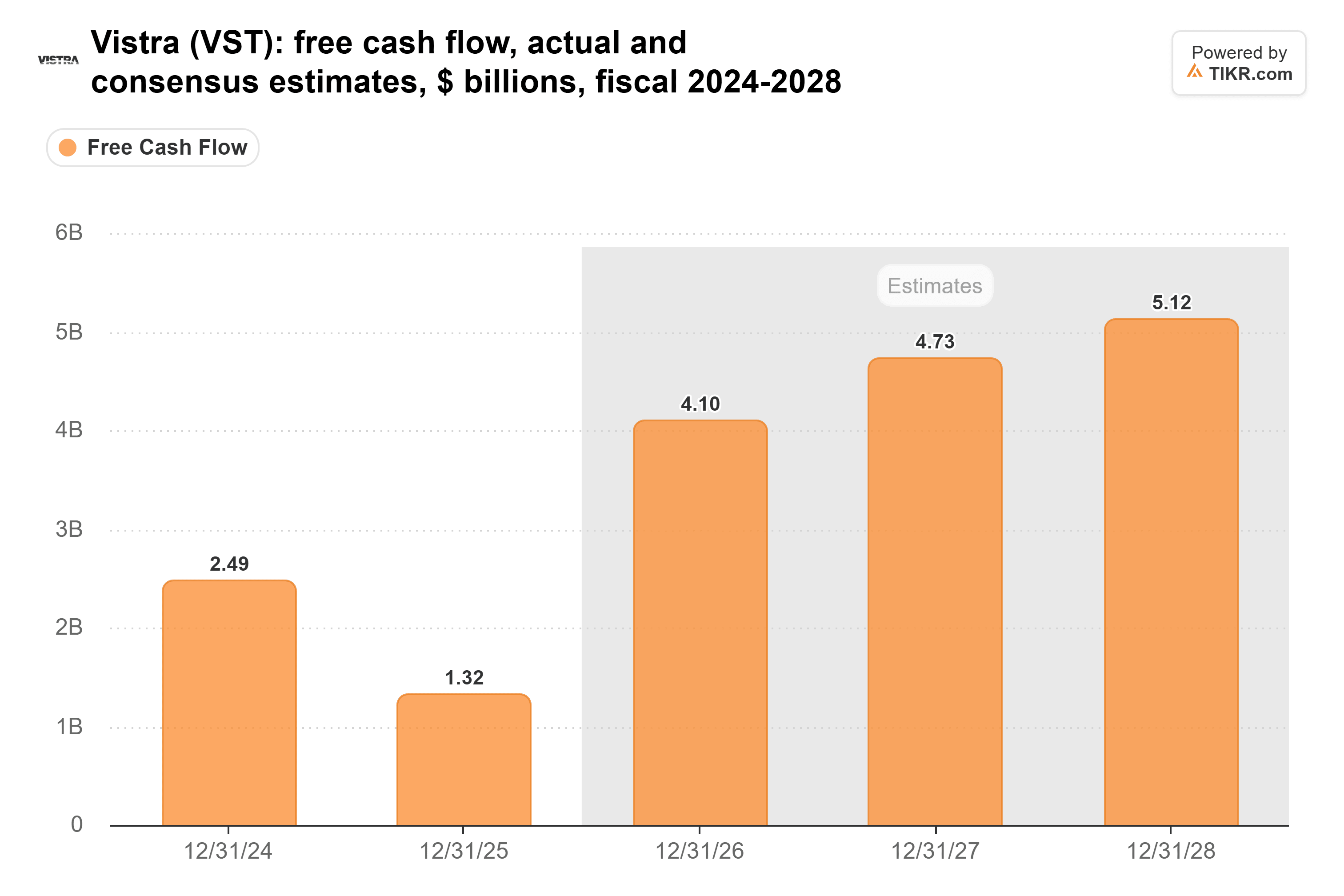
(The 2025 dip came mostly from collateral. Vistra posted $769 million of cash against its hedges that year, after getting $842 million back in 2024.) And I don’t see anything in the new 2027 outlook that should push those estimates down.
The queue was always overstated
On the call, Burke said “load interconnect queues were overstated across the country and especially in ERCOT, driven by speculation from developers.” The Texas numbers back him up. ERCOT is weighing about 474 GW of connection requests, roughly 90% of them from data centers, while the grid’s record peak this year was about 91 GW.
That’s more than five times the most power Texas has ever drawn at once.
Burke kept Vistra’s load forecast in place after the election: 4% to 6% growth in ERCOT and 2% to 3% in PJM through 2030. He said utilities are seeing pent-up demand from manufacturing, government and oil and gas as well as AI. The weak spot is Texas power prices. Burke blamed their recent slide on crypto miners going offline to convert into data centers and on the state’s audit and permitting pause, and he doesn’t expect a long-term impact. The outlook uses current forward curves, so today’s lower prices are already in it.
A big share of that 70% is buybacks
The growth is per share, and Vistra plans to shrink its share count fast. Moldovan said Vistra will still have roughly $2 billion a year to spare after $1 billion a year of buybacks, $300 million of dividends and its announced growth projects. The forecast puts all of that extra cash into buybacks: “we’re effectively in this chart, assuming a roughly $3 billion a year of share repurchases.”
Vistra already cut its diluted share count by more than a quarter from 2021 to 2025:
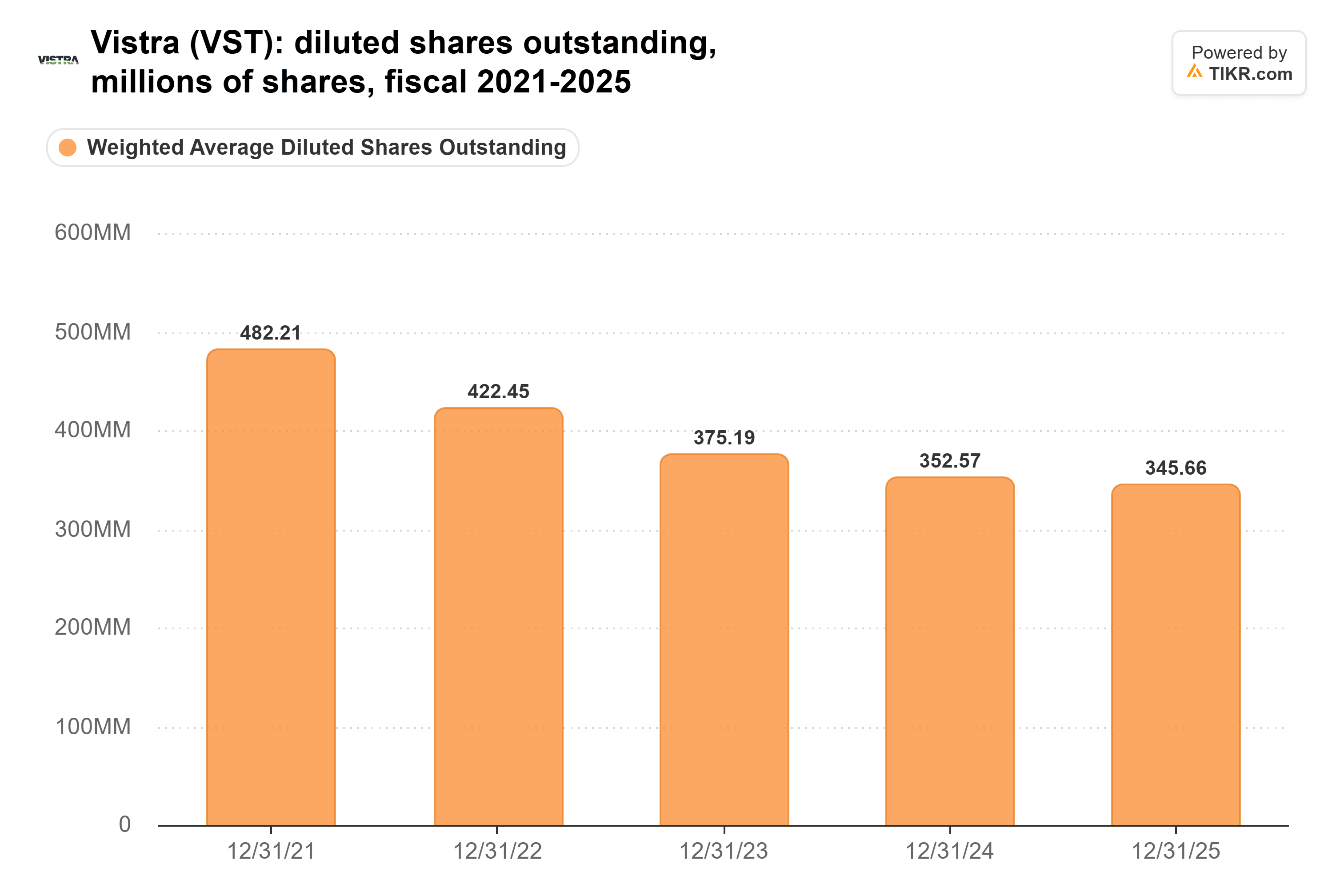
But the number of shares each dollar retires depends on the stock price. In 2023, $1.26 billion of buybacks retired 45.0 million shares at $27.89 each. In 2025, $1.01 billion retired just 6.55 million at $154.00. So a cheaper stock helps. Moldovan worked out his 2027 figure at the Nov. 2 share price, before the vote, and the board just added $1.5 billion to the buyback.
The market isn’t paying for AI
Vistra’s forward P/E is 13x, below its five-year average of 15x and far from the 37x it hit in August 2025:
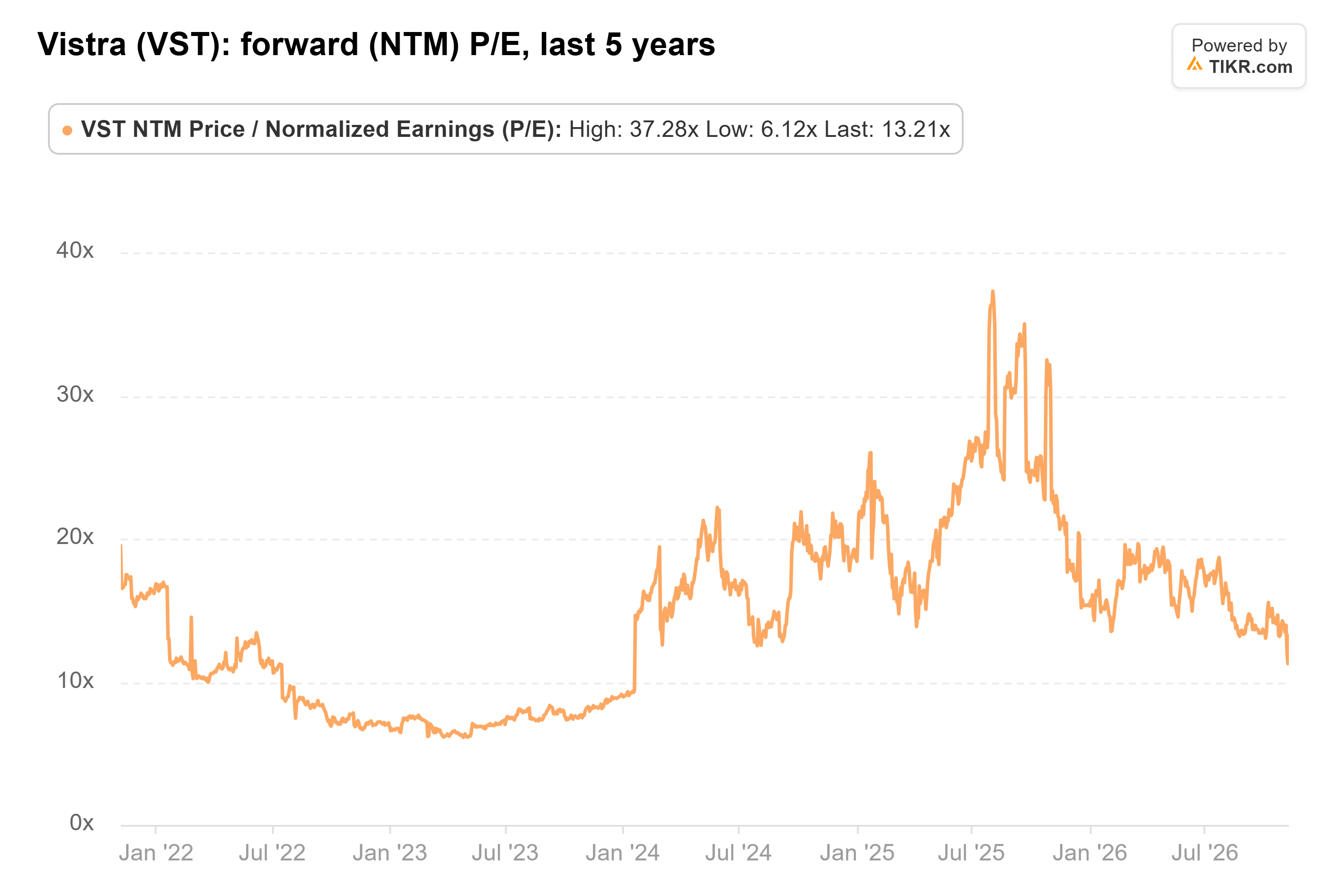
At that multiple, investors are paying for plants Vistra already runs, contracts it has signed and a buyback it can fund. Any new AI deals come free. I’d be a buyer here, because the sell-off punished Vistra for a Texas data center queue its own outlook never counted on.
Texas is still the risk to watch. About 98% of Vistra’s expected 2027 output was hedged by Oct. 30. But Burke said Vistra is much less hedged in ERCOT for 2028, so lower Texas prices would show up there first. And Comanche Peak still has 1,200 MW without a long-term buyer, in a state whose next governor takes office in January.
So what is Vistra stock actually worth?
TIKR lets you forecast the future price of any stock in less than a minute. Just enter a few assumptions into TIKR’s valuation model and see what Vistra could be worth. Start from Wall Street consensus estimates, or adjust the inputs to reflect your own view of the business. It’s free to use.
Disclaimer:
Please note that the articles on TIKR are not intended to serve as investment or financial advice from TIKR or our content team, nor are they recommendations to buy or sell any stocks. We create our content based on TIKR Terminal’s investment data and analysts’ estimates. Our analysis might not include recent company news or important updates. TIKR has no position in any of the stocks mentioned. Thank you for reading, and happy investing!