Key Takeaways
- Merck raised its 2026 sales outlook on Aug. 4, the same day Amgen reported second-quarter revenue up 10%.
- Both dividends are well-covered, each using 52% of free cash flow over the twelve months to June 30, 2026.
- Amgen yields 2.5% to Merck’s 2.4% and raised its dividend 8% a year from fiscal 2020 to fiscal 2025, against 6% a year at Merck.
- Amgen carries more debt, at 2.5x net debt to EBITDA against 1.6x at Merck.
On Aug. 4, Merck (MRK) raised and narrowed its 2026 sales outlook to $66.3 billion to $67.3 billion. The same day, Amgen (AMGN) reported second-quarter revenue up 10% to $10.1 billion.
For income investors, those results back two dividends that look nearly identical: a 2.4% yield at Merck and 2.5% at Amgen, each using 52% of its free cash flow over the twelve months to June 30, 2026.
So what separates them is how fast each check grows from here, and what’s behind it. Which one pays you more over the next 10 years?
| Metric | Merck (MRK) | Amgen (AMGN) |
|---|---|---|
| Dividend yield | 2.4% | 2.5% |
| Annual dividend | $3.40 | $10.08 |
| Dividend growth, fiscal 2020–2025 | 5.8% a year | 8.3% a year |
| Dividend growth, fiscal 2015–2025 | 6.2% a year | 11.7% a year |
| Cash dividend payout ratio (TTM to June 30, 2026) | 52% | 52% |
| Net debt/EBITDA (LTM) | 1.6x | 2.47x |
| Interest coverage (LTM) | 13.47x | 4.14x |
Merck has room to spare, most years
Merck’s sales grew beyond its biggest drug in the second quarter of 2026, rising 5% to $16.6 billion, with Keytruda at $8.4 billion, Winrevair up 75% to $588 million and Animal Health up 8% to $1.8 billion.
On the Aug. 4 call, CFO Caroline Litchfield said, “We remain committed to the dividend with the goal of increasing it over time.” The cash backs her up: the dividend used a well-covered 52% of free cash flow over the twelve months to June 30, 2026.
The longer record is bumpier, though. Dividends paid rose from $5.12 billion in fiscal 2016 to $8.18 billion in fiscal 2025. Free cash flow ranged from $4.56 billion in fiscal 2017 to $18.1 billion in fiscal 2024, and it fell short of the dividend in fiscal 2017 and fiscal 2020.
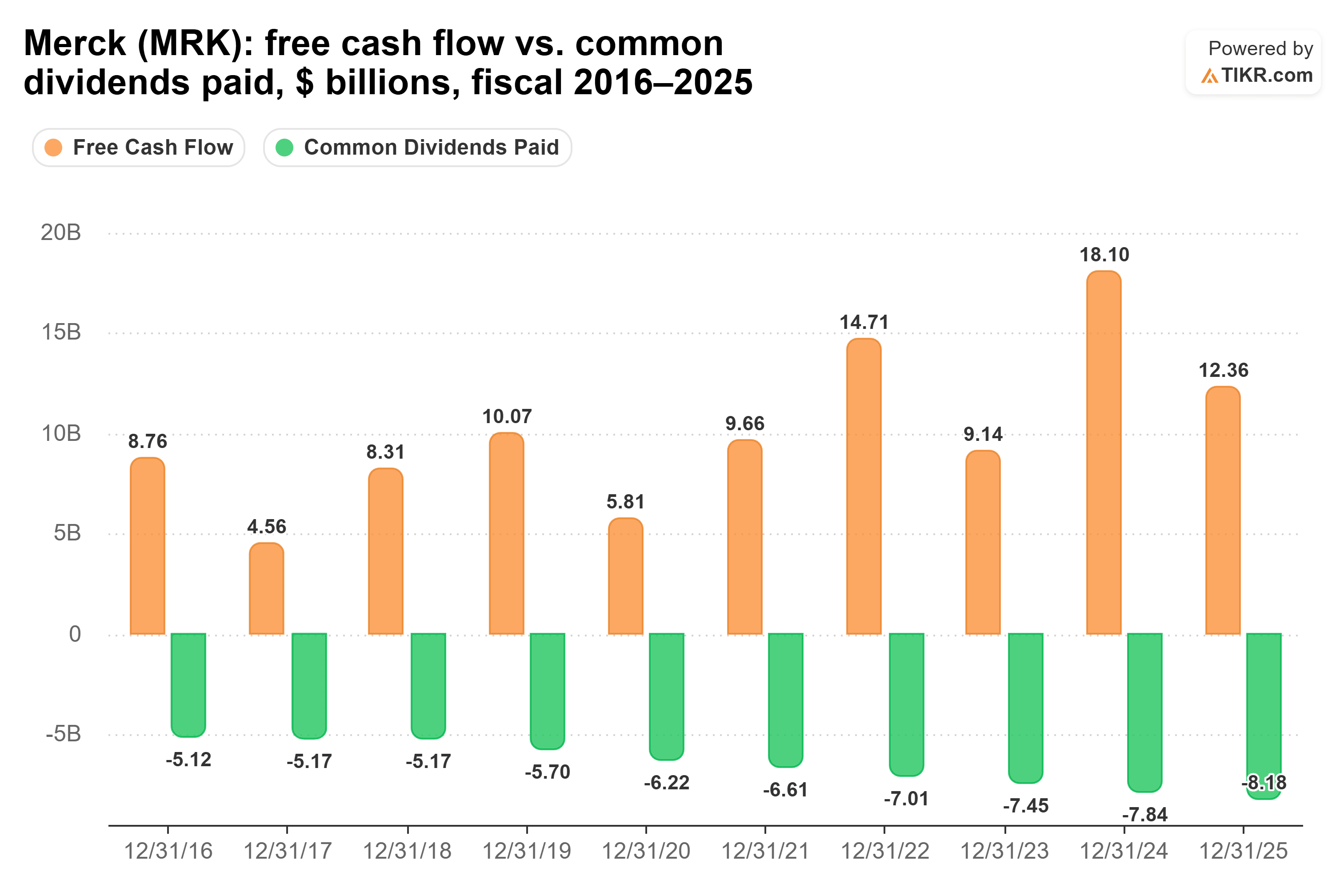
The risk is everything else that wants that cash. Merck completed its $6.8 billion Terns Pharmaceuticals acquisition by the Aug. 4 call, and it’s on pace for about $3 billion of buybacks this year.
Amgen grows faster, on more debt
Amgen covers its dividend just as well as Merck, and its business grew faster in the same quarter. Second-quarter 2026 revenue rose 10%, and its six key growth drivers, from Repatha to biosimilars, grew 26%.
Free cash flow was $3.5 billion in the second quarter of 2026, up from $1.9 billion in the same quarter of 2025. The $2.52 quarterly dividend was 6% above the same quarter of 2025.
Over the decade, the dividend has outgrown the cash behind it. Dividends paid rose from $3.00 billion in fiscal 2016 to $5.12 billion in fiscal 2025. Free cash flow was $9.62 billion in fiscal 2016 and $8.10 billion in fiscal 2025…

…though free cash flow covered the dividend in all 10 years.
The bigger risk is debt: Amgen had $57.3 billion of it against $14.0 billion of cash on June 30, 2026. Over the last twelve months, that worked out to 2.47x net debt to EBITDA and 4.14x interest coverage, against 1.6x and 13.47x at Merck. On the Aug. 4 call, CEO Robert Bradway said a “sound financial structure” gives Amgen “the flexibility to invest with discipline.” The structure is sound, but it has a lot less cushion than Merck’s.
So which dividend wins?
Amgen pays you more over the next 10 years. At each stock’s 5-year dividend growth rate, 8.3% a year at Amgen and 5.8% at Merck, $10,000 in Amgen pays about $3,668 over the decade, against about $3,127 from Merck.
Even at the pace each dividend grew in fiscal 2025, 5.8% at Amgen and 5.1% at Merck, Amgen pays about $3,261 over the decade to Merck’s $3,037.
And Amgen looks able to keep raising. Its payout leaves it as much room as Merck’s, and it expects $38.2 billion to $39.4 billion of revenue in 2026.
That isn’t to say Merck’s dividend is the weaker bet. It carries far less debt, its sales outlook went up in August, and its CFO has committed to raising the dividend over time. But Amgen pays more today, has raised faster for a decade and covers its dividend just as well. Over 10 years, that adds up to more income.
Of course, Amgen’s dividend has grown faster than its free cash flow since fiscal 2016, so watch its next raise. One well below this year’s 6% would shrink its lead.
So what is Amgen stock actually worth?
TIKR lets you forecast the future price of any stock in less than a minute. Just enter a few assumptions into TIKR’s valuation model and see what Amgen could be worth. Start from Wall Street consensus estimates, or adjust the inputs to reflect your own view of the business. It’s free to use.
Disclaimer:
Please note that the articles on TIKR are not intended to serve as investment or financial advice from TIKR or our content team, nor are they recommendations to buy or sell any stocks. We create our content based on TIKR Terminal’s investment data and analysts’ estimates. Our analysis might not include recent company news or important updates. TIKR has no position in any of the stocks mentioned. Thank you for reading, and happy investing!