Key Takeaways
- AT&T yields 4.6% and plans to hold its dividend at $1.11 a share, while Comcast yields 6.5% after raising its dividend 7.5% a year from fiscal 2020 to fiscal 2025.
- Over the twelve months to June 30, 2026, AT&T’s dividend took 45% of its free cash flow, and Comcast’s took 24%.
- Analysts expect Comcast’s free cash flow to fall in fiscal 2026, which would raise its dividend to 36% of free cash flow, against 46% at AT&T.
- Comcast plans to separate NBCUniversal and Sky in a spin-off within about a year and hasn’t yet set a dividend policy for the two companies.
Retirees living off their portfolios want a dividend check they can count on, and two of the biggest names in connectivity are offering very different checks right now.
AT&T (T) yields 4.6% and plans to hold its dividend at $1.11 a share while returning $45 billion+ to shareholders from 2026 to 2028. Comcast (CMCSA) pays more, at 6.5%. But it plans to separate NBCUniversal and Sky in a spin-off within about a year, and it hasn’t said what its dividend will look like after that.
So which is the better dividend stock for retirees?
| Metric | AT&T (T) | Comcast (CMCSA) |
|---|---|---|
| Dividend yield | 4.6% | 6.5% |
| Annual dividend | $1.11 | $1.32 |
| Dividend growth a year, fiscal 2020–2025 | -11.8% | 7.5% |
| Cash dividend payout ratio, TTM to June 30, 2026 | 45% | 24% |
| Cash dividend payout ratio, fiscal 2026 consensus | 46% | 36% |
| Net debt/EBITDA, LTM | 2.91x | 2.35x |
| Forward P/E, NTM | 10.1x | 6.0x |
AT&T: a steady $1.11, with room to spare
AT&T’s dividend fell from $2.08 a share in fiscal 2020 to $1.11 in fiscal 2025, and management plans to keep it there. At that level it’s well-covered. It took 45% of free cash flow over the twelve months to June 30, 2026, and it takes 46% on analysts’ fiscal 2026 consensus. In each fiscal year from 2023 to 2025, it took between 40% and 44% of free cash flow.

The business behind the dividend is growing. Second-quarter 2026 revenue rose 2.3% from a year earlier to $31.6 billion, and service revenue from fiber and wireless rose 5.1% as AT&T retires its copper network. As CEO John Stankey put it, “where we have fiber, we win with fiber and wireless.”
Management expects free cash flow of $18 billion+ in 2026, rising to $21 billion+ in 2028. It plans to spend essentially all of this year’s free cash flow on dividends and buybacks. The main risk is debt. Net debt is 2.91x EBITDA over the last twelve months, and AT&T expects that ratio to rise after its EchoStar deal closes. It then expects to return to its 2.5x target range within about three years.
Comcast: a bigger check, with a breakup ahead
Comcast’s dividend has gone the other way, rising from $0.92 a share in fiscal 2020 to $1.32 in fiscal 2025, or 7.5% a year. By TIKR’s figures, it has gone up every fiscal year for 17 years through fiscal 2025. It also took a slim 24% of free cash flow over the twelve months to June 30, 2026.
Free cash flow rose from $10.5 billion in fiscal 2016 to $21.9 billion in fiscal 2025. Dividends paid grew more slowly, from $2.60 billion to $4.89 billion.

Analysts expect less in fiscal 2026. Their $13.8 billion consensus would raise the dividend’s share of free cash flow to 36%. The second quarter shows the pressure: adjusted EBITDA fell 13.4% from a year earlier. Domestic broadband revenue fell 5.5% on lower rates and customer losses as Comcast reworked its pricing. Still, 17 analysts make the estimate, and last year’s consensus came within 12% of the actual.
The bigger question is the separation. Comcast has paused buybacks until the separation is done. In July, CFO Jason Armstrong said the company will “take the coming months, obviously, to work through capital allocation, capital structure policies.” Meanwhile, its debt is lighter than AT&T’s, at 2.35x EBITDA over the last twelve months.
So which dividend wins?
For retirees, Comcast is the better dividend stock. On $10,000, it pays $650 a year today, against $460 from AT&T. Its dividend also takes less of its free cash flow, both over the last twelve months (24% against 45%) and on fiscal 2026 estimates (36% against 46%).
At each dividend’s pace now (no raise at AT&T in fiscal 2025, a 6.5% raise at Comcast), the gap widens. In year 10, that $10,000 would pay about $1,141 a year from Comcast, an 11.4% yield on today’s money, against about $460 from AT&T.
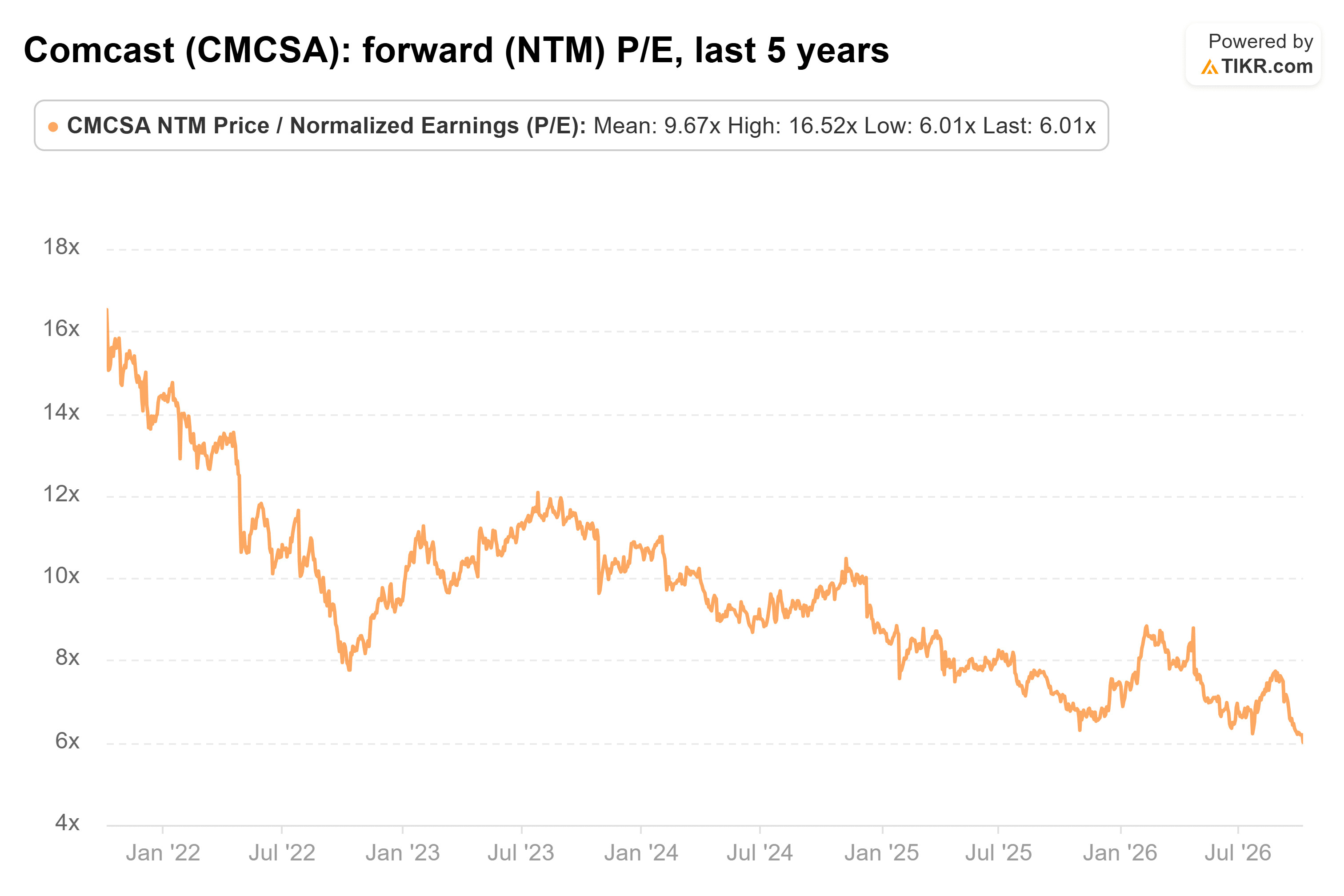
Retirees also get that yield cheaply. Comcast trades at 6.0x forward earnings, its five-year low, against a 9.7x average and a 16.5x high in October 2021.
That isn’t to say AT&T’s dividend is in danger. Its business is growing, its free cash flow guidance rises every year through 2028, and it has no breakup to work through. It’s just that Comcast pays $190 more a year on the same $10,000. It also has more room to spare, even if analysts’ lower free cash flow estimate comes true.
Of course, the separation could still change the picture. Comcast said in July that it aims to finish the separation in about a year, and what each company will pay is the announcement to watch.
So what is Comcast stock actually worth?
TIKR lets you forecast the future price of any stock in less than a minute. Just enter a few assumptions into TIKR’s valuation model and see what Comcast could be worth. Start from Wall Street consensus estimates, or adjust the inputs to reflect your own view of the business. It’s free to use.
Disclaimer:
Please note that the articles on TIKR are not intended to serve as investment or financial advice from TIKR or our content team, nor are they recommendations to buy or sell any stocks. We create our content based on TIKR Terminal’s investment data and analysts’ estimates. Our analysis might not include recent company news or important updates. TIKR has no position in any of the stocks mentioned. Thank you for reading, and happy investing!