


Key Takeaways
- Bristol Myers Squibb yields 4.3% and CVS Health yields 3.1%, and both companies raised their 2026 outlooks this summer.
- Over the 12 months to June 30, 2026, Bristol Myers paid out 45% of its free cash flow as dividends, against 29% for CVS.
- CVS carries net debt of 3.2x EBITDA, against 1.7x for Bristol Myers, and its dividend per share didn’t rise in fiscal 2025.
- CVS says it will weigh more cash returns as its leverage improves, so that leverage is the figure to watch.
Any retiree hunting for dividend income wants a check that shows up every quarter and grows every year.
Bristol Myers Squibb (BMY) and CVS Health (CVS) both raised their 2026 outlooks this summer. Bristol Myers yields 4.3%, and CVS yields 3.1%.
So which is the better dividend stock for a retiree?
| Metric | Bristol Myers Squibb (BMY) | CVS Health (CVS) |
|---|---|---|
| Dividend yield | 4.3% | 3.1% |
| Annual dividend, current rate | $2.52 | $2.66 |
| Dividend growth, fiscal 2020–2025 | 6.2% a year | 5.9% a year |
| Cash dividend payout ratio (TTM to June 30, 2026) | 45% | 29% |
| Net debt/EBITDA (LTM) | 1.74x | 3.17x |
Bristol Myers is outgrowing its generics
Bristol Myers’ revenue rose 6% to $13.0 billion in the second quarter of 2026. Its Growth Portfolio grew 15% to $7.6 billion. That more than made up for a Legacy Portfolio that fell 4% to $5.4 billion as generics hit drugs like Revlimid and Pomalyst. Management raised its 2026 revenue guidance to about $49.0 billion to $50.0 billion.
Over the 12 months to June 30, 2026, Bristol Myers paid $5.09 billion in dividends out of $11.44 billion of free cash flow. That’s a comfortable 45% cash dividend payout ratio. Free cash flow held between $12.0 billion and $15.2 billion in every fiscal year from 2020 to 2025, while dividends paid rose from $4.08 billion to $5.05 billion.

By TIKR’s figures, dividends per share have risen 18 fiscal years in a row through fiscal 2025. CFO David Elkins reaffirmed the company’s “commitment to the dividend” on the July 30 call.
The main risk is that trailing free cash flow of $11.44 billion already sits below that range, so the newer drugs have to keep outrunning the generics.
CVS is still rebuilding
Bristol Myers’ cash has held steady. CVS’s has swung, though it’s recovering fast.
Second-quarter 2026 revenue rose 7.3% to $106.1 billion. Adjusted EPS jumped to $2.58 from $1.81 a year earlier as Aetna’s margins recovered. Management raised its 2026 guidance for cash flow from operations to at least $11.5 billion, from at least $9.5 billion.
The dividend is very well-covered today. CVS paid $3.42 billion out of $11.76 billion of free cash flow over the 12 months to June 30, 2026, a 29% cash dividend payout ratio. But free cash flow fell from $15.8 billion in fiscal 2021 to $6.33 billion in fiscal 2024, then recovered to $7.81 billion in fiscal 2025.

The dividend stalled along the way. CVS paid $2.66 a share in fiscal 2025, no more than the year before, and that’s still its current rate. Over the decade, though, its dividend grew faster than Bristol Myers’: 6.6% a year from fiscal 2015 to fiscal 2025, against 5.3%.
The main risk is debt, at 3.17x EBITDA over the last twelve months against 1.74x for Bristol Myers.
So which dividend wins?
For retirees, Bristol Myers Squibb is the better dividend stock. It pays the bigger check, and it has steadier cash and a lighter balance sheet behind it.
Start with the income. $10,000 in Bristol Myers pays $430 a year at its 4.3% yield, against $310 for CVS.
At each stock’s 5-year rate, that grows to about $741 in year 10 for Bristol Myers. That’s a 7.4% yield on the original $10,000, against about $518, or 5.2%, for CVS.
At each dividend’s pace now, the gap is wider: Bristol Myers raised 2.9% in fiscal 2025, and CVS didn’t raise at all. At those rates, year 10 pays about $556 against $310. At either pace, CVS’s income never catches up.
CVS’s dividend looks safe. Its 29% payout ratio is far lower than Bristol Myers’ 45%, and the raised cash flow guidance points to more cash this year. What CVS still has to fix is its balance sheet. Net debt rose from 2.4x EBITDA in fiscal 2022 to 4.6x in fiscal 2024, and it was still 3.9x in fiscal 2025.
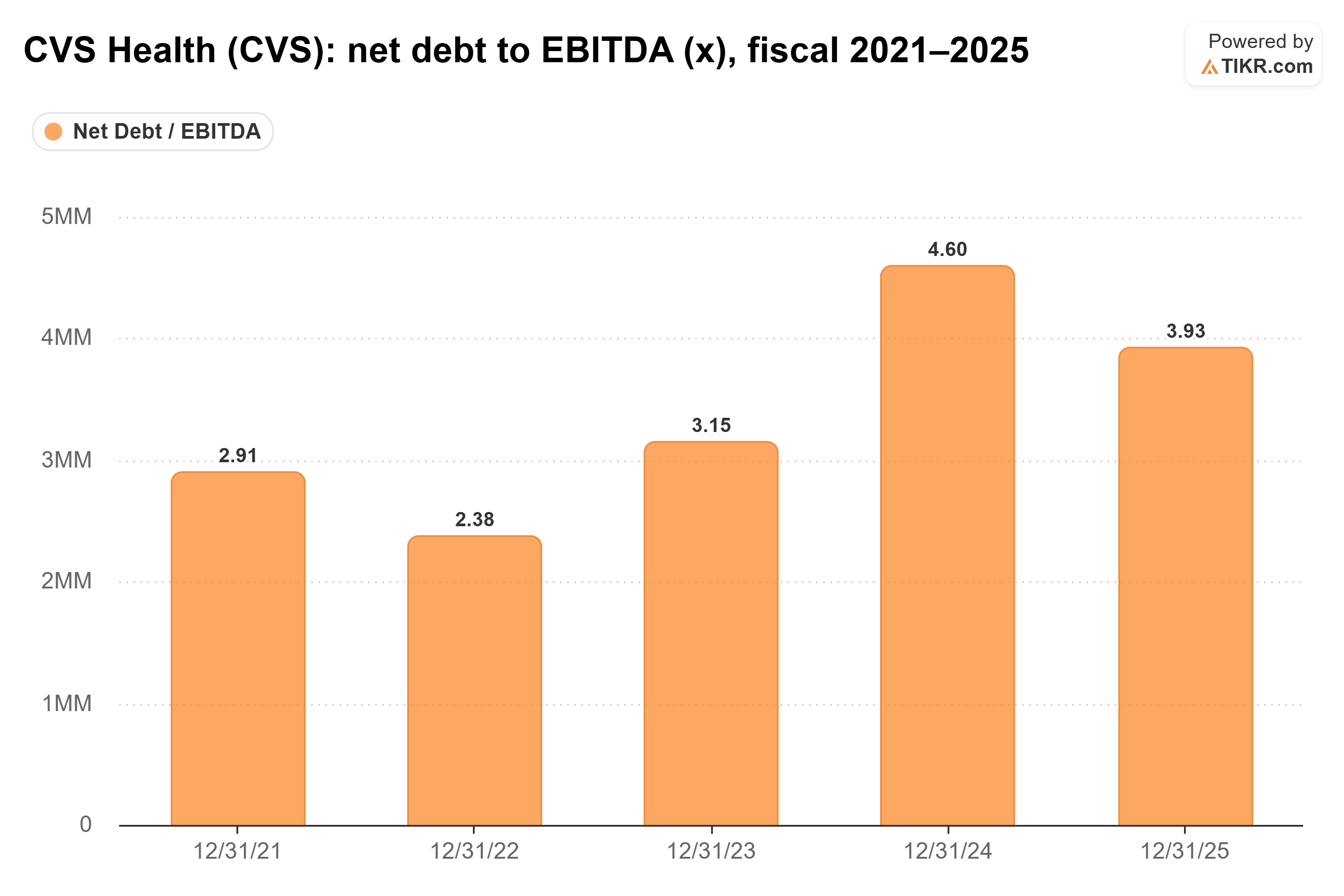
As CFO Brian Newman put it on the Aug. 5 call: “We will continue to evaluate capital deployment opportunities as our leverage position improves.”
It’s just that, for a retiree counting on that check, I’d rather own the company that pays more today. Bristol Myers kept raising last year, and it has no balance sheet to fix first.
Of course, CVS’s leverage is coming down. If its raises resume, this answer could change.
So what is Bristol Myers Squibb stock actually worth?
TIKR lets you forecast the future price of any stock in less than a minute. Just enter a few assumptions into TIKR’s valuation model and see what Bristol Myers Squibb could be worth. Start from Wall Street consensus estimates, or adjust the inputs to reflect your own view of the business. It’s free to use.
Value Bristol Myers Squibb for free
Disclaimer:
Please note that the articles on TIKR are not intended to serve as investment or financial advice from TIKR or our content team, nor are they recommendations to buy or sell any stocks. We create our content based on TIKR Terminal’s investment data and analysts’ estimates. Our analysis might not include recent company news or important updates. TIKR has no position in any of the stocks mentioned. Thank you for reading, and happy investing!


