Key Takeaways
- An $850,000 portfolio split evenly across Verizon, Enterprise Products Partners and UPS pays about $51,200 a year in dividends, or about $4,270 a month.
- Verizon and Enterprise Products have plenty of cash behind their payouts, from businesses that are still growing.
- UPS’s dividend is the stretched one: it took 85% of free cash flow over the past year, though management expects that cash to keep rising.
- If UPS halved its dividend, the portfolio’s income would fall to about $42,900 a year. If it stopped paying, the income would fall to about $34,500.
A 6% yield is hard to ignore when your dividends pay the bills.
Take a hypothetical retiree who splits $850,000 evenly across Verizon Communications (VZ), Enterprise Products Partners (EPD) and United Parcel Service (UPS). At today’s prices, that buys about 6,130 shares of Verizon, 7,643 units of Enterprise and 2,557 shares of UPS.
Together, they pay about $51,200 a year in dividends, or about $4,270 a month. That’s a 6.0% yield on this part of the portfolio. (Of course, no one should ever own just three stocks.) Here’s how the income breaks down:
| Stock | Shares | Cost | Income a year | Share of income | Coverage, latest / forward |
|---|---|---|---|---|---|
| Verizon (VZ) | 6,130 | $283,329 | $17,348 | 34% | 52% / 53% of free cash flow |
| Enterprise Products (EPD) | 7,643 units | $283,326 | $17,120 | 33% | 1.69x / 1.86x distributable cash flow |
| UPS (UPS) | 2,557 | $283,316 | $16,774 | 33% | 85% / 88% of free cash flow |
| Total | $51,242 |
Source: TIKR. Prices are at 1:47 p.m. ET on Nov. 10, 2026, and dividends are at each company’s current annual rate. Verizon’s and UPS’s coverage is the cash dividend payout ratio, for the 12 months to Sept. 30, 2026, and on fiscal 2026 consensus. Enterprise’s coverage is for fiscal 2025, and on fiscal 2026 consensus.
6 safe dividend stocks paying retirees 6%+ yields
There are over 100 stocks paying 6%+ annual dividends today.
But after an extensive investment review leveraging TIKR’s proprietary data, we now believe only six of them are truly safe for retirees.
They’re all yours for free as part of our new investment report, which you can access right here.
Verizon is adding phones without buying them
Verizon’s dividend check rests on a wireless business that’s growing again. It added 406,000 postpaid phones in the third quarter of 2026. CEO Dan Schulman says it isn’t paying up for them: “Net adds are easy if your cost of acquisition goes way up and you give away a free line. I don’t consider free lines to even be net adds.”
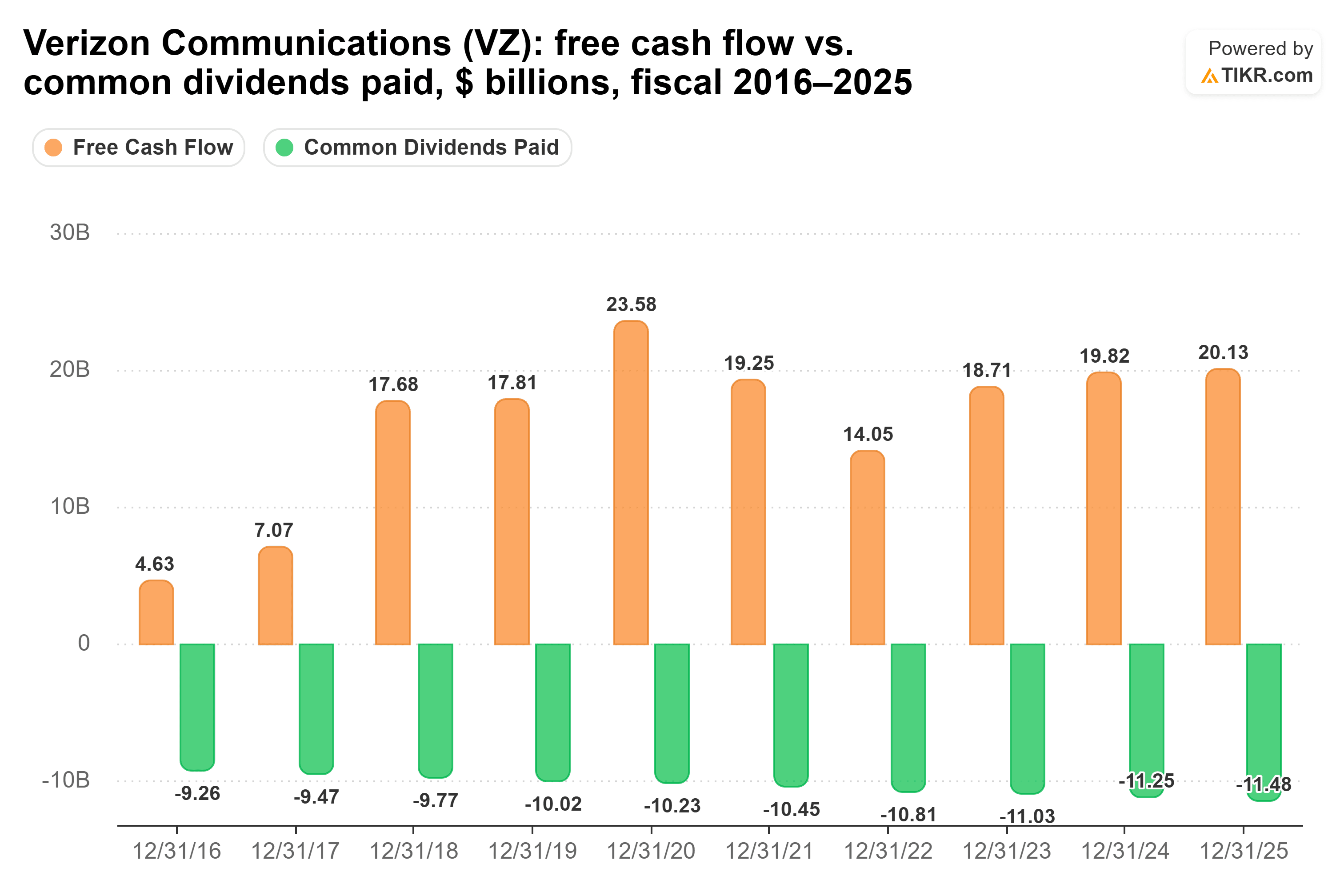
Free cash flow was $7.8 billion in the quarter, up 12.1% from a year before. That leaves the dividend well-covered: it took 52% of free cash flow over the 12 months to Sept. 30, 2026, and takes 53% on fiscal 2026 consensus. Free cash flow has topped dividends every year since fiscal 2018, and in fiscal 2025 it reached $20.1 billion against $11.5 billion of dividends:
The trade-off is growth. Verizon’s dividend rose just 1.9% a year from fiscal 2020 to fiscal 2025, from $2.48 to $2.73 a share, though management says it remains “committed to growing the dividend.”
Enterprise has the most room to spare
Enterprise is an MLP, so it pays distributions on units and sends a K-1 at tax time. Its cash comes from moving more natural gas out of the Permian Basin, where its processing volumes hit a record 4.6 billion cubic feet a day in the third quarter, up 12% from a year before. Distributable cash flow covered fiscal 2025’s distributions 1.69x, and analysts expect 1.86x for fiscal 2026.
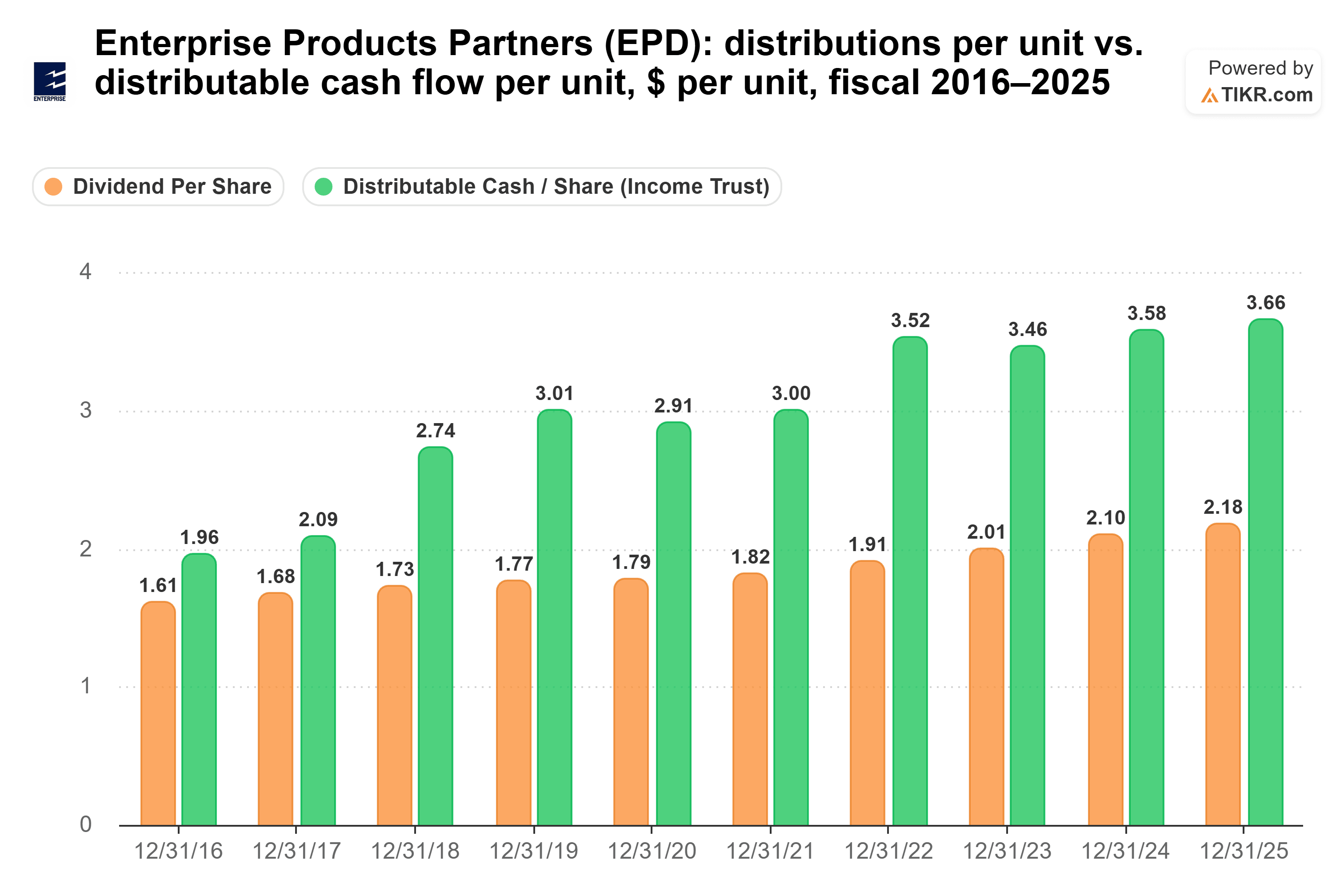
That cushion has widened over the past decade. Distributable cash flow per unit rose from $1.96 in fiscal 2016 to $3.66 in fiscal 2025, while distributions went from $1.61 to $2.17:
The raises are getting smaller, though. From fiscal 2020 to fiscal 2025, the distribution grew 4.0% a year, from $1.78 to $2.17 a unit, and October’s increase was 2.8% over a year before. Management also says 2027’s EBITDA growth may be “more modest” than 2026’s.
UPS is giving up volume to make more per box
UPS is deliberately cutting lower-margin Amazon volume, so its US average daily volume fell 3.3% in the third quarter. US Domestic revenue still rose to $14.9 billion, from $14.2 billion a year before, though its operating margin slipped to 7.6% from 8.4%. The dividend took 85% of free cash flow over the 12 months to Sept. 30, 2026, and takes 88% on fiscal 2026 consensus. In fiscal 2025, dividends outran free cash flow, $5.40 billion against $4.77 billion:
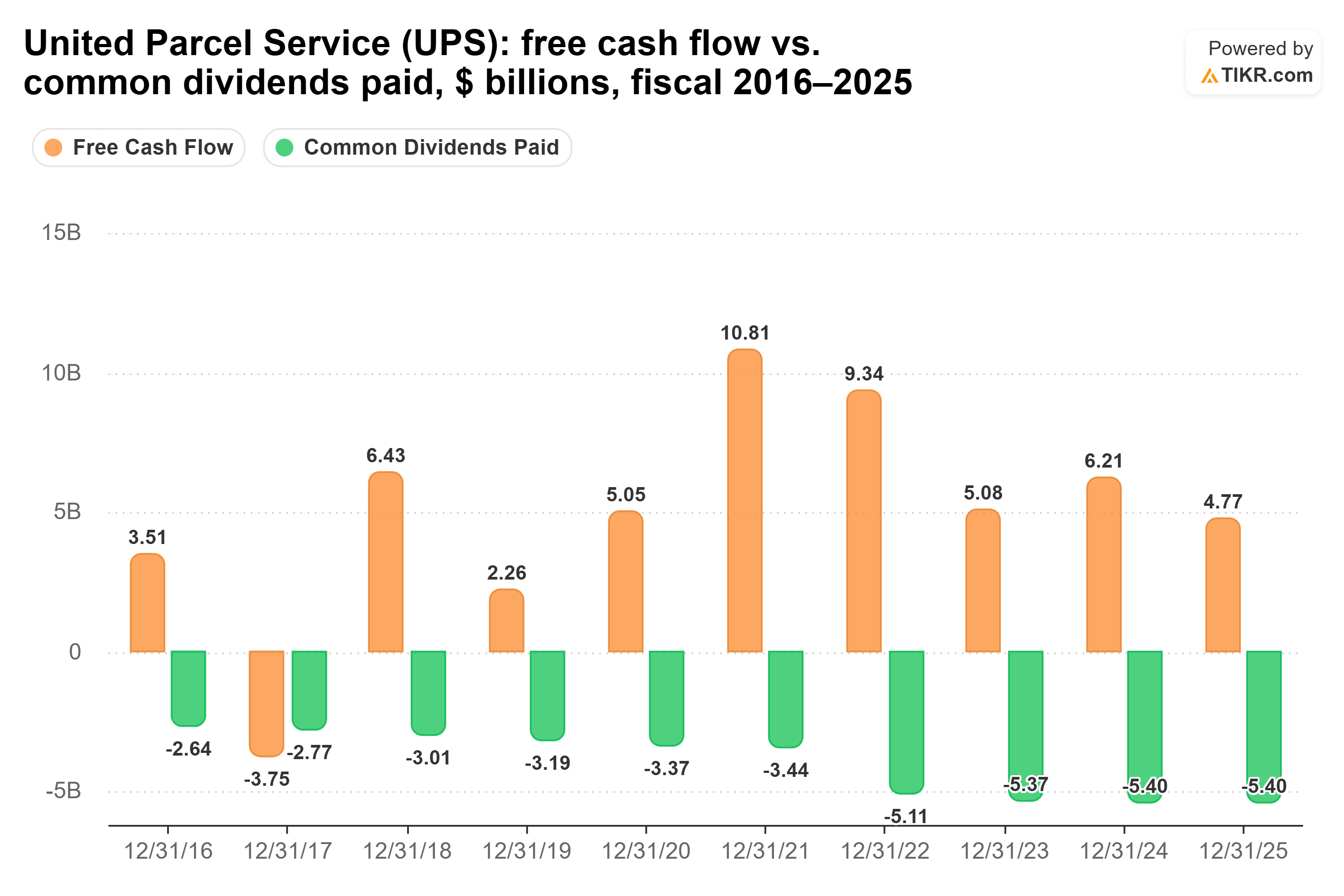
Management expects the cash to catch up. It now guides to about $6.1 billion of adjusted free cash flow for 2026, against about $5.4 billion of dividends, and free cash flow for the first nine months was $4.22 billion, up from $2.74 billion a year before. CEO Carol Tomé was blunt on the third-quarter call: “So clearly, our dividend is safe and secure.”
The dividend isn’t growing, though. UPS declared $1.64 a share on Nov. 4, the same quarterly rate it paid through fiscal 2025, after raising it 10.2% a year from fiscal 2020 to fiscal 2025, from $4.04 to $6.56 a share.
Two checks to count on, one to watch
Verizon’s dividend is safe but slow, and Enterprise’s is safe and still growing.
UPS has the least cash behind its dividend, so it’s the check I’d worry about. If it halved its dividend, this portfolio’s income would fall to about $42,900 a year. If it stopped paying altogether, the income would fall to about $34,500. And it plans $1.3 billion of pension contributions this year, which leaves little room for a rough one. That said, things seem fine at least for now.
The way I see it, this portfolio’s income is in good shape. Still, I wouldn’t count on UPS’s third of it until its free cash flow proves management right. UPS’s fourth-quarter report, due early next year, will show whether 2026’s free cash flow landed near that $6.1 billion.
Enjoy your retirement in style with these safe 6%+ dividend yields
Dividends can hold the key to enormous wealth. But only if you buy the right ones.
Picking the right high-yield dividend stock can be the difference between a dream retirement…and scraping by every month, waiting for the next Social Security check to clear.
We’ve identified six stocks yielding 6%+ that we believe every retiree should know about right now.
Disclaimer:
Please note that the articles on TIKR are not intended to serve as investment or financial advice from TIKR or our content team, nor are they recommendations to buy or sell any stocks. We create our content based on TIKR Terminal’s investment data and analysts’ estimates. Our analysis might not include recent company news or important updates. TIKR has no position in any of the stocks mentioned. Thank you for reading, and happy investing!