


Key Takeaways
- More than a dozen firms raised their Mastercard price targets after its third-quarter beat. Five of them run from Monness’s $535 with a Hold to Cantor Fitzgerald’s $765 with an Overweight.
- Consensus EPS estimates for 2026 through 2028 rose less than half a percent after the report, so the higher targets come from analysts paying a higher multiple for the same earnings.
- Mastercard trades at 30x forward earnings, a bit below its five-year average of 31x but well above the 23x it hit in June.
- The bullish targets price Mastercard at or a little above its usual multiple on next year’s earnings, while Monness’s $535 prices it below its five-year low.
Mastercard (MA) beat Wall Street’s third-quarter estimates on Oct. 29, and more than a dozen firms raised their price targets in the days after. Five of them show how wide the spread runs.
Morgan Stanley, TD Cowen, J.P. Morgan and Cantor Fitzgerald all stayed bullish, with new targets from $712 to $765. Monness kept its Hold, but even it raised its target, to $535.
That’s a wide spread for a stock that rose 17% in the month to Nov. 3 and trades near its 52-week high. So which side has it right? It comes down to whether the earnings picture actually got better.
Everybody Raised, Even the Hold
Here’s where each firm landed after the report:
- Morgan Stanley: Overweight, $712, up from $681
- TD Cowen: Buy, $726, up from $667
- J.P. Morgan: Overweight, $755, up from $720
- Cantor Fitzgerald: Overweight, $765, up from $695
- Monness: Hold, $535, up from $510
Those are raises of 4.6% to 10.1%. And the quarter gave the firms reasons to feel good: net revenue rose 14% to $9.81 billion, ahead of the $9.66 billion Wall Street expected, and value-added services grew 19% on a currency-neutral basis.
But new CFO Ling Hai added a catch on the third-quarter call. Part of the beat came from services projects and payment network deals that were pulled forward from the fourth quarter. “You will see a similar offset in Q4,” he said.
A dollar that moves from December into September doesn’t add anything to the year.
The Estimates Barely Budged
Here’s what analysts expect Mastercard to earn per share through 2028, as of Nov. 1:

The consensus calls for $20.04 this year, $23.13 in 2027 and $26.89 in 2028. On Oct. 22, a week before the report, those numbers were $19.95, $23.07 and $26.85.
So each year’s estimate rose less than half a percent, a fraction of what the targets moved. That lines up with what Hai said.
TIKR Tracks 40 Analysts on Mastercard. How Many Say “Buy”?
See the full breakdown of Buy, Hold, and Sell ratings on Mastercard, along with Wall Street’s revenue and earnings estimates, all in one place. More than 500,000 investors use TIKR to research stocks like this one. See Mastercard’s Analyst Ratings
Analysts Are Paying Up for the Same Earnings
Mastercard’s forward P/E has climbed back from its June low, but it’s still a bit below its five-year average:
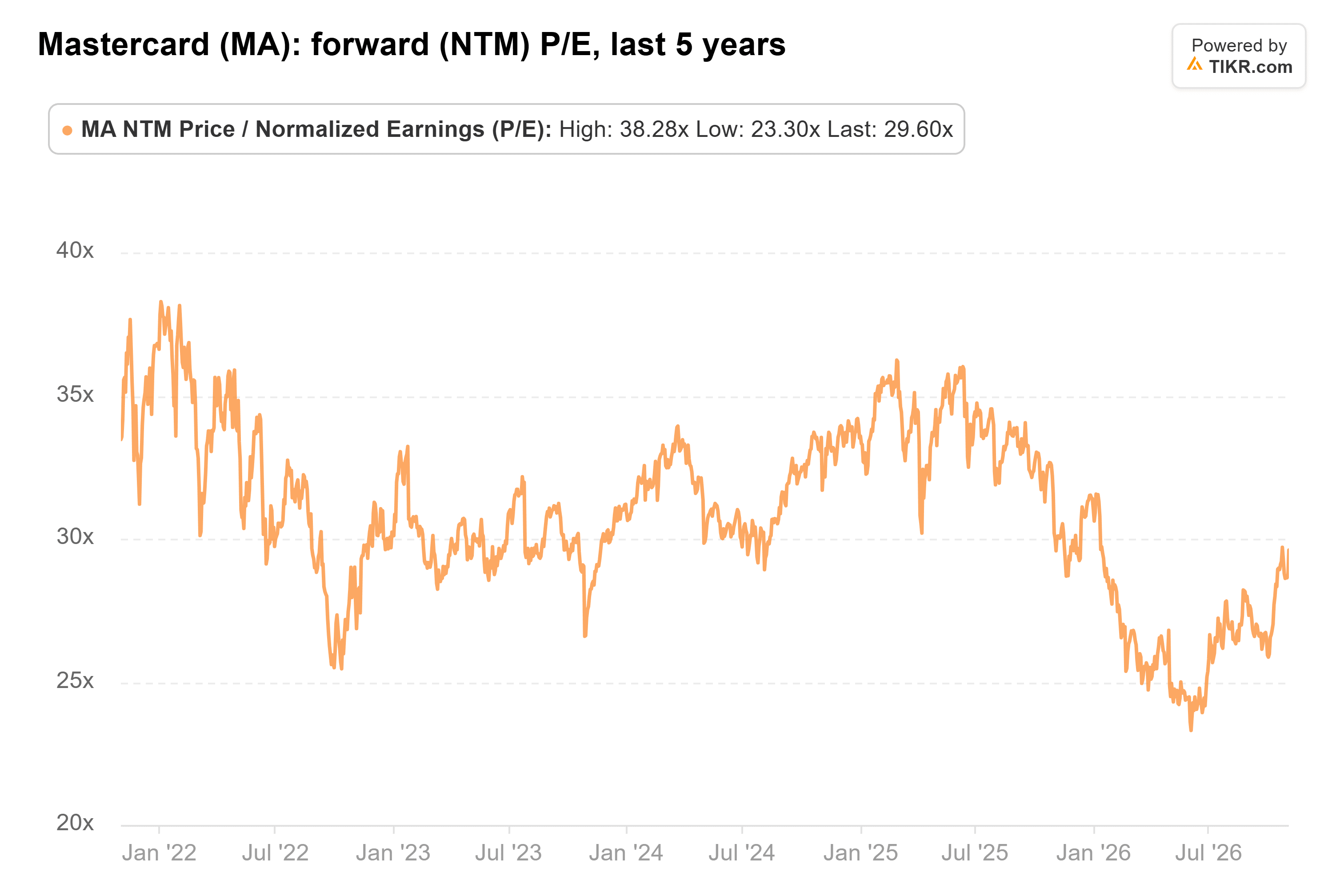
On Nov. 2 it stood at 30x. Over the past five years it has averaged 31x, peaked at 38x in January 2022 and bottomed at 23.3x in June. At the end of September it was 26x, so the past month’s run added nearly four turns to the multiple, with almost no change in earnings.
Now divide each target by the $23.13 consensus for 2027:
- Morgan Stanley’s $712: 30.8x
- TD Cowen’s $726: 31.4x
- J.P. Morgan’s $755: 32.6x
- Cantor’s $765: 33.1x
- Monness’s $535: 23.1x
The stock trades at 28x that same estimate at its Nov. 3 close of $647. A year from now, 2027 is the year a forward multiple gets measured on, so the comparison holds. Morgan Stanley and TD Cowen sit right at Mastercard’s five-year average, with J.P. Morgan and Cantor a little above it. Monness is pricing it just under its June low.
The Business Is Still Growing
The higher multiple isn’t sitting on top of a stalled business. Analysts expect revenue to grow 14% this year and still 12% in 2028:

That’s $37.4 billion this year, $42.1 billion in 2027 and $47.1 billion in 2028, up from $32.8 billion in 2025. EPS is expected to grow even faster, 15% next year. If the multiple holds, the stock can rise along with it.
There are risks. Hai said rebates and incentives will take a bigger share of gross assessments in the fourth quarter than in the third, and that pricing will lap earlier increases. Cross-border volume growth also slowed to 11% in the third quarter, from 12% in the second.
The Buys Have the Better Case on Mastercard
The raises themselves were mostly analysts catching up to the stock, since the estimates hardly moved. But you don’t need a big re-rating to reach Morgan Stanley’s $712, just Mastercard’s usual multiple on next year’s earnings. To reach Monness’s $535, 17% below the Nov. 3 close, the multiple would have to sink below its five-year low and stay there.
Frankly, that’s a bigger bet than any of the Buys.
Of course, all five targets lean on that $23.13 for 2027. Mastercard usually reports fourth-quarter results in late January, and that’s when Hai gives his first full-year outlook. If it points to a weaker 2027 than analysts expect, they’ll cut that estimate, and the targets will come down with it.
So What is Mastercard Stock Actually Worth?
TIKR lets you forecast the future price of any stock in less than a minute. Just enter a few assumptions into TIKR’s valuation model and see what Mastercard could be worth. Start from Wall Street consensus estimates, or adjust the inputs to reflect your own view of the business. It’s free to use.
Disclaimer:
Please note that the articles on TIKR are not intended to serve as investment or financial advice from TIKR or our content team, nor are they recommendations to buy or sell any stocks. We create our content based on TIKR Terminal’s investment data and analysts’ estimates. Our analysis might not include recent company news or important updates. TIKR has no position in any of the stocks mentioned. Thank you for reading, and happy investing!


