Key Takeaways
- IonQ stock fell 32.5% over the past month, and B. Riley cut its price targets on IonQ, Rigetti Computing and D-Wave Quantum by up to 32.5%, citing sector weakness and funding risks.
- IonQ’s third-quarter report on Nov. 5 needs to show revenue growing faster than the cash the company burns.
- Free cash flow improved to -$114 million in the second quarter from -$159 million in the first, as revenue rose to $80.1 million.
- At 18x forward sales, IonQ trades at its lowest multiple in five years, and a second quarter in a row of shrinking burn would make that look cheap.
IonQ (IONQ) stock has dropped 32.5% in a month, closing at $29.54 on Nov. 4, and Wall Street is marking down the whole quantum group. On Monday, B. Riley Securities analyst Craig Ellis cut his price targets on IonQ, Rigetti Computing (RGTI) and D-Wave Quantum (QBTS) by 25% to 32.5%. He cited weakness across quantum and AI stocks and kept Buy ratings on all three.
Funding was the company-specific worry. Ellis pointed to IonQ’s recent $2 billion raise and its plans for more acquisitions, which raise questions about dilution. At Rigetti and D-Wave, he pointed to federal funding that’s turning into government equity stakes.
That sets the bar for IonQ’s third-quarter report, due after the close on Thursday, Nov. 5. The company has grown sales quickly for more than a year. Now it has to show revenue growing faster than the cash going out the door, so the losses start to narrow.
The sales are coming in
Analysts expect $455 million of revenue this year, more than triple 2025’s $130 million:

That figure sits right inside management’s 2026 forecast of $450 million to $460 million. The forecast includes the SkyWater foundry IonQ bought on July 31, which adds about $170 million after sales between the two companies are netted out. IonQ’s own businesses make up $280 million to $290 million of the range, which is still more than double last year. And management has beaten its own forecasts this year: second-quarter revenue was $80.1 million, against guidance of $65 million to $68 million.
TIKR tracks 14 analysts on IonQ. How many say “Buy”?
See the full breakdown of Buy, Hold, and Sell ratings on IonQ, along with Wall Street’s revenue and earnings estimates, all in one place. More than 500,000 investors use TIKR to research stocks like this one. See IonQ’s Analyst Ratings
Now the burn has to shrink
Cash is a different story. IonQ’s quarterly free cash flow went from -$23 million in the September 2024 quarter to -$159 million in the first quarter of 2026, then improved in the second:
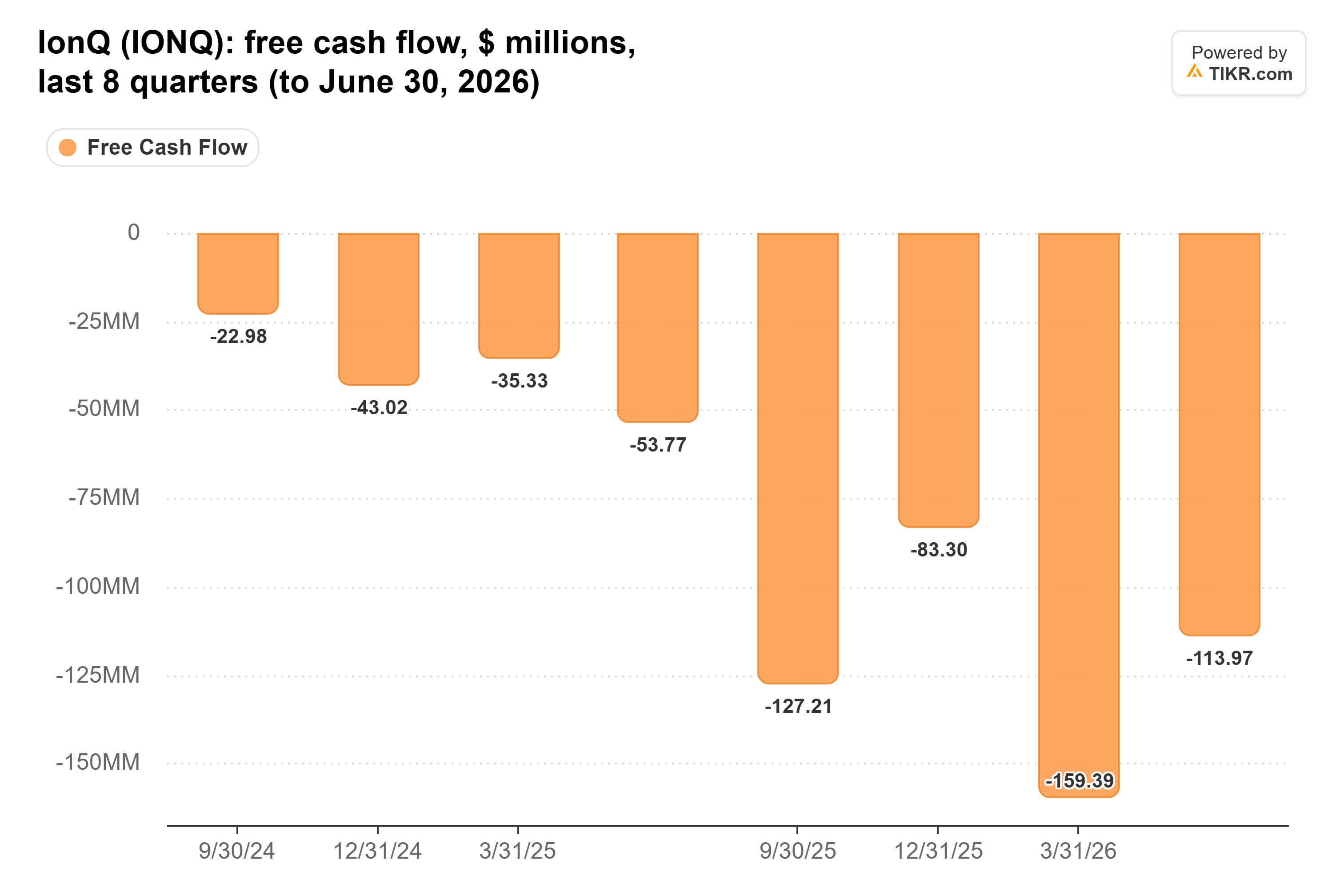
The bulls will point to that second quarter. Revenue rose 24% from the first quarter, and the burn fell to $114 million. That’s about $1.42 burned for every dollar of sales, down from about $2.60 a year earlier. Over the year, the burn roughly doubled while revenue nearly quadrupled.
So Thursday comes down to two lines. IonQ burned $127 million in the third quarter of 2025 and $114 million last quarter. A third-quarter figure below both, on higher revenue, would mean two quarters in a row of losses shrinking against sales.
Management’s loss forecast points the same way, with a catch. In February IonQ forecast a 2026 adjusted EBITDA loss of $310 million to $330 million, and it reaffirmed that range in May. After a $217.0 million loss in the first half, the range leaves $93 million to $113 million for the second half, less than the second quarter’s $120.3 million on its own.
But IonQ’s August and September outlook updates covered revenue only and didn’t repeat the loss range, and the September one was the first to include SkyWater. Foundry work carries thinner margins, and IonQ’s gross margin (before depreciation and amortization) had already fallen to 24.9% in the second quarter, from 59.8% a year earlier. Whether management still stands behind that loss range is one of the first things to check on Thursday.
Analysts don’t expect the burn to shrink in dollars. Their consensus is free cash flow of -$642 million this year, -$743 million in 2027 and -$811 million in 2028. The 2026 figure also implies a heavier second half: after $273 million burned from January through June, it leaves about $369 million for the last six months, or roughly $185 million a quarter. The burn still shrinks against revenue each year and drops below sales from 2027, so the case for the stock needs sales to keep outrunning the cash, quarter after quarter.
IonQ pays for the gap with new shares. It had 429.41 million shares outstanding after its October stock sale, up from 221.92 million at the end of 2024. On Nov. 4 it closed its all-stock purchase of Elisity, issuing $1.15 billion more in stock. That’s the dilution Ellis is worried about.
Rigetti and D-Wave are next
Investors won’t stop at IonQ. Rigetti and D-Wave both report on Tuesday, Nov. 10, and both fell about as hard in October: Rigetti lost 28.5% and D-Wave 35.7%.
Rigetti looks like a smaller version of IonQ. It brought in $5.1 million of revenue in the second quarter, against a $28.1 million operating loss. It had $541.3 million of cash and investments and no debt at the end of June. Analysts expect its revenue to grow 228.2% this year. Ellis cut his target to $25 from $35. He sees Rigetti’s third quarter as a possible low point before revenue from its C-DAC system for India comes in during the fourth. If IonQ shows sales outrunning its burn, Rigetti’s investors will want the same, and they may have to wait for that system.
D-Wave’s last quarter went the other way. Second-quarter revenue was flat at $3.1 million, while GAAP operating expenses nearly doubled to $55.0 million. Analysts still expect revenue to grow 72.7% this year, and management said on its second-quarter call that the fourth quarter should bring in most of this year’s revenue. The support for that is $35.5 million of first-half bookings, including a $20 million system sale to Florida Atlantic University. Ellis cut his target to $27 from $40. If IonQ delivers, D-Wave’s investors will want to know on Nov. 10 when its sales start growing faster than its costs.
Cheapest in five years
The selloff has pushed IonQ’s forward price/sales multiple to its lowest point in five years:
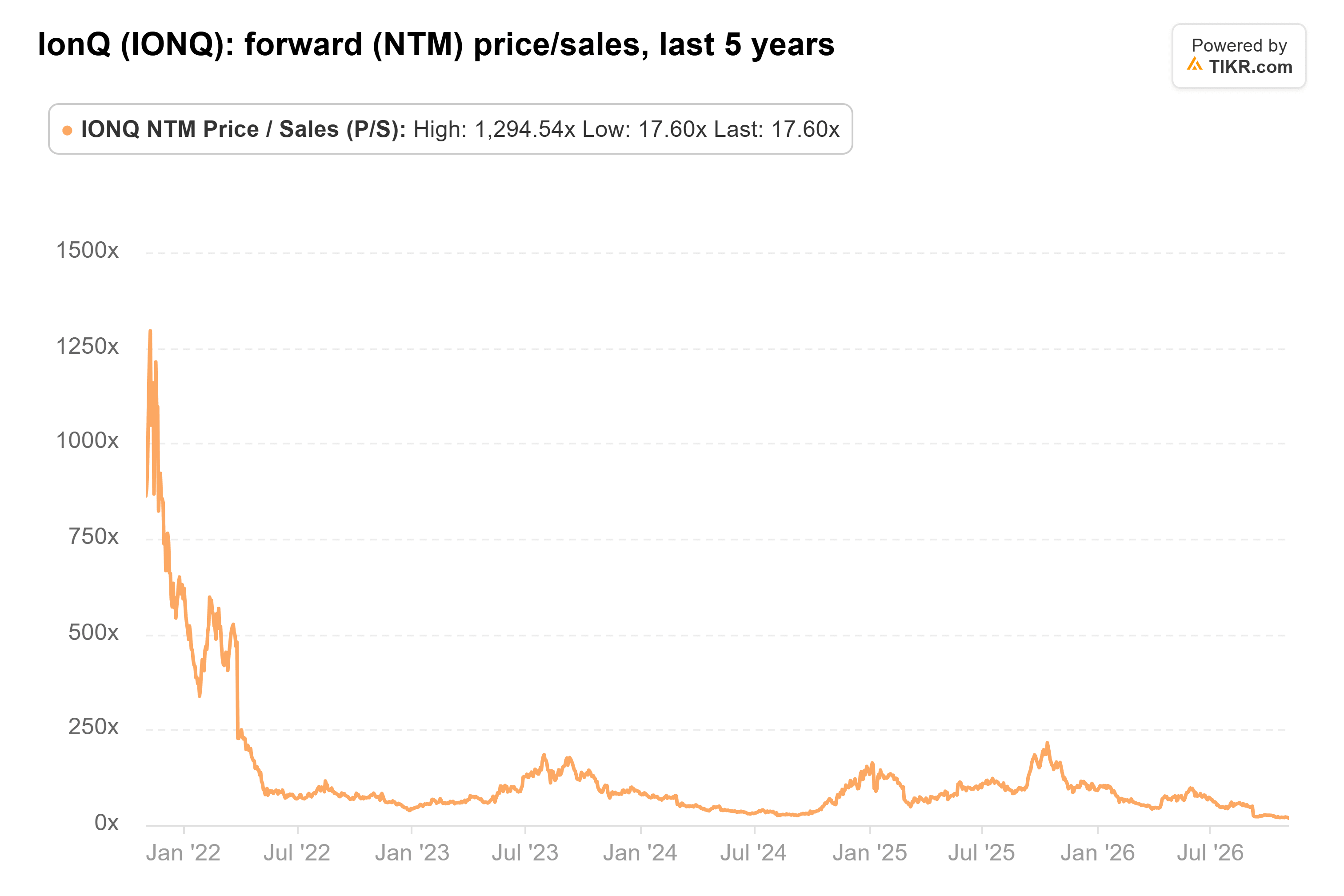
IonQ traded at 18x forward sales on Nov. 2, a fraction of its five-year average of 125x, though readings from 2021 and early 2022, when IonQ had little revenue, inflate that average. Part of the drop comes from forward sales that now include SkyWater’s foundry revenue, which BofA valued at 2x sales in September. And Ellis’s new $75 target for IonQ is still far above where the stock trades: more than 2.5 times the Nov. 4 close.
Quantum stocks trade on sentiment and roadmap news as much as on cash. So a revenue beat or a higher forecast could lift IonQ on Thursday even if the burn grows. But funding drove much of this month’s target cuts, so investors are watching the cash.
IonQ already showed last quarter that it can grow sales faster than its burn. If the third quarter shows the burn shrinking again and management stands by its loss range with SkyWater inside, 18x forward sales is too pessimistic for a company growing this fast. If the burn jumps back toward the first quarter’s $159 million, or toward the roughly $185 million a quarter that consensus implies, the target cuts were right.
One quarter won’t settle it. Elisity’s numbers join from the fourth quarter, and customer deliveries of the 256-qubit Superion system aren’t planned until 2027.
So what is IonQ stock actually worth?
TIKR lets you forecast the future price of any stock in less than a minute. Just enter a few assumptions into TIKR’s valuation model and see what IonQ could be worth. Start from Wall Street consensus estimates, or adjust the inputs to reflect your own view of the business. It’s free to use.
Disclaimer:
Please note that the articles on TIKR are not intended to serve as investment or financial advice from TIKR or our content team, nor are they recommendations to buy or sell any stocks. We create our content based on TIKR Terminal’s investment data and analysts’ estimates. Our analysis might not include recent company news or important updates. TIKR has no position in any of the stocks mentioned. Thank you for reading, and happy investing!