Key Takeaways
- Cloudflare reports third-quarter results after the close on Nov. 5. It’s the first full quarter since the company cut about 20% of its workforce in May.
- The savings from the layoff are already built into management’s margin guidance, so revenue growth is the number that matters on Thursday.
- To match the second quarter’s 36% growth, Cloudflare needs about $764 million of revenue, about 4% above the top of its guidance and in line with its last three beats.
- Amazon’s AWS and Microsoft’s cloud both grew faster in the September quarter, and Zscaler will be watching what Cloudflare says about its security sales.
Cloudflare (NET) reports its third-quarter results after the close on Thursday, Nov. 5. It’s the first full quarter since the company laid off about 20% of its staff in May.
Amazon (AMZN) and Microsoft (MSFT) both posted faster cloud growth last week, so Cloudflare can’t blame demand if its growth slips. And Zscaler (ZS), which competes with Cloudflare for corporate security deals, gets an early look at how Cloudflare’s sales team held up after the cut.
On Nov. 3, JPMorgan upgraded Cloudflare to Overweight from Neutral, kept its $350 price target and cited valuation. The upgrade came days after the stock sank 14% in a week during a software selloff, and it still leaves the stock up about 35% in 2026.
The layoff has at least one big fan. On 20VC, SaaStr founder Jason Lemkin held up Cloudflare as the example other CEOs cutting staff should follow:
“Every quarter is growing faster, but on May 7th, they lay off 20% of the folks, bam, we don’t need it, we’re too big.”
He added that there was “no downside to the business that is apparent yet.”
Thursday’s report is the first real test of that “yet.”
Cloudflare announced the cut on May 7: about 20% of its workforce, or more than 1,100 people. Headcount ended June at about 4,700, according to the second-quarter call.
TIKR Tracks 34 Analysts on Cloudflare. How Many Say “Buy”?
See the full breakdown of Buy, Hold, and Sell ratings on Cloudflare, along with Wall Street’s revenue and earnings estimates, all in one place. More than 500,000 investors use TIKR to research stocks like this one. See Cloudflare’s Analyst Ratings
Faster Growth Means About $764 Million
Lemkin’s “every quarter” is close. Revenue growth rose from 27% in the first quarter of 2025 to 36% in the second quarter of 2026, with two quarters in a row at 34% along the way.
Management guides third-quarter revenue to $736 million to $737 million, or 31% growth. But Cloudflare has beaten the top of its guidance by 3.0% to 4.7% in each of the last three quarters.
To match the second quarter’s 36%, revenue has to reach about $764 million, up from the $562.0 million Cloudflare reported a year ago. That’s about 4% above the top of guidance, within the range of its recent beats.
Analysts expect 2026 revenue of $2.87 billion, which would be 32% growth on 2025’s $2.17 billion. That’s faster than the 30% growth Cloudflare posted in 2025:
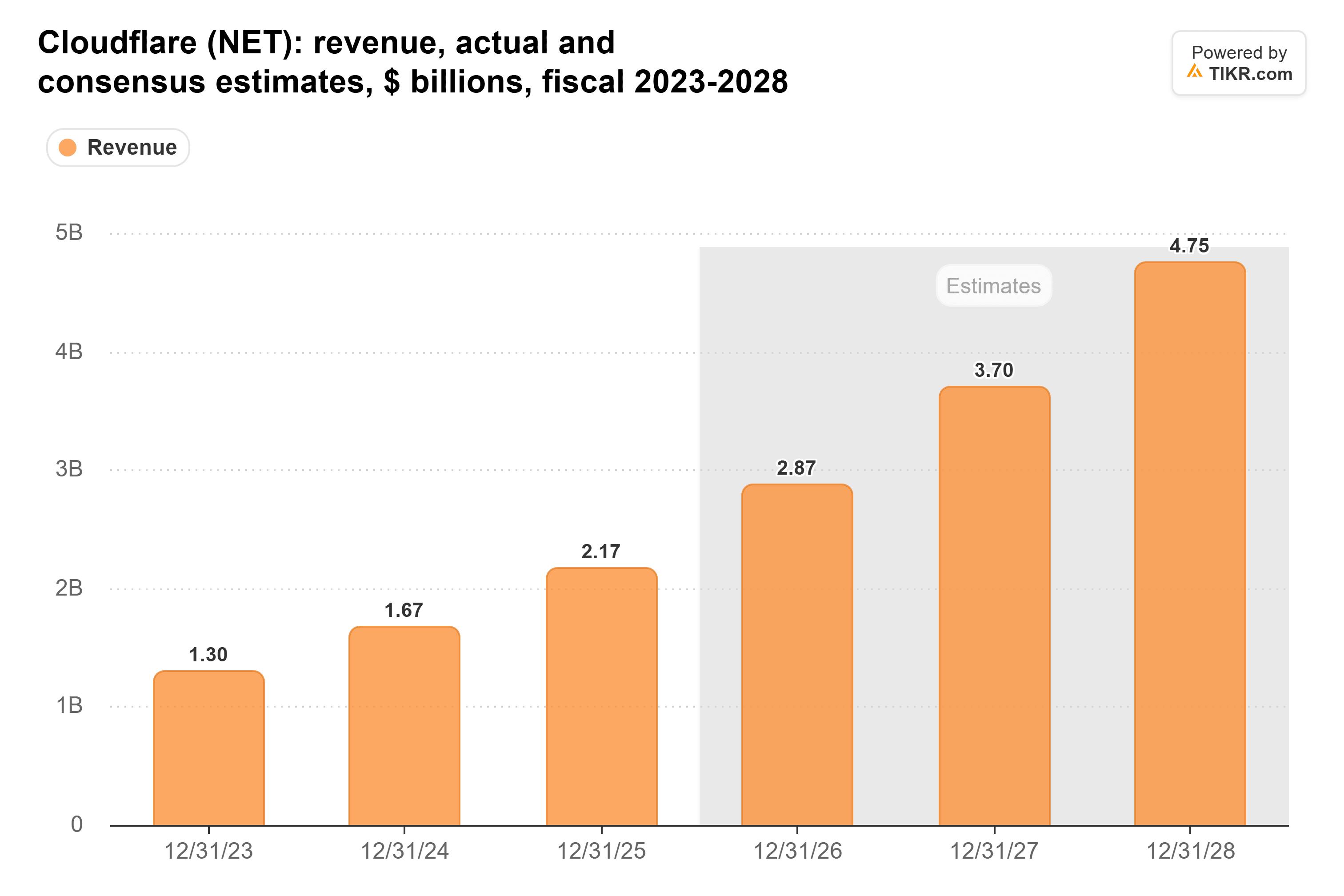
The estimate already sits at the top of management’s raised full-year range of $2.864 billion to $2.870 billion, so analysts are counting on another beat. A third quarter near $737 million would leave that estimate too high.
The Margin Is the Easy Part
The savings from the layoff are already in the guidance. Management expects $129 million to $130 million of non-GAAP operating income in the third quarter. That’s a margin of about 17.5% to 17.7%, up from 13.8% in the second quarter and 15% a year earlier.
On TIKR’s measure, which counts stock pay, Cloudflare’s operating margin has stayed between -6.6% and -12.4% for eight straight quarters:

The best of those quarters was -6.6%, in the fourth quarter of 2025. If Cloudflare can’t top that with a fifth fewer people, the savings went somewhere else.
Free cash flow was climbing before the cut. It dipped in the second quarter, when Cloudflare booked $150.7 million of restructuring charges:
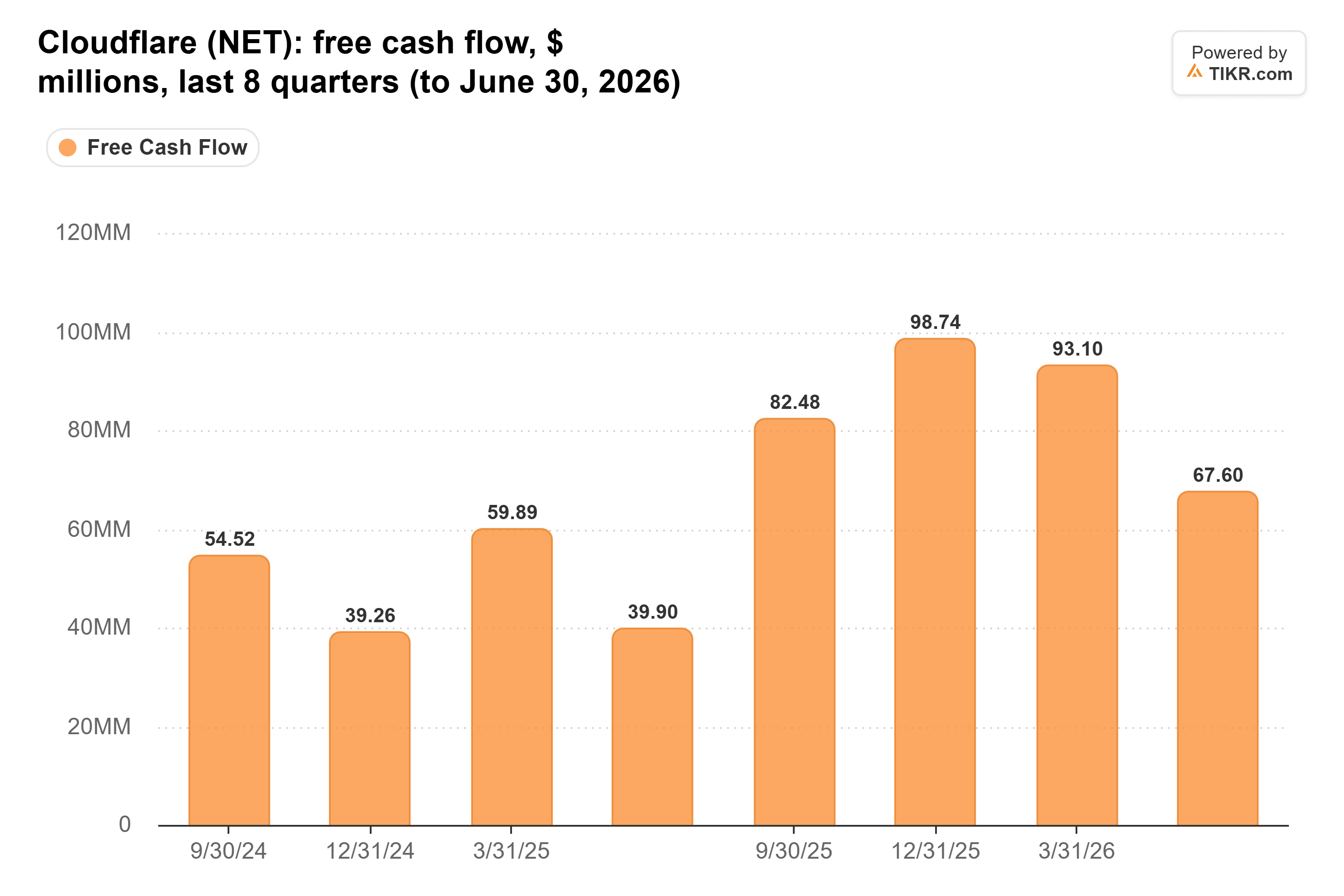
To show that the leaner company is generating more cash, Thursday’s figure needs to beat the $75.0 million Cloudflare reported a year ago.
Amazon and Microsoft Took Away the Demand Excuse
AWS sales grew 39% to $46.0 billion in the September quarter, up from 37% in the June quarter, its fastest growth in nearly five years.
Azure revenue grew 48% in Microsoft’s September quarter, up from 43% the quarter before, and Microsoft Cloud growth sped up to 30%. With the two biggest clouds both speeding up, companies were still adding to their cloud and AI budgets into the fall. If Cloudflare’s growth slows anyway, I’d look first at how it has executed since the cut.
Zscaler sits on the other side of that question. It guides revenue for its quarter ending in October to $935 million to $939 million, about 19% growth, after 25% in the July quarter, which included its Red Canary acquisition. Cloudflare’s count of customers paying more than $100,000 a year grew 27% to 4,698 in the second quarter. If that pace held after the cut, Zscaler will have more to prove when it reports.
Cloudflare Needs More Than a Margin Beat
Thursday’s margin will tell us little that the guidance hasn’t already said. Revenue is the figure that answers the headline. About $764 million or more means growth kept accelerating with a fifth fewer people, and Lemkin’s case study holds up. A figure near $737 million means growth slowed to about 31%. With Amazon and Microsoft speeding up, I’d read that as the cut costing Cloudflare some of its selling power.
One quarter won’t settle it, though. Watch whether management raises the full-year range a third time. The first 2027 outlook isn’t due until the fourth-quarter report, likely in February.
So what is Cloudflare stock actually worth?
TIKR lets you forecast the future price of any stock in less than a minute. Just enter a few assumptions into TIKR’s valuation model and see what Cloudflare could be worth. Start from Wall Street consensus estimates, or adjust the inputs to reflect your own view of the business. It’s free to use.
Disclaimer:
Please note that the articles on TIKR are not intended to serve as investment or financial advice from TIKR or our content team, nor are they recommendations to buy or sell any stocks. We create our content based on TIKR Terminal’s investment data and analysts’ estimates. Our analysis might not include recent company news or important updates. TIKR has no position in any of the stocks mentioned. Thank you for reading, and happy investing!