Key Takeaways for Marriott International Stock as of August 2026
- Profitability Beat, Top-Line Miss: Marriott International stock reported Q2 revenue of $7.07B, a 1.69% miss against Street estimates, while adjusted EBITDA of $1.59B beat by 2.63% and adjusted EPS of $3.19 topped estimates by 3.63%, up 20.38% YoY.
- Guidance Raised on Margins, Cut on Rooms: Marriott raised full-year global RevPAR guidance to 3% to 3.5% growth and adjusted EBITDA guidance to $5.97B-$6.03B (+11-12% YoY), but full-year net rooms growth now leans toward the low end of its 4.5% to 5% range.
- U.S. Strength Offsets Middle East Drag: U.S. and Canada RevPAR rose 5% in Q2, the highest quarterly increase in 13 quarters, and luxury RevPAR climbed over 9%, even as EMEA RevPAR fell just over 5% on a 43% Middle East decline.
- Card Deal Payoff: CEO Tony Capuano sized the new Chase and Amex co-brand agreements at “somewhere between $100 million and $125 million” in incremental annual fees by full year 2028.
World Cup Tailwind Powers Marriott’s Q2, But the Middle East Cuts Its Rooms Guide
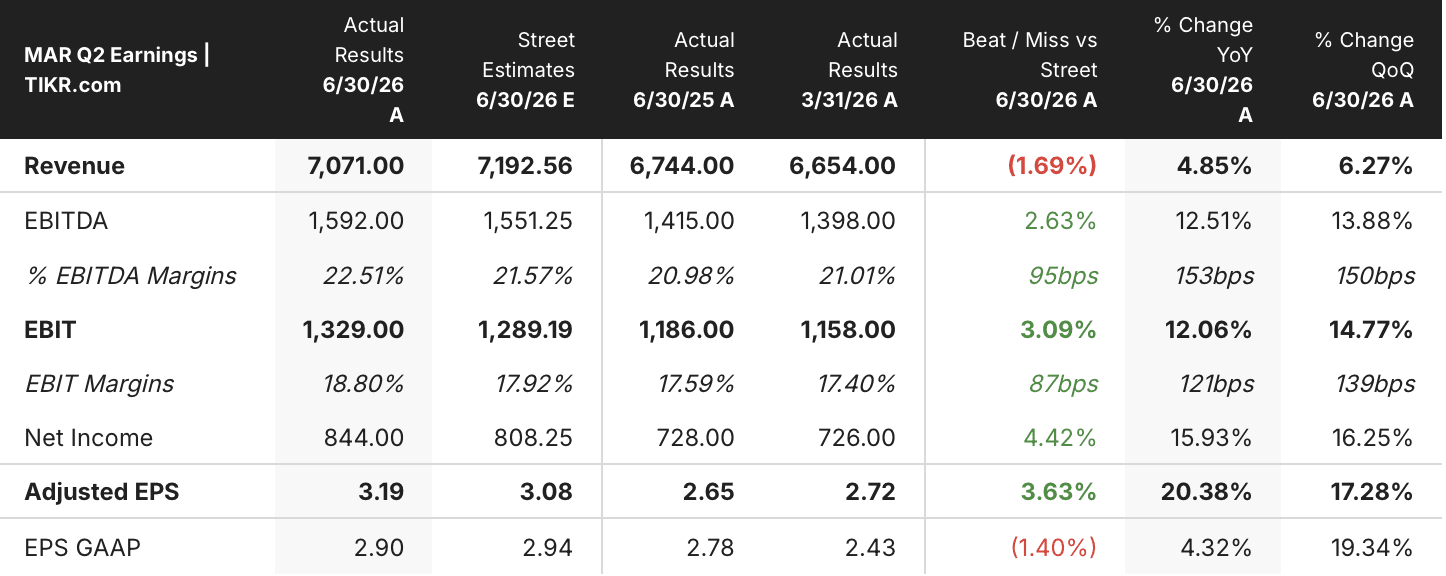
Marriott International (MAR) turned in a Q2 2026 that beat on profitability while missing revenue, a split that defined the entire call. Revenue landed at $7.07 billion, a 1.69% miss against Street estimates of $7.19 billion, yet adjusted EBITDA of $1.59 billion beat by 2.63% and adjusted diluted EPS of $3.19 cleared estimates by 3.63%, up 20.38% year over year. Gross fee revenues climbed 13% to $1.58 billion, and CEO Tony Capuano credited a global RevPAR increase of 3.4%, with U.S. and Canada RevPAR up 5%, the strongest quarterly print in 13 quarters.
Luxury led that strength, with RevPAR up over 9% in the region, and select service RevPAR grew more than 4%, showing the gains reached beyond the top of the portfolio. The World Cup added roughly 45 basis points to full-year global RevPAR, above the 30 to 35 basis points management previously expected. That outperformance pushed Marriott to raise full-year global RevPAR guidance to 3% to 3.5% growth and full-year adjusted EBITDA guidance to $5.97 billion to $6.03 billion, implying 11% to 12% growth.
The Middle East told a different story. RevPAR there fell 43% in the quarter on regional conflict, dragging EMEA RevPAR down just over 5% even as Europe rose over 4% on Mediterranean leisure demand. That weakness is now showing up in development, too: full-year net rooms growth is shifting toward the low end of Marriott’s 4.5% to 5% range, driven by construction delays in the Middle East.
Capuano pointed to a different growth lever entirely on the Q2 earnings call, sizing the newly signed co-brand credit card agreements with JPMorgan Chase and American Express: “by full year 2028, the impact on Marriott’s co-brand card fees from these new deals could be somewhere between $100 million and $125 million at our current royalty rate of 26%.” That figure lands years out, but it signals where Marriott expects fee growth to come from as room additions slow. CFO Jen Mason confirmed the immediate impact is smaller, just $30 million from two quarters of the new terms in 2026, with full-year adjusted diluted EPS still guided to grow 16% to 18% on strong EBITDA gains and a shrinking share count, backed by more than $4.5 billion in planned 2026 shareholder returns.
TIKR Values Marriott International Stock at $432, Pricing In Fee Growth Over Room Growth
TIKR’s mid-case model values Marriott International stock at $432 by December 2030, implying a 25% total return from the current price of $347, or 5% annualized over 4.4 years.
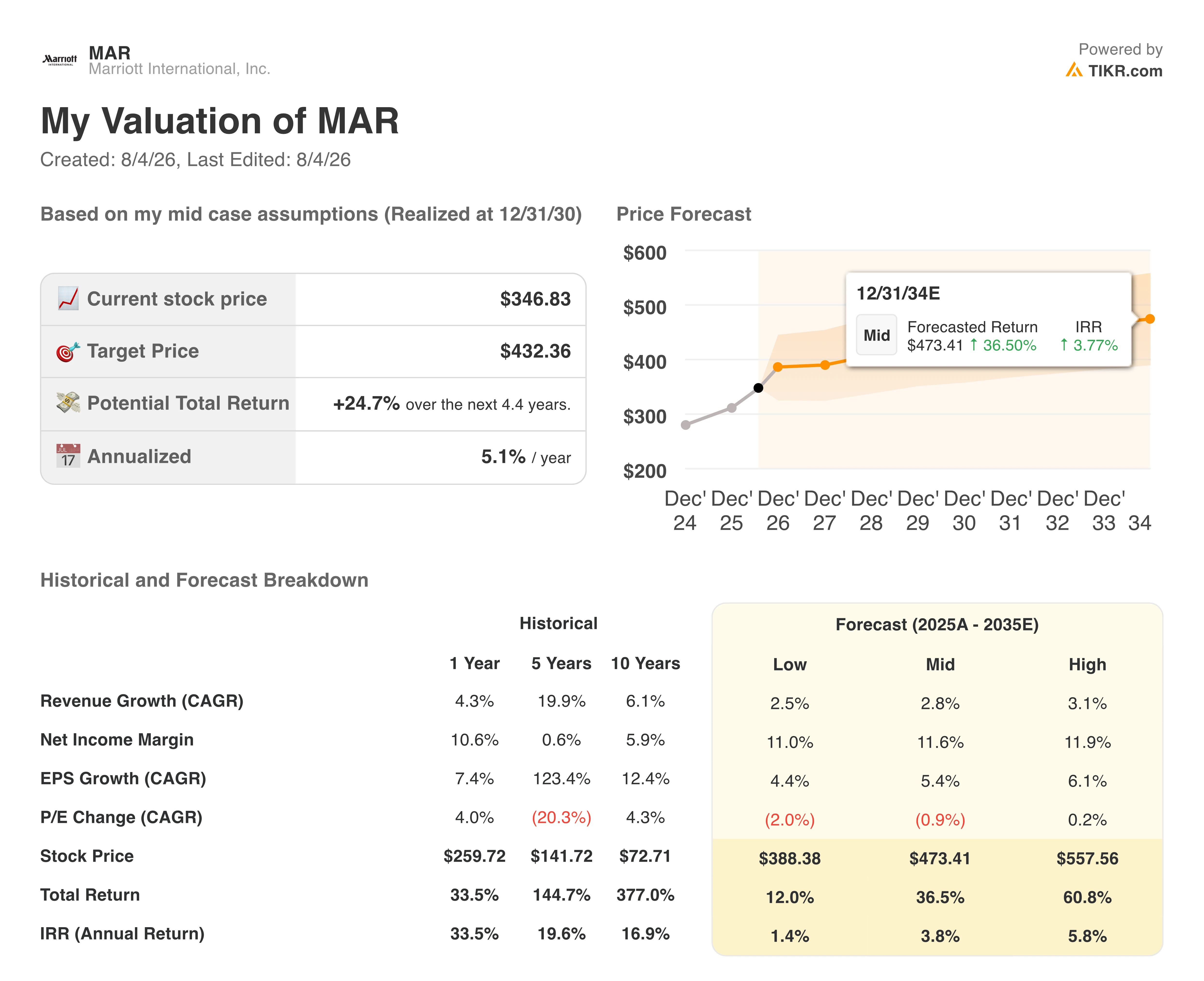
A 25% total return stretched across 4.4 years places Marriott International stock in a steady-compounder bracket rather than a re-rating story, with the model leaning on earnings growth and buybacks rather than multiple expansion to get there.
That framing tracks directly with what Marriott just guided to: adjusted EBITDA growing 11% to 12% and adjusted EPS growing 16% to 18% for the full year, even as net rooms growth slips toward the low end of its range. The model’s return path assumes Marriott can keep growing fees and shrinking share count fast enough to offset a Middle East-driven slowdown in room additions, and the raised RevPAR and EBITDA guidance from this quarter support that assumption.
Should You Invest in Marriott International, Inc.?
The only way to really know is to look at the numbers yourself. TIKR gives you free access to the same institutional-quality financial data that professional analysts use to answer exactly that question.
Pull up Marriott International, Inc. stock and you’ll see years of historical financials, what Wall Street analysts expect for revenue and earnings in the quarters ahead, how valuation multiples have moved over time, and whether price targets are trending up or down.
You can build a free watchlist to track Marriott International, Inc. alongside every other stock on your radar. No credit card required. Just the data you need to decide for yourself.
Access Professional Tools to Analyze MAR stock on TIKR for Free →
Looking for New Opportunities?
- See what stocks billionaire investors are buying so you can follow the smart money.
- Analyze stocks in as little as 5 minutes with TIKR’s all-in-one, easy-to-use platform.
- The more rocks you overturn… the more opportunities you’ll uncover. Search 100K+ global stocks, global top investor holdings, and more with TIKR.
Disclaimer:
Please note that the articles on TIKR are not intended to serve as investment or financial advice from TIKR or our content team, nor are they recommendations to buy or sell any stocks. We create our content based on TIKR Terminal’s investment data and analysts’ estimates. Our analysis might not include recent company news or important updates. TIKR has no position in any stocks mentioned. Thank you for reading, and happy investing!