Key Takeaways
- NVIDIA has lost nearly $1.4 trillion in market value since its October record, and the Nov. 5 chip selloff also took more than 10% off Broadcom.
- Josh Brown says a year of shrinking multiples has left NVIDIA so exposed that earnings 5% below expectations could take 40% off the stock.
- For that to happen, NVIDIA’s forward P/E would have to fall from 15x, already half its three-year average, to about 9.5x on top of the earnings cut.
- Analysts expect NVIDIA’s earnings to grow 71% in fiscal 2028, so the bigger risk is the year after that, and the Nov. 17 report is the next test.
NVIDIA (NVDA) has lost nearly $1.4 trillion in market value since its Oct. 6 record. Nearly $450 billion of that went in the Nov. 5 selloff, when NVIDIA fell more than 9% and Broadcom (AVGO) dropped more than 10%, according to Yahoo Finance.
Washington set it off. Democrats won both chambers of Congress, and candidates in both parties campaigned against AI data centers, the facilities filled with NVIDIA’s chips.
Plenty of investors are now calling NVIDIA cheap. On the Nov. 6 episode of The Compound and Friends, Ritholtz Wealth Management CEO Josh Brown questioned whether it’s really a bargain at “14 times earnings,” and gave a warning:
“If NVIDIA’s earnings are 5% lower over the next 12 months than we expected them, the stock could fall 40%.”
He admitted, “I’m making it up, but it really can.”
That’s eight points off the stock for every point off earnings.
TIKR tracks 62 analysts on Nvidia. How many say “Buy”?
See the full breakdown of Buy, Hold, and Sell ratings on Nvidia, along with Wall Street’s revenue and earnings estimates, all in one place. More than 500,000 investors use TIKR to research stocks like this one. See Nvidia’s Analyst Ratings
Cheap for a reason
Brown’s case starts with the big companies selling into the AI boom, Broadcom and NVIDIA included. Their multiples have shrunk for more than 12 months: “The multiple compression has been severe. The only reason the stocks haven’t really suffered is because they’re growing earnings faster than the rate that we’re compressing their multiple.”
NVIDIA’s earnings have grown fast. Analysts expect normalized EPS of $9.31 for fiscal 2027 (the year ending January 2027), $15.91 for fiscal 2028 and $21.34 for fiscal 2029:
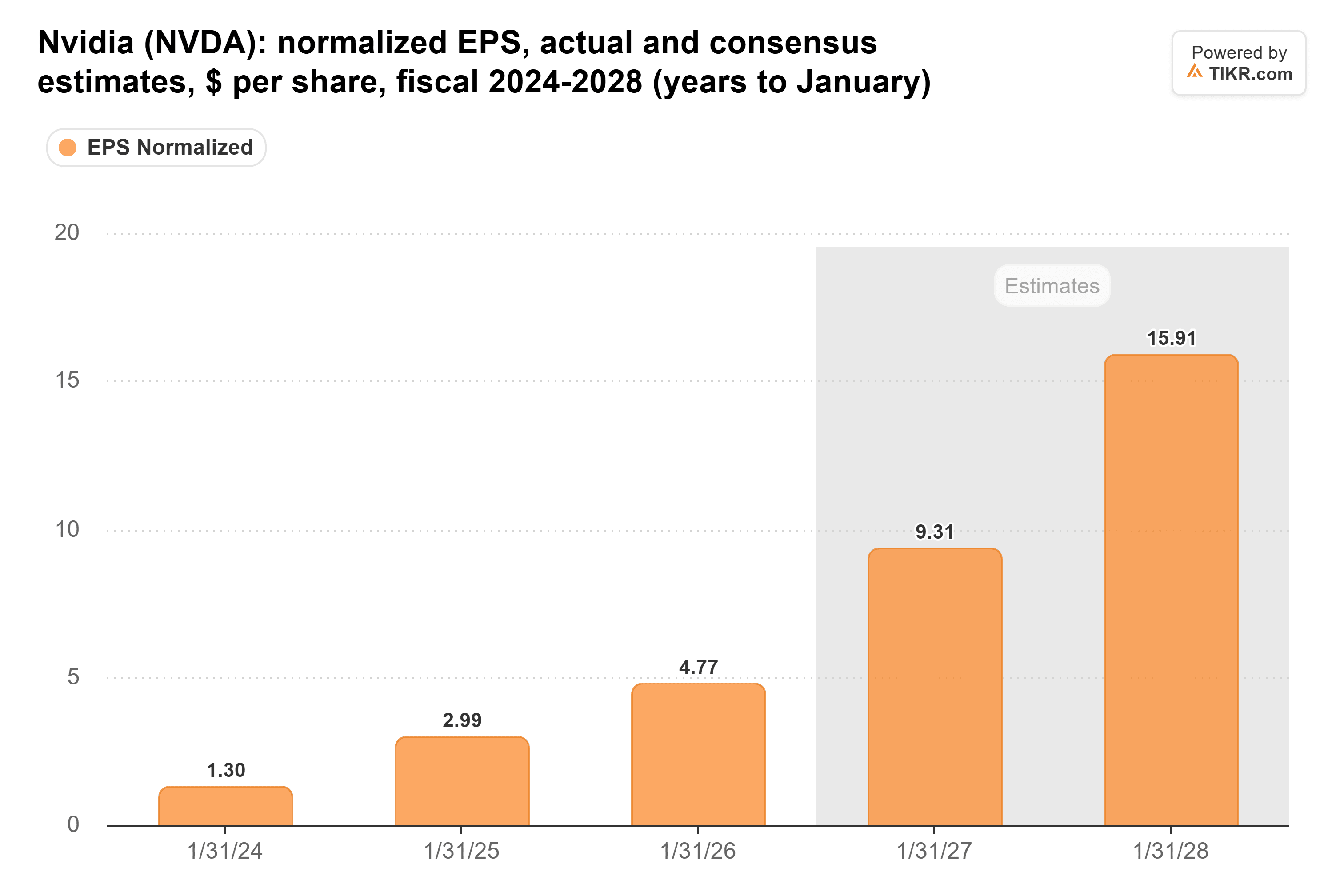
The fiscal 2028 estimate alone is up 25% since the end of June.
The multiple has gone the other way. NVIDIA traded at 15x forward earnings on Nov. 5, the low of its three-year range and half its 30x average:
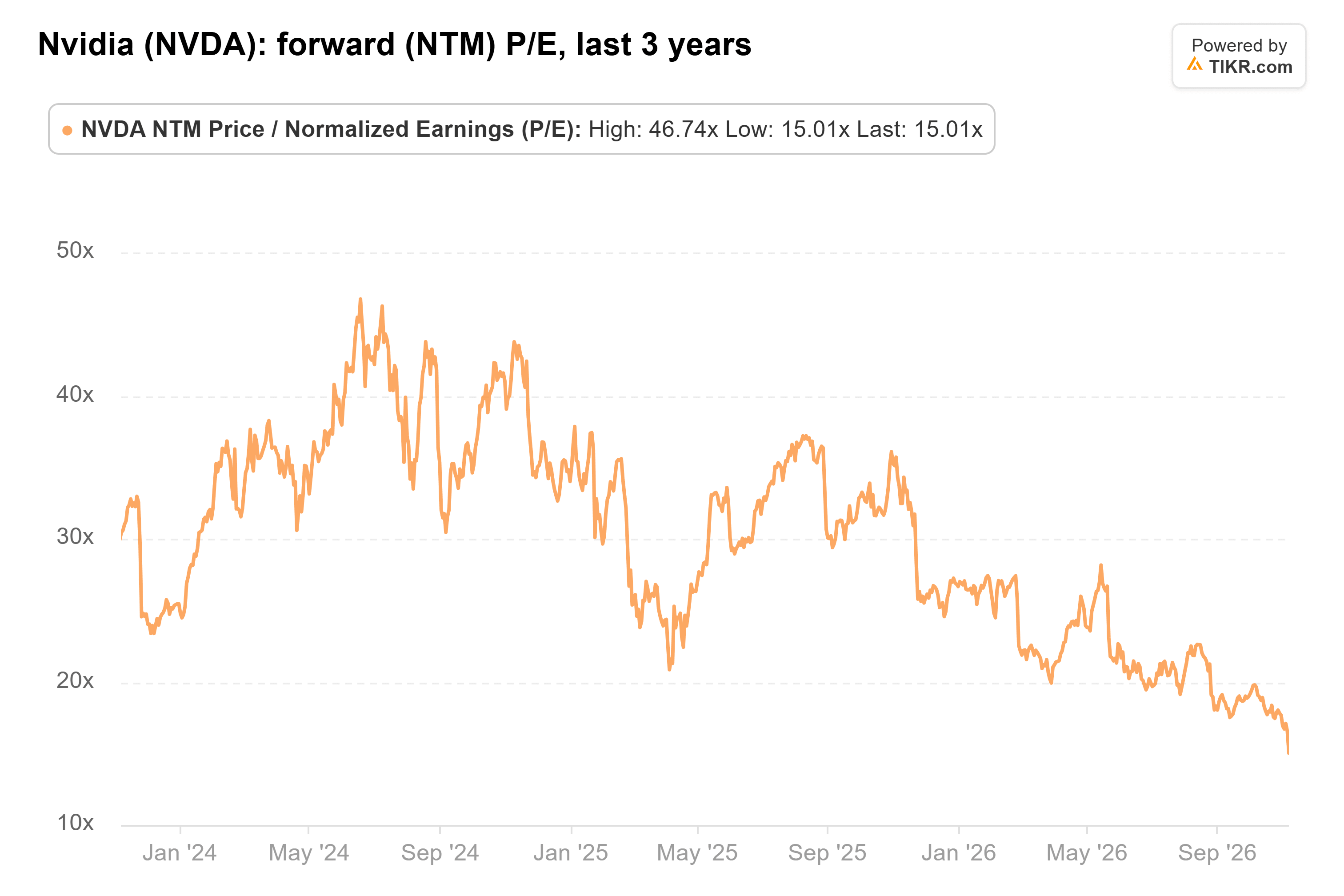
Brown’s read is that the market never believed this pace of growth would carry into 2027 and 2028. At 15x, the multiple backs him up: investors are paying for NVIDIA’s next two years of earnings as if they’re the peak. Consensus already has revenue growth slowing from 68.2% in fiscal 2028 to 30.5% in fiscal 2029.
What it takes to lose 40%
At 15x, a 5% cut to NVIDIA’s forward earnings with the multiple held steady takes 5% off the stock. To lose 40%, the multiple would also have to shrink to about 9.5x (15x × 0.60 ÷ 0.95).
TIKR’s quarter-end readings of NVIDIA’s forward P/E go back to 2014, and none of them is below 14x.
So for Brown’s 40% to happen, a small cut would have to convince investors that NVIDIA’s growth stops after fiscal 2028.
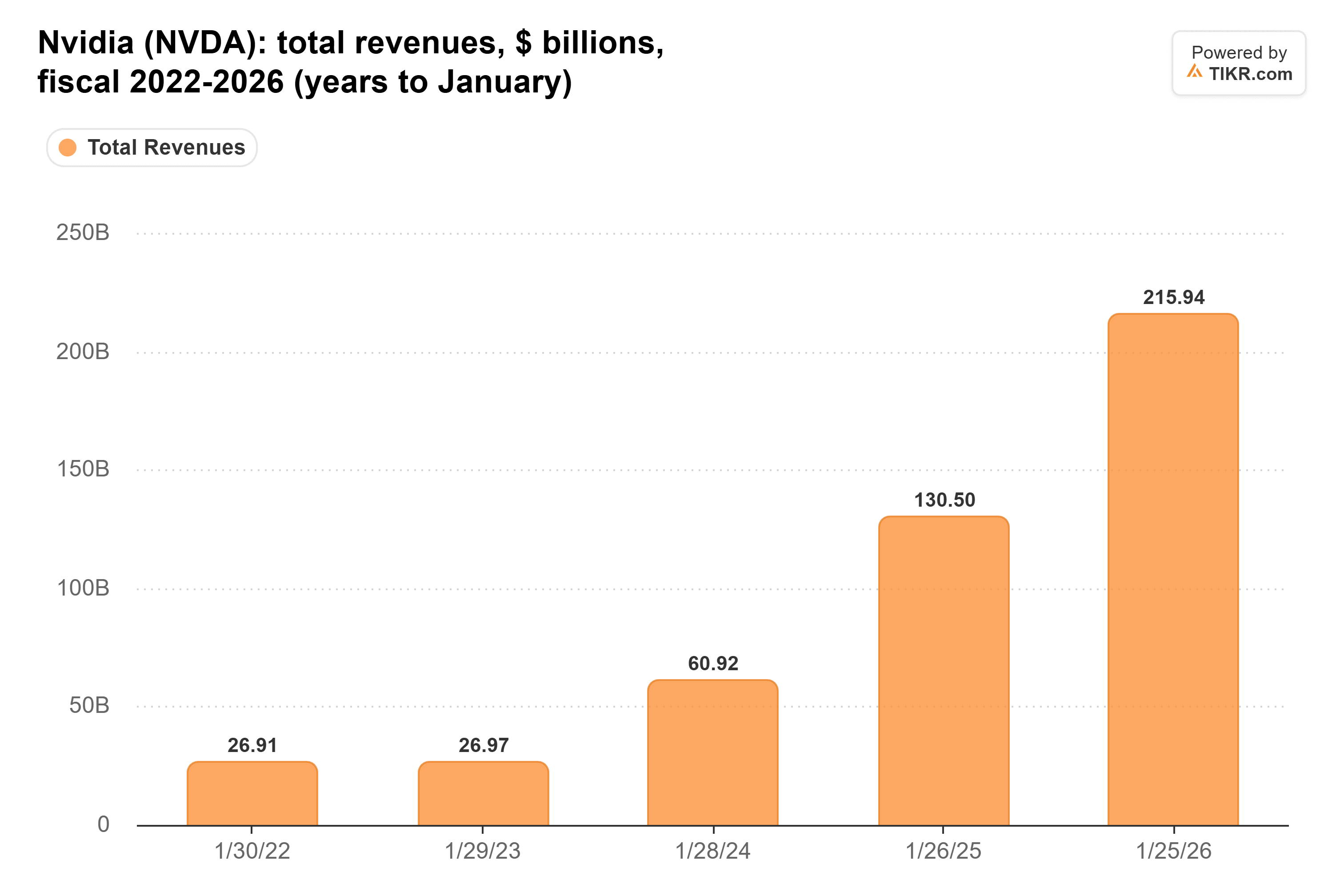
NVIDIA investors have been through a stall before. Revenue was flat at $27.0 billion in fiscal 2023, and GAAP operating margin fell to 15.7% from 37.3%. Then revenue grew eightfold to $215.9 billion over the next three years as the AI boom took off:
Venture capitalist Tomasz Tunguz sees how it could happen again. On This Week in Startups, he said chips are already sitting in warehouses because there isn’t enough electricity to run them. His warning: “at some point, NVIDIA bookings plateau just because we can’t deploy them within the US, and then you have a seismic shock to those stocks.”
That worry is harder to dismiss after the election. Customers headquartered in the US brought in $149.6 billion of NVIDIA’s revenue in fiscal 2026, 69.3% of the total.
Fiscal 2028 isn’t the problem
The next 12 months don’t look like where that cut would land. Management guides fiscal 2028 revenue up about 70% and says supply limits that figure. It also says customers’ forecasts point to growth doubling. And revenue has beaten the top of NVIDIA’s guidance in each of the last three quarters.
Jim Cramer made the bull case on Mad Money on Nov. 5. If NVIDIA just meets estimates, he said, “you’d have a stock with a growth rate of 70% that’s selling for less than 12 times next year’s earnings.” Consensus backs up his growth figure: going from $9.31 to $15.91 is a 71% jump.
Cramer added the catch himself: “But it is not a bargain if the following year can’t grow any further because the U.S. won’t permit new data centers as fast as they do now.”
Brown is right that the risk is lopsided. But a 5% trim to next year’s earnings won’t take 40% off NVIDIA. A cut to fiscal 2029, the year both Cramer and Tunguz worry about, could. At 15x, the stock already prices in much of that fear, and that discount works as a cushion as long as the fiscal 2028 outlook holds.
Of course, the first test comes Nov. 17, when NVIDIA reports third-quarter results against guidance of $108.0 billion, plus or minus 2%. What management says about fiscal 2028, and whether customers start pulling back on US data center plans, will matter more than the quarter itself.
So what is NVIDIA stock actually worth?
TIKR lets you forecast the future price of any stock in less than a minute. Just enter a few assumptions into TIKR’s valuation model and see what NVIDIA could be worth. Start from Wall Street consensus estimates, or adjust the inputs to reflect your own view of the business. It’s free to use.
Disclaimer:
Please note that the articles on TIKR are not intended to serve as investment or financial advice from TIKR or our content team, nor are they recommendations to buy or sell any stocks. We create our content based on TIKR Terminal’s investment data and analysts’ estimates. Our analysis might not include recent company news or important updates. TIKR has no position in any of the stocks mentioned. Thank you for reading, and happy investing!