Key Takeaways
- At today’s prices, about 10,085 shares of Kinder Morgan (about $316,600) or about 5,715 shares of Williams Companies (about $380,400) would each pay $1,000 a month in dividends.
- Kinder Morgan’s 3.8% yield saves about $63,800 up front, while Williams’ dividend grew faster, 4.6% a year from fiscal 2020 to fiscal 2025 against Kinder Morgan’s 2.2%.
- Both cover their dividends about twice over with distributable cash flow, and analysts expect Kinder Morgan’s coverage to rise to 2.40x this year.
- For a retiree who wants $1,000 a month, I’d take the cheaper Kinder Morgan check and watch how much cash it has left after its growth spending.
Any retiree hunting for a steady dividend check will end up looking at natural gas pipelines like Kinder Morgan (KMI) and Williams Companies (WMB). Both just reported strong third quarters, and both are building new projects to serve LNG exports and power plants.
So consider a hypothetical retiree who wants $1,000 a month from one of them. At today’s prices, Kinder Morgan’s 3.8% yield means it takes about 10,085 shares, or about $316,600. Williams yields 3.2%, so it takes about 5,715 shares, or about $380,400.
That’s a gap of about $63,800 for the same $1,000 a month. So is Williams worth the extra money?
| Stock | Shares | Cost | Yield | Income a month | Distributable cash flow coverage, fiscal 2025 / fiscal 2026 est. |
|---|---|---|---|---|---|
| Kinder Morgan (KMI) | 10,085 | $316,619 | 3.8% | $1,000 | 2.07x / 2.40x |
| Williams Companies (WMB) | 5,715 | $380,448 | 3.2% | $1,000 | 2.39x / 2.28x |
Sources: TIKR, StockAnalysis; today’s prices and each company’s current dividend rate.
6 safe dividend stocks paying retirees 6%+ yields
There are over 100 stocks paying 6%+ annual dividends today.
But after an extensive investment review leveraging TIKR’s proprietary data, we now believe only six of them are truly safe for retirees.
They’re all yours as part of our new investment report. Learn more about how to get access right here.
Kinder Morgan has more projects than ever
Kinder Morgan had a strong third quarter. Adjusted EBITDA rose 9% from a year earlier to $2.18 billion. Natural gas gathering volumes rose 14% and transport volumes rose 3% as LNG exports, power plants and industry pull more gas. The expansion backlog ended September at $14.4 billion, including $13.2 billion of natural gas projects, the largest in its history.
Executive Chairman Richard Kinder said on the third-quarter call: “We have assets that generate large amounts of recurring cash flow. We are in a business that is in need of substantial additional infrastructure.”
Management now expects 2026 to beat its budget by more than 6% on Adjusted EBITDA and by more than 13% on Adjusted EPS. That beat is a big part of why analysts expect distributable cash flow of $2.86 a share this year, up from $2.42 in fiscal 2025.
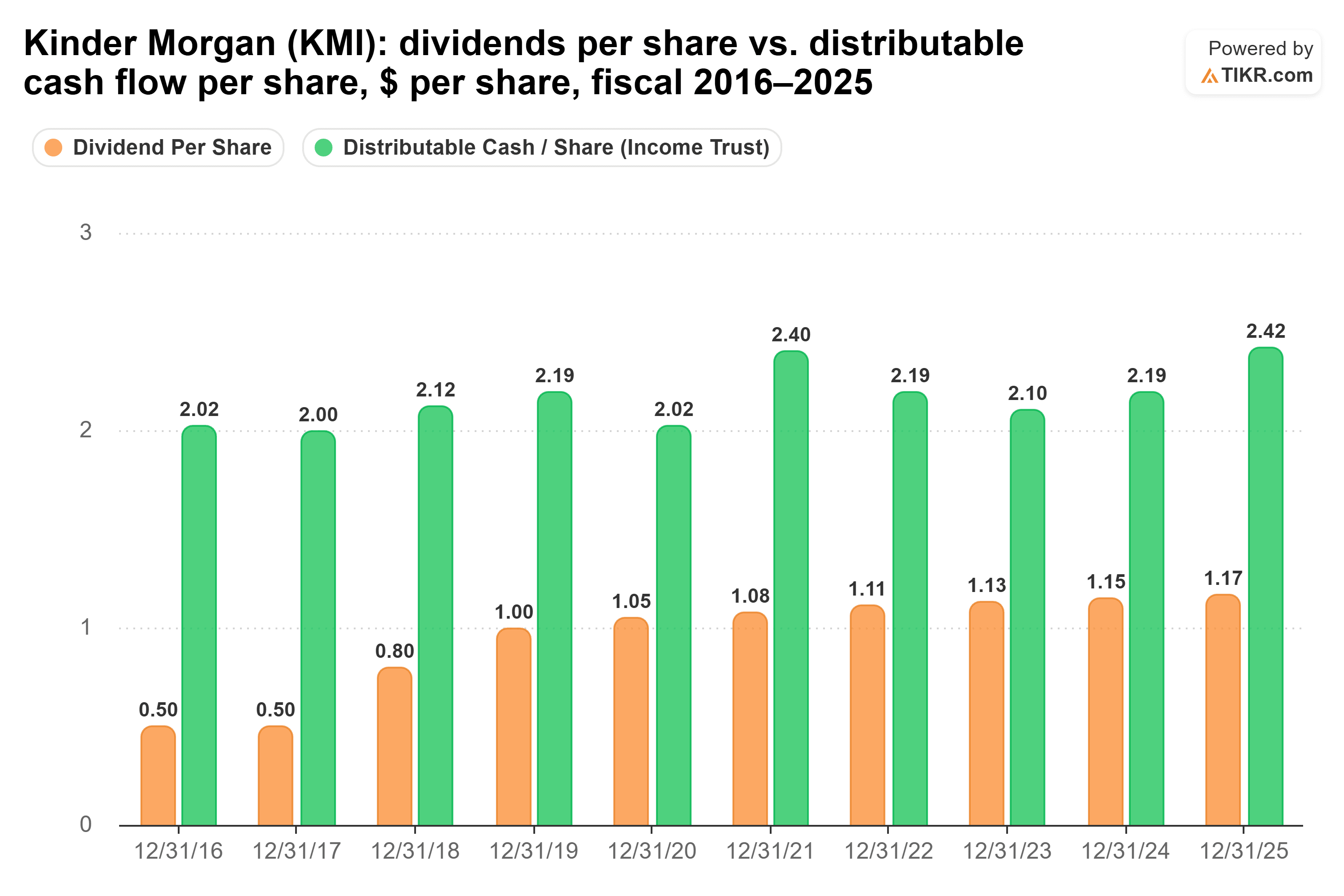
On Oct. 21, Kinder Morgan raised its quarterly dividend 2% from a year earlier to $0.2975 a share, or $1.19 a year. Fiscal 2025’s $2.42 a share of distributable cash flow covered $1.17 of dividends 2.07x. Coverage hasn’t dropped below its fiscal 2023 low of 1.86x in any year since fiscal 2016:
Williams costs more, and its dividend grows faster
Williams is chasing the same demand for natural gas, and it’s spending heavily to get there. It expects $7.3 billion to $7.9 billion of growth capex this year. That includes power projects like Socrates, which came fully online ahead of schedule, and the Momentum Midstream acquisition in the Haynesville, which also closed early.
Williams already has results to show for it. Third-quarter Adjusted EBITDA rose 6% from a year earlier to $2.04 billion. Management expects 2026 to land in the upper half of its $8.3 billion to $8.5 billion guidance, and it targets Adjusted EBITDA growth of more than 11% a year through 2030.
CFO John Porter made clear on the third-quarter call that the growth has to pay off: “We don’t want to get to the end of this and find that we’ve lost any ground in terms of the great track record we’ve had on cash returns on invested capital.”
The dividend grew 4.6% a year from fiscal 2020 to fiscal 2025, rising to $2.00 a share from $1.60. It’s now $2.10 a year. The $0.525 a share Williams declared on Oct. 27 matched the quarter before, at its 2026 rate. In fiscal 2025, $4.78 a share of distributable cash flow covered the dividend 2.39x. Coverage has held between 2.32x and 2.39x over the last three fiscal years, up from 1.72x in fiscal 2020:
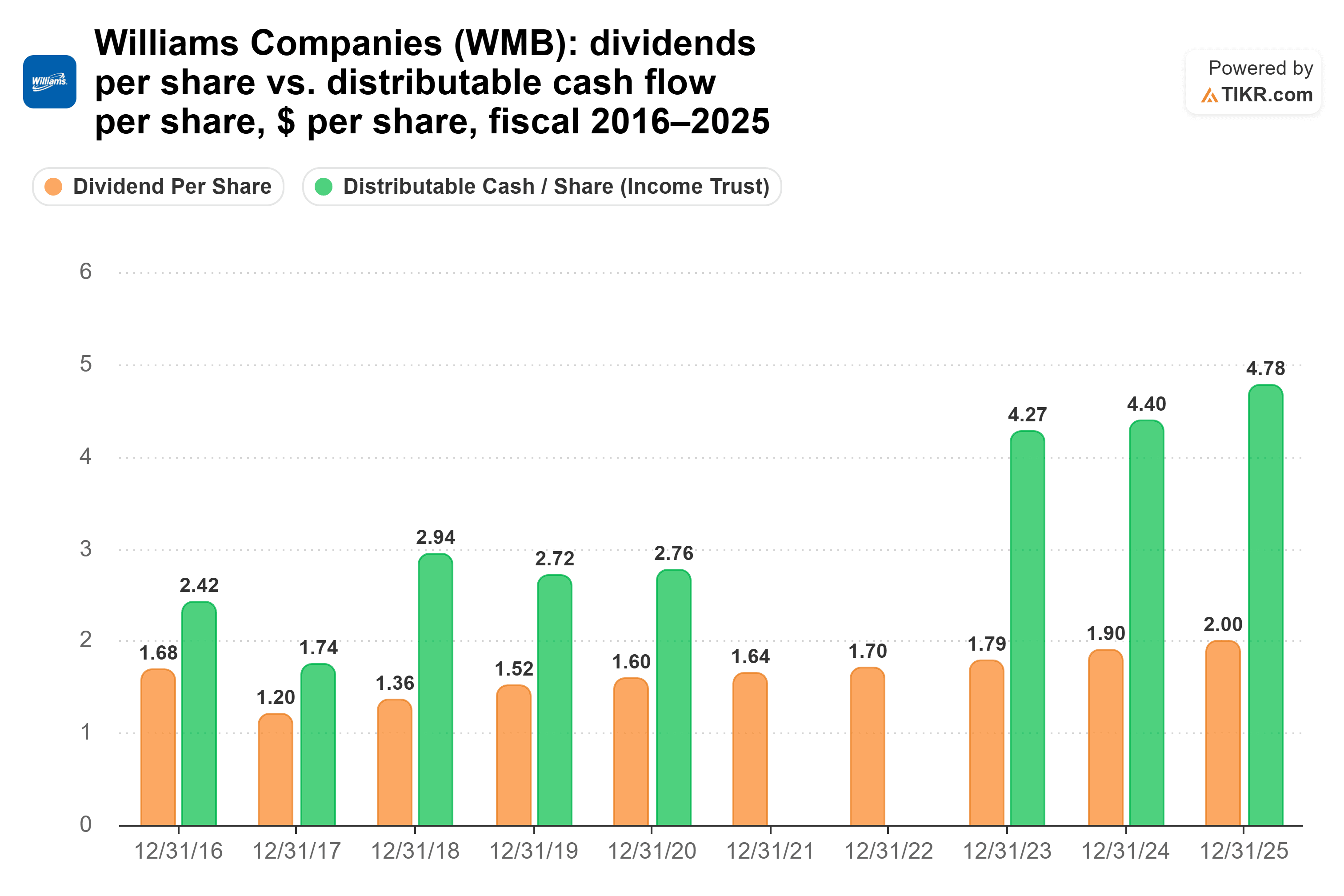
Analysts expect coverage to slip to 2.28x this year, since distributable cash flow per share should reach only $4.81 while the dividend rises to $2.11. That’s still well-covered. Management has said its leverage will be tightest in 2026 and 2027, before the growth spending pays off.
I’d take the cheaper check
Kinder Morgan has the lower coverage on fiscal 2025’s figures, so it’s the one to test for a cut. It has cut before: it paid $1.60 a share in fiscal 2015 and $0.50 in fiscal 2016. (Williams cut too, from $2.45 in fiscal 2015 to $1.20 in fiscal 2017.)
But the less covered of the two isn’t a risky check today. Kinder Morgan covers its dividend about twice over, and analysts expect 2.40x this year. Its Net Debt-to-Adjusted EBITDA ended September at 3.5x, the low end of its target range. And Richard Kinder bought 500,000 shares on Nov. 6, about $15 million worth.
What I’d watch is the cash left over. Free cash flow after capital spending and dividends was just $230 million through the first nine months of 2026. CEO Kimberly Dang expects capex of “around $4 billion-ish for the next few years.” That leaves little room for bigger raises, though plenty of coverage for the dividend Kinder Morgan pays now.
Williams’ case is growth. At 4.6% a year, its 5,715 shares would pay about $17,900 in year 10, against about $14,600 from Kinder Morgan’s shares at 2.2%. The market already charges for that: Williams trades at 26x forward earnings, against 20x for Kinder Morgan.
If I could only pick one for $1,000 a month, it’d be Kinder Morgan. It costs about $63,800 less, its coverage is rising, and its executive chairman is buying. Of course, if Kinder Morgan’s free cash flow after dividends stays this thin while it builds out its $14.4 billion backlog, I wouldn’t expect much more than those 2% raises.
Forget Kinder Morgan: 6 safe 6%+ dividend yields you can buy right now
Dividends can hold the key to enormous wealth. But only if you buy the right ones.
Picking the right high-yield dividend stock can be the difference between a dream retirement…and scraping by every month, waiting for the next Social Security check to clear.
We’ve identified six stocks yielding 6%+ that we believe every retiree should know about right now. (And Kinder Morgan isn’t one of them.)
Disclaimer:
Please note that the articles on TIKR are not intended to serve as investment or financial advice from TIKR or our content team, nor are they recommendations to buy or sell any stocks. We create our content based on TIKR Terminal’s investment data and analysts’ estimates. Our analysis might not include recent company news or important updates. TIKR has no position in any of the stocks mentioned. Thank you for reading, and happy investing!