Key Takeaways
- Constellation Energy shares rose about 13% after Google agreed to buy about 3.6 gigawatts of its power, including a 20-year contract for 890 megawatts of new nuclear capacity.
- A week after Amazon’s 20-year deal, this shows Constellation’s nuclear fleet becoming a business built on long contracts, and that kind of business deserves a higher valuation.
- The main risk is that long contracts could lock Constellation into prices below what scarce power fetches on the open market.
- Before Tuesday’s jump, Constellation traded at 21.6 times forward earnings, below its three-year average of 26.2 times.
Constellation Energy (CEG) shares are up about 13% on Tuesday after Google agreed to buy a huge chunk of its power: about 3.6 gigawatts, with new nuclear capacity making up roughly a quarter of it.
That comes just a week after Amazon (AMZN) signed its own 20-year deal with Constellation, which TIKR covered last week.
Two of the biggest AI spenders in one week. That’s a pattern.
What exactly happened
Google parent Alphabet (GOOG) signed a 20-year power purchase agreement (a long-term contract to buy a plant’s output) for 890 megawatts of new nuclear capacity. The power comes from “uprates”: new turbines, steam generators, and digital controls that get more power out of 11 existing reactors in Illinois, Pennsylvania, and New Jersey. The first is due in 2028.
On top of that, Google agreed to buy another 2.7 gigawatts from Constellation’s existing plants for 15 years. The companies say the whole deal will unlock more than $4.3 billion of new investment by Constellation.
Why Google needs this
Over the past four years, Google’s capital spending has climbed almost fourfold, to $91.5 billion in 2025…
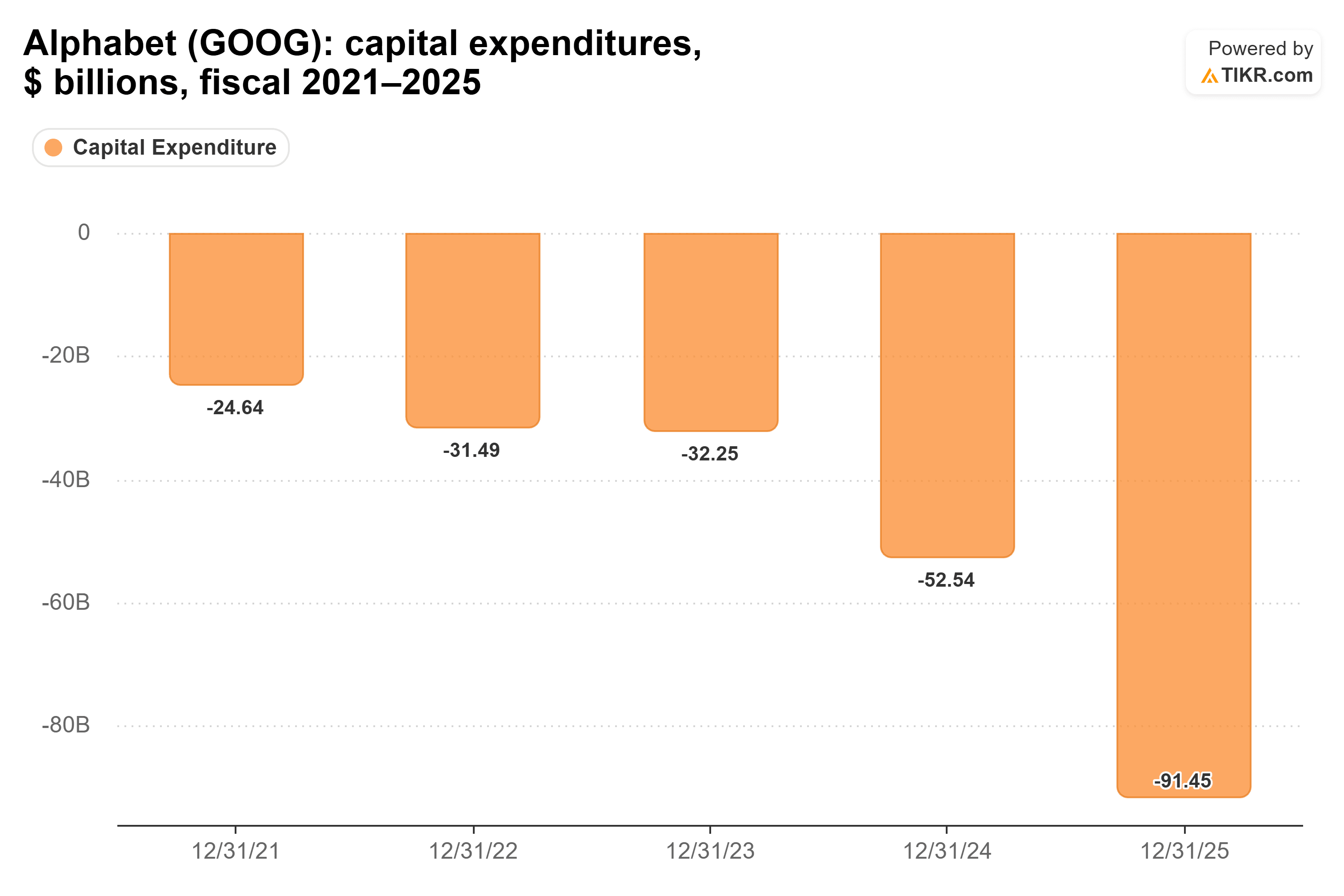
…and all those data centers need power around the clock, which is getting harder to come by. PJM, the largest US grid, has proposed that data centers either bring their own power or risk being cut off at times of peak demand, and the companies said this deal responds to that “bring your own power” proposal.
As Morgan Stanley’s Ariana Salvatore said on the firm’s Thoughts on the Market podcast last week, AI spending can continue, but “likely it’s going to increasingly concentrate in locations where developers can address concerns around things like electricity costs, infrastructure, water, and community impacts.”
For a lot of Big Tech, Constellation solves that problem. It now has 20-year deals with four of the biggest AI spenders:
- Microsoft (MSFT), to restart a reactor at Three Mile Island
- Meta Platforms (META), for the output of its Clinton plant in Illinois
- Amazon, for 690 megawatts from its Calvert Cliffs plant in Maryland
- Google, for 890 megawatts of uprates
Here’s the thing: a power producer selling into the open market lives and dies by swinging power prices. A fleet tied up in 15- and 20-year contracts with the richest companies on Earth earns income you can plan around, a lot like a utility. And investors pay more for that.
Isn’t Constellation leaving money on the table?
The obvious objection: power is getting scarce, so long contracts could lock Constellation into prices below what its power would fetch on the open market in 2035 or 2040. (Neither company’s announcement, as reported, gives a price.)
That’s a real trade-off, and I’d take it. The certainty is what lets Constellation commit $4.3 billion to new capacity. And if PJM’s proposal goes through, big buyers will need their own power badly enough to pay up for it.
Analysts already expected Constellation’s revenue to jump to $35.5 billion this year, from $25.5 billion in 2025, and reach $38.5 billion by 2028…
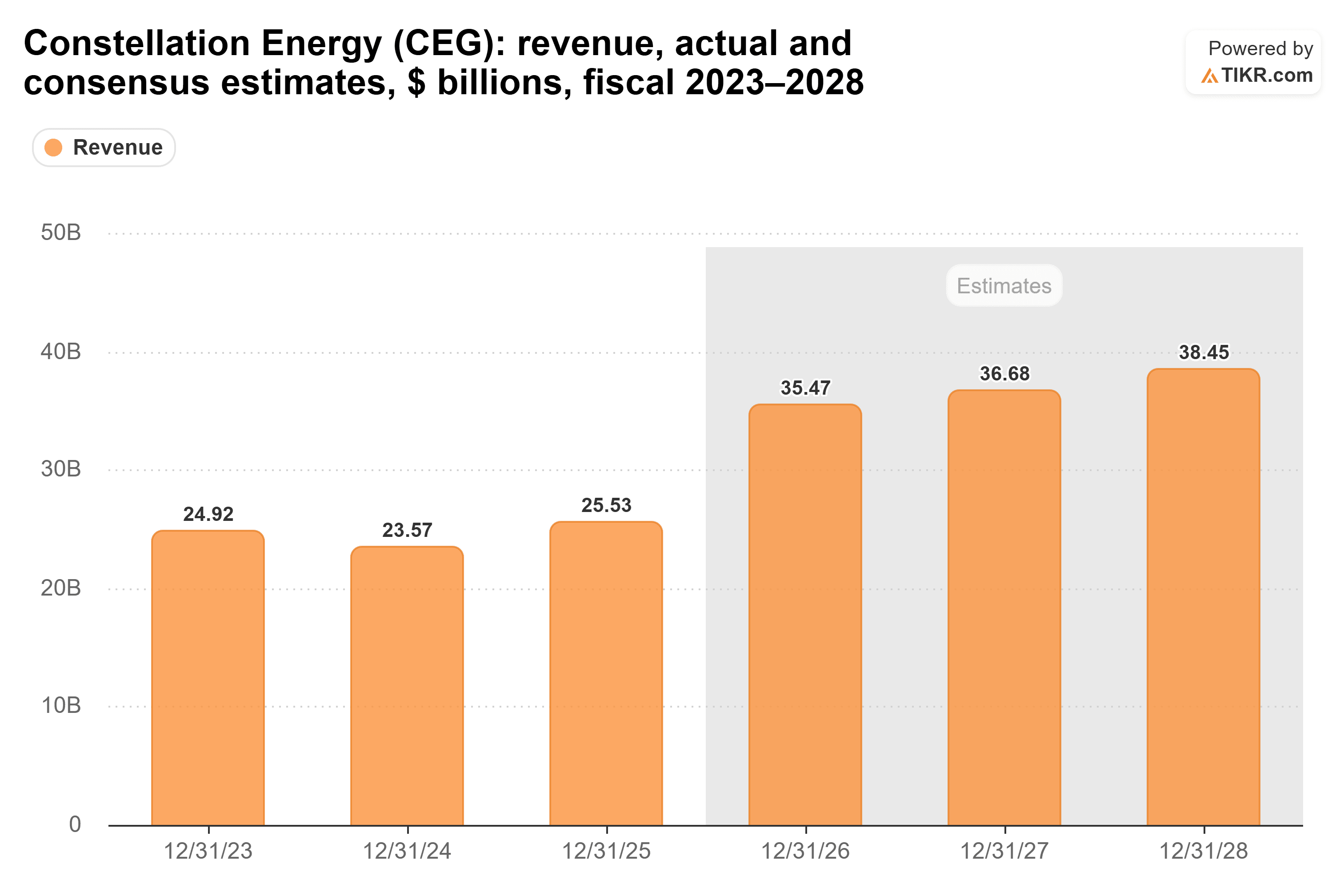
Most of this year’s jump comes from Calpine, the power producer Constellation finished buying in January. And I wouldn’t expect Tuesday’s deal to move these estimates much soon: the new nuclear power doesn’t flow until 2028, and the 2.7 gigawatts comes from plants Constellation already runs. What the deal changes is how confident you can be in those numbers.
So does it deserve a higher multiple?
I think so, and the market isn’t paying it yet. Going into Tuesday, Constellation traded at 21.6 times forward earnings. That’s below its three-year average of 26.2 times and far off its peak of 37.8 times last October…
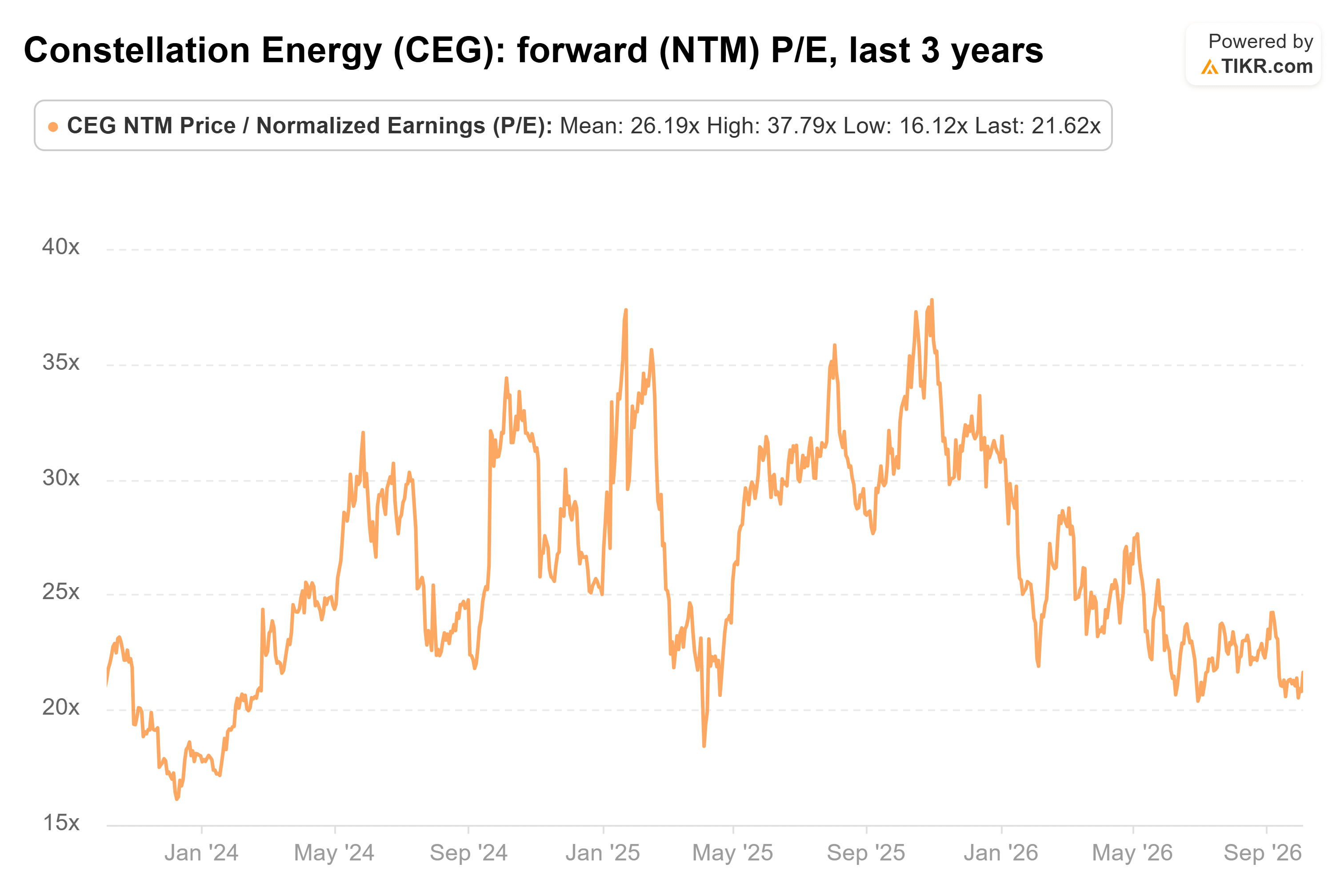
With today’s jump added in, the multiple comes to roughly 24 times (assuming earnings estimates hold), which is still under that average.
Google’s bet, coming days after Amazon’s, tells me contracts with the big tech companies are becoming the core of Constellation’s business, and the stock’s multiple doesn’t fully reflect that yet.
Of course, PJM’s plan is still only a proposal, and the first uprate isn’t due until 2028, so plenty has to go right between now and then.
So what is Constellation Energy stock actually worth?
TIKR lets you forecast the future price of any stock in less than a minute. Just enter a few assumptions into TIKR’s valuation model and see what Constellation Energy could be worth. Start from Wall Street consensus estimates, or adjust the inputs to reflect your own view of the business. It’s free to use.
Value Constellation Energy for free
Disclaimer:
Please note that the articles on TIKR are not intended to serve as investment or financial advice from TIKR or our content team, nor are they recommendations to buy or sell any stocks. We create our content based on TIKR Terminal’s investment data and analysts’ estimates. Our analysis might not include recent company news or important updates. TIKR has no position in any of the stocks mentioned. Thank you for reading, and happy investing!