Key Takeaways
- OpenAI’s annualized revenue was approaching $50 billion at the end of September, about $20 billion below the figure previously reported, according to the Financial Times.
- Computer scientist Cal Newport says the AI labs’ bet on ever-larger models won’t pay off, and that Google is set to win with cheaper models built into products people already use.
- Analysts expect Alphabet’s revenue to grow from $403 billion in 2025 to $738 billion in 2028, and its operating margin was 32% in 2025.
- Microsoft already owns roughly 27% of OpenAI and trades at 26.4x forward earnings, below its three-year average of 30.0x.
OpenAI’s revenue scare knocked tech stocks lower on Thursday. But according to one computer scientist, OpenAI’s bigger problem is Alphabet (GOOG).
The Financial Times reported that OpenAI’s annualized revenue was approaching $50 billion at the end of September, about $20 billion below the figure previously reported. A day later, Bloomberg reported that OpenAI expects to reach or exceed $70 billion by the end of the year.
On Friday’s episode of Prof G Markets, Georgetown computer science professor Cal Newport was asked what keeps Sam Altman up at night. His answer: if general-purpose chatbots stop being a good business, “they really have to worry that Google is going to eat their lunch economically speaking.”
That’s a far bigger worry than any one revenue figure.
Bigger stops paying off
Newport’s case starts with the technology. The labs are betting that ever-larger models will keep getting better at everything. He thinks the gains have become “jagged,” concentrated in coding, math, and cybersecurity. His verdict is blunt: “They’re not going to scale, and I think that bet is not going to pay off.”
Instead, he expects “plenty of models that are open weight or cheap or even run on device” that will “do well enough” when they’re paired with the right agents.
If good enough wins, the edge goes to whoever can serve AI cheapest to the most people. Newport thinks that’s Google: “So Google is going to develop lower-cost models, run on custom hardware, they have the data center cloud infrastructure really dialed in.” Then it builds those answers into Search and Workspace, where people already spend their day.
Alphabet doesn’t need the breakthrough
That’s a comfortable spot for Alphabet, because its AI doesn’t have to pay for itself. Analysts expect revenue to climb from $403 billion in 2025 to $738 billion in 2028…

Analysts expect Alphabet to add roughly $96 billion in revenue in 2026 alone, which is nearly twice OpenAI’s entire run rate.
The growth is profitable, too. Alphabet’s operating margin was 32.0% in 2025, up from 27.4% in 2023, and it got there while spending heavily to build out its AI…
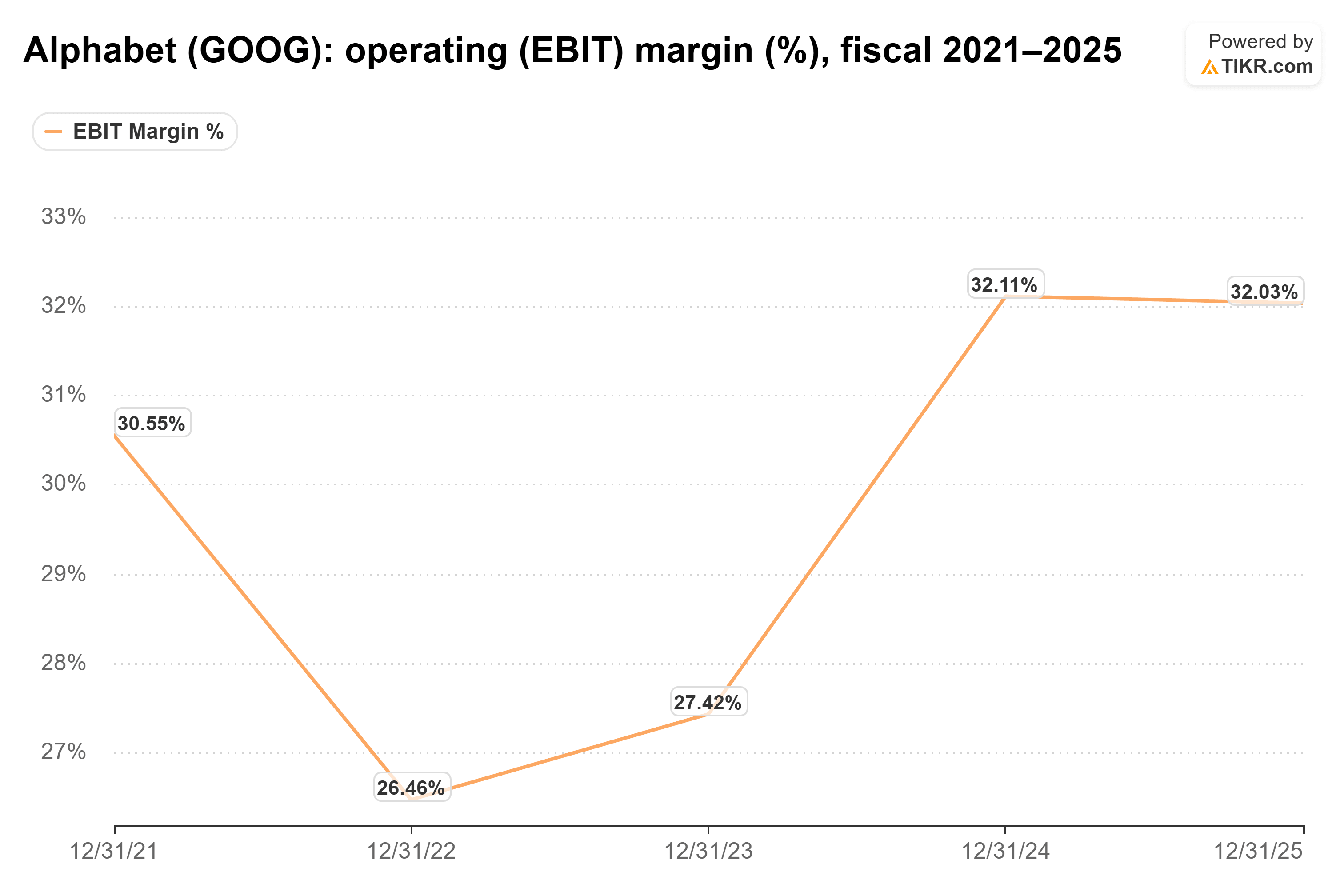
That margin is the cushion behind Newport’s argument. Alphabet can afford to sell AI cheaply inside Search because the rest of the business already pays the bills. OpenAI has to make its money from AI itself.
OpenAI’s growth still counts
The strongest case against Newport is how fast OpenAI is growing. Getting from about $50 billion in September to $70 billion by December would be a 40% jump in a single quarter. It would also show that customers are paying up for frontier models right now.
Newport’s point is about what comes after that. As cheaper models get good enough, he expects rivals to “pick apart the specific things people are using ChatGPT for that are useful” and build them into their own products. That’s a pricing problem, and it shows up in margins long before it shows up in a run rate.
Microsoft is the backstop
Newport’s endgame for OpenAI runs through Redmond. If Google wins on search and work tools, he said, OpenAI ends up “probably being, you know, acquired by Microsoft in a competitive bid against Google’s dominance.” He called that “a financial nightmare scenario for OpenAI.”
The same scenario looks a lot less scary from Microsoft’s (MSFT) side. Microsoft already owns roughly 27% of OpenAI, the stake both companies announced when OpenAI recapitalized in late 2025. And the market isn’t paying up for its AI story. Microsoft trades at 26.4x forward earnings, below its three-year average of 30.0x and well off its 37.0x peak in July 2024…

Buying the rest of a weakened OpenAI (and this is pure speculation) would put its models fully under Microsoft’s roof, at a price well below what OpenAI commands today.
Alphabet wins either way
I think Newport has the direction right. If bigger models keep paying off, Alphabet still has a frontier lab with a $400 billion business behind it. If they stop paying off, cheaper models inside Search and Workspace are exactly where the money goes.
Either way, Google gets its lunch.
Of course, this is one computer scientist’s read on where the technology goes. OpenAI’s run rate at year-end will be the first real test of it.
So what is Alphabet stock actually worth?
TIKR lets you forecast the future price of any stock in less than a minute. Just enter a few assumptions into TIKR’s valuation model and see what Alphabet could be worth. Start from Wall Street consensus estimates, or adjust the inputs to reflect your own view of the business. It’s free to use.
Disclaimer:
Please note that the articles on TIKR are not intended to serve as investment or financial advice from TIKR or our content team, nor are they recommendations to buy or sell any stocks. We create our content based on TIKR Terminal’s investment data and analysts’ estimates. Our analysis might not include recent company news or important updates. TIKR has no position in any of the stocks mentioned. Thank you for reading, and happy investing!