


Key Takeaways
- St. Louis Fed President Alberto Musalem said on Thursday that rates “ought to be going up further” over the next six to nine months. The Fed already raised its benchmark rate to a range of 3.75% to 4.00% in September.
- President Trump has blamed the Fed’s board for September’s hike, and the Fed’s next decision comes on Oct. 28, days before the midterm elections.
- Musalem says heavy borrowing by the AI hyperscalers is helping push rates up, and rate hikes do little to slow that borrowing.
- Big banks like JPMorgan Chase and Bank of America grew revenue through the last hiking cycle, but JPMorgan already trades at 3.0x tangible book value, near its five-year high.
If you own JPMorgan Chase (JPM) or Bank of America (BAC), a Fed official just handed you some good news. President Trump is unlikely to see it that way.
On Thursday, St. Louis Fed President Alberto Musalem told Bloomberg Talks that “more monetary policy firming will be required” to bring inflation back to target in a timely way. On rates, he said they “ought to be going up further in an appropriate period of time in the next six to nine months.”
That would come on top of the Fed’s Sept. 16 hike, its first since 2023, which took its benchmark rate to a range of 3.75% to 4.00%.
Cue the fireworks.
Trump vs. a “hostile board”
President Trump wants lower rates, and he isn’t shy about saying so. After the September hike, he blamed a “hostile board” that Fed Chair Kevin Warsh, his own pick, couldn’t overpower.
On Wednesday, the day before Musalem’s interview, he went further: “You have a board that would like to see the country do badly, in my opinion, because I think interest rates should come down.”
Minutes released that same day showed most Fed officials expect another hike this year, and the next decision comes on Oct. 28, days before the midterms. (Musalem says he hasn’t prejudged that meeting.)
Blame it (partly) on Big Tech
The interesting part is why Musalem thinks rates have to keep climbing. Booming investment and consumer spending are pushing real rates up, he said, and two big borrowers are adding to the pressure:
“As we all know, hyperscalers have switched from positive free cash flow a year ago to negative free cash flow now. They’re accessing capital markets in large size.”
The other is the US government. Musalem calls the pair “two large non-interest sensitive borrowers.”
That’s the Fed’s bind. Rate hikes do little to slow Amazon (AMZN), Microsoft (MSFT), Alphabet (GOOG) and Meta Platforms (META) as they borrow to build data centers. As Fidelity’s Jurrien Timmer put it on The Compound and Friends, “the hyperscalers could care less where rates are because they go into the market, they borrow bonds, and they’ll make a 30-40% return on that debt issuance because they’re building a data center.”
So who does feel the hikes? Musalem was blunt: those big borrowers “are likely going to be putting some financing pressure on the interest rate sensitive borrowers, so households, small businesses, even large businesses.”
Not great if you’ve got a loan to refinance.
Big banks get paid for this
Some companies do come out ahead when rates rise, and big banks top the list: they can charge more on loans faster than they have to pay up on deposits.
JPMorgan’s last hiking cycle shows it. Its revenue dipped to $122 billion in 2022, the year the Fed started hiking, then climbed to $167 billion by 2024 and held at $168 billion in 2025…

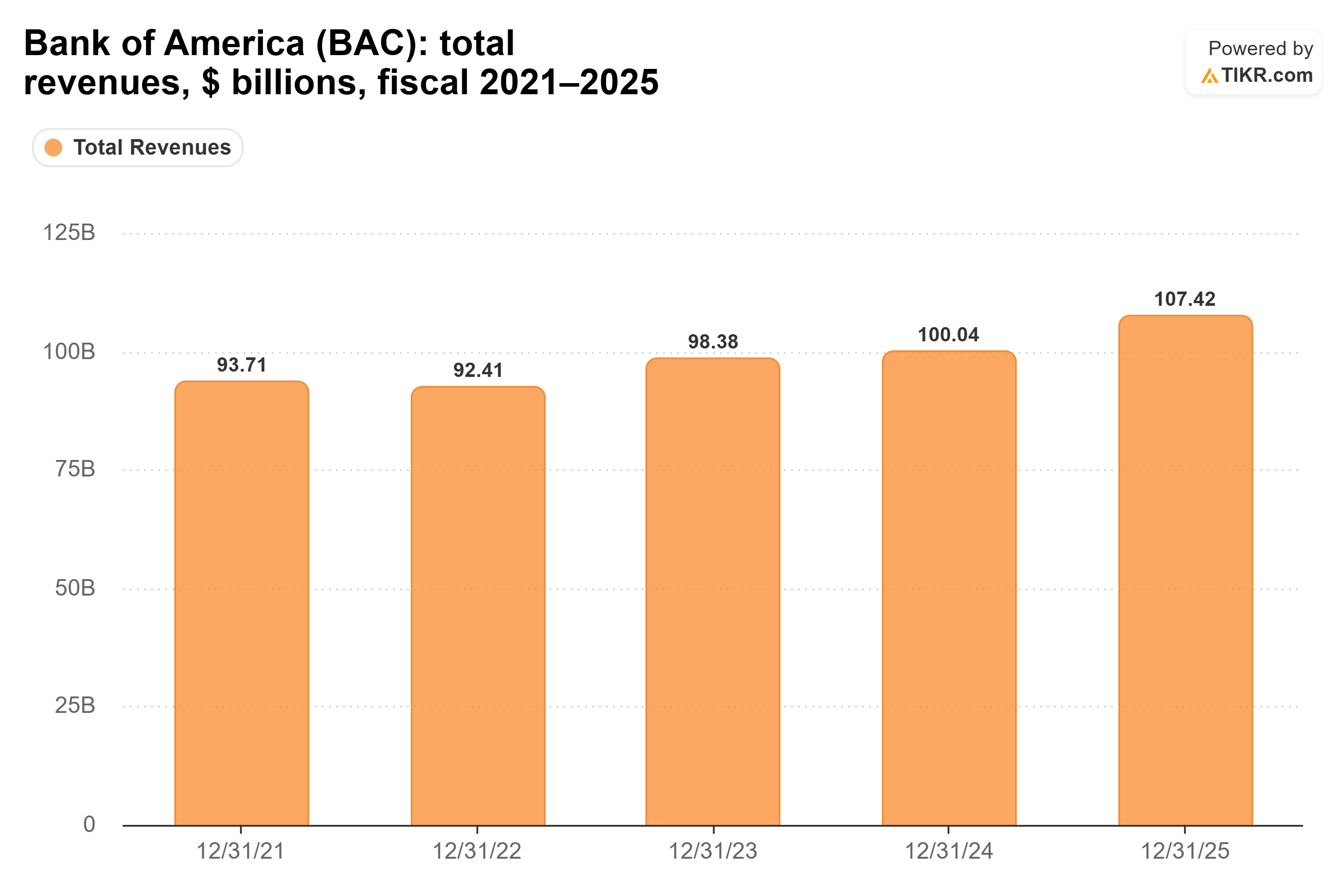
Bank of America shows the same pattern on a smaller scale, and its huge deposit base makes it one of the most rate-sensitive of the big banks. Its revenue rose from $92.4 billion in 2022 to $107 billion in 2025…
The catch? Investors already know all this. JPMorgan trades at 3.0x tangible book value. That’s well above its five-year average of 2.3x, and not far off the 3.3x high it hit in August…

(Its five-year low, 1.5x, came in October 2022, right in the middle of the last hiking cycle.)
Don’t expect the Fed to blink
Rising rates help banks, but only up to a point. The households and small businesses Musalem expects to take the hit are the same people who borrow from banks, so the hikes that boost lending income could also push loan losses higher.
Even so, I think Musalem has the direction right. Inflation is still running above the Fed’s target, September’s hike was unanimous, and I can’t see the Fed changing course just because the President is angry. If rates keep climbing, I’d rather be in the big banks than betting against the Fed, though you should know you’re paying a premium for JPMorgan.
Of course, not everyone at the Fed is eager to keep going. Vice Chair Philip Jefferson and New York Fed President John Williams have both said they may wait for more data, and September’s jobs report came in soft. Oct. 28 should tell us how loud the fireworks get.
So what is JPMorgan Chase stock actually worth?
TIKR lets you forecast the future price of any stock in less than a minute. Just enter a few assumptions into TIKR’s valuation model and see what JPMorgan Chase could be worth. Start from Wall Street consensus estimates, or adjust the inputs to reflect your own view of the business. It’s free to use.
Disclaimer:
Please note that the articles on TIKR are not intended to serve as investment or financial advice from TIKR or our content team, nor are they recommendations to buy or sell any stocks. We create our content based on TIKR Terminal’s investment data and analysts’ estimates. Our analysis might not include recent company news or important updates. TIKR has no position in any of the stocks mentioned. Thank you for reading, and happy investing!


