


Key Takeaways for EQT Stock as of August 2026
- Earnings Miss, Bigger Guide: EQT’s Q2 adjusted EPS of $0.39 missed the $0.40 consensus as net income fell 73% YoY to $211M, but management raised full-year production guidance by ~90 Bcfe and trimmed capex by $25M.
- Buyback Pivot: EQT is nearing its $5B net debt target and plans to funnel free cash flow into aggressive share buybacks.
- Target Premium: The Street’s 25 analysts carry 17 buys, 4 outperforms, and 4 holds on EQT stock, with a $68 mean target sitting 26% above the $54 close.
- Model Upside: TIKR’s mid-case model pegs EQT stock at $107 by December 2030, implying 98% total return and 17% annualized gains from today’s $54 price.
EQT Stock’s Earnings Miss Masks a Bigger Buyback Pivot
EQT Corporation (EQT) missed Wall Street’s second-quarter profit target on July 21, posting adjusted earnings of $0.39 a share against a $0.40 consensus as net income sank 73% year over year to $211 million on weaker natural gas prices. Realized prices, including hedges, slipped to $2.65 per thousand cubic feet equivalent from $2.81 a year earlier, even as Henry Hub gas averaged just $2.89 per MMBtu for the quarter.
Sales volume still climbed to 634 billion cubic feet equivalent from 568 Bcfe a year earlier. Management used that outperformance to raise its full-year production forecast by roughly 90 Bcfe at the midpoint while cutting planned capital spending by $25 million, a combination that points to a company generating more gas for less money even in a soft-price quarter.
What matters more than the miss is what EQT plans to do with the cash it is still generating. CFO Jeremy Knop laid out the shift on the Q2 earnings call: “We are on the doorstep of achieving our long-term net debt target of $5 billion… we intend to accumulate cash, which we plan to aggressively deploy into share buybacks during the industry’s episodic down cycles.” That is a company pivoting away from years of debt paydown toward returning capital, right as its stock sits near a 52-week low.
The moves stacking behind that pivot reinforce it. EQT signed a 10-year gas supply deal with Competitive Power Ventures tied to PJM power pricing rather than a gas index, bought Blackline Midstream’s propane terminals for $77 million at what it called a 20% free cash flow yield, and locked in a five-year Asian LNG offtake agreement starting in 2028. None of those required much new capital, which is exactly the point: EQT is stacking demand-linked cash flow while keeping its capital base flat, freeing up more of that $330 million in quarterly free cash flow for buybacks instead of new wells.
The miss reflects a cyclical gas-price trough, not weaker execution, and the buyback signal is what should reset how investors price EQT stock from here.
EQT Stock’s Street Coverage Keeps Climbing Even After the Miss
Twenty-five analysts cover EQT stock as of August 24, split among 17 buys, 4 outperforms, 4 holds, and 1 no opinion. Their mean target sits at $68, 26% above that same day’s $54 close.
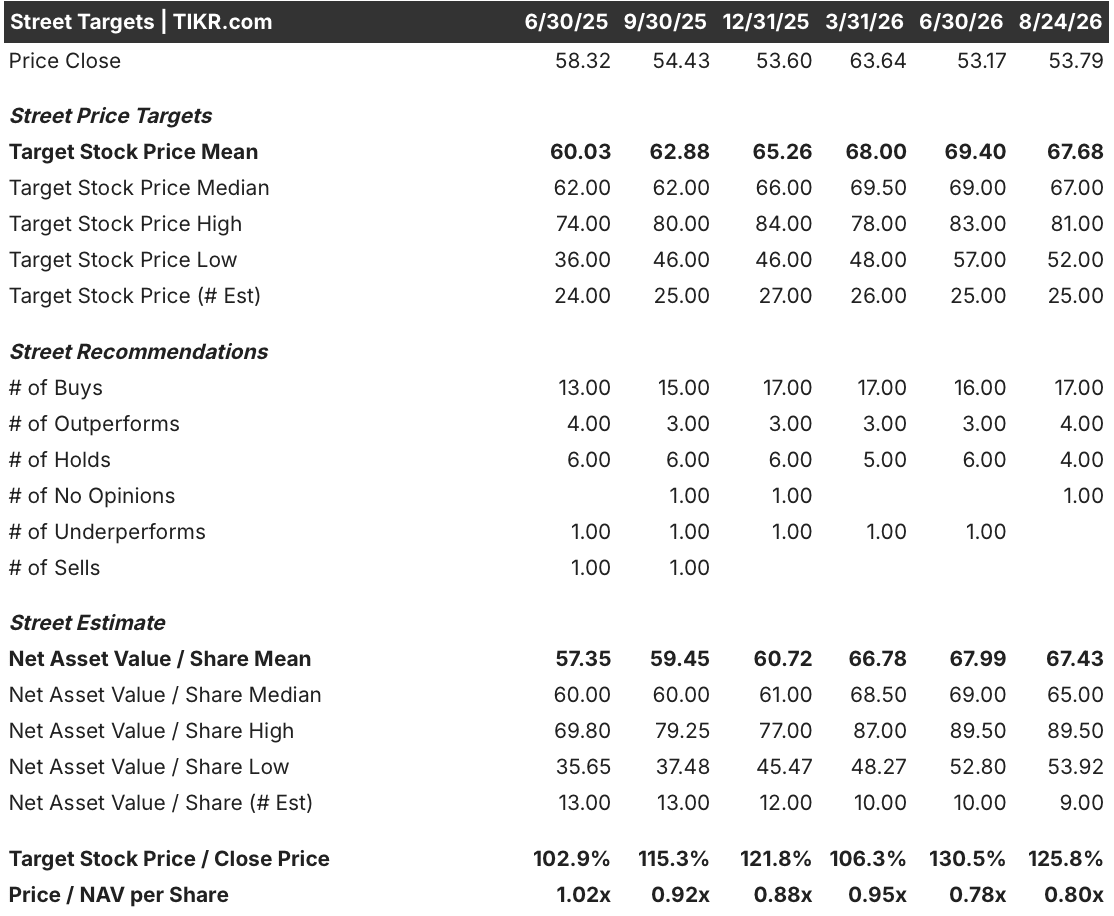
The multi-quarter trend backs up the buyback thesis more than it undercuts it. The mean target has climbed from $60 in June 2025 to $68 today, even as the stock round-tripped from $58 to a March 2026 high near $64 and back down to $54. Analysts kept raising targets through the first half of 2026 and only trimmed modestly after the Q2 miss. Barclays cut its target to $68 from $70 in mid-August, but that reduction barely dents the multi-quarter climb. Coverage has also held near 25 to 27 analysts throughout, showing no exodus despite the earnings shortfall.
TIKR Values EQT Stock at $107, Pricing a Buyback-Driven Repricing
TIKR’s mid-case model values EQT stock at $107 by December 2030, implying a 98% total return from the current $54 price, or 17% annualized over roughly 4.3 years.
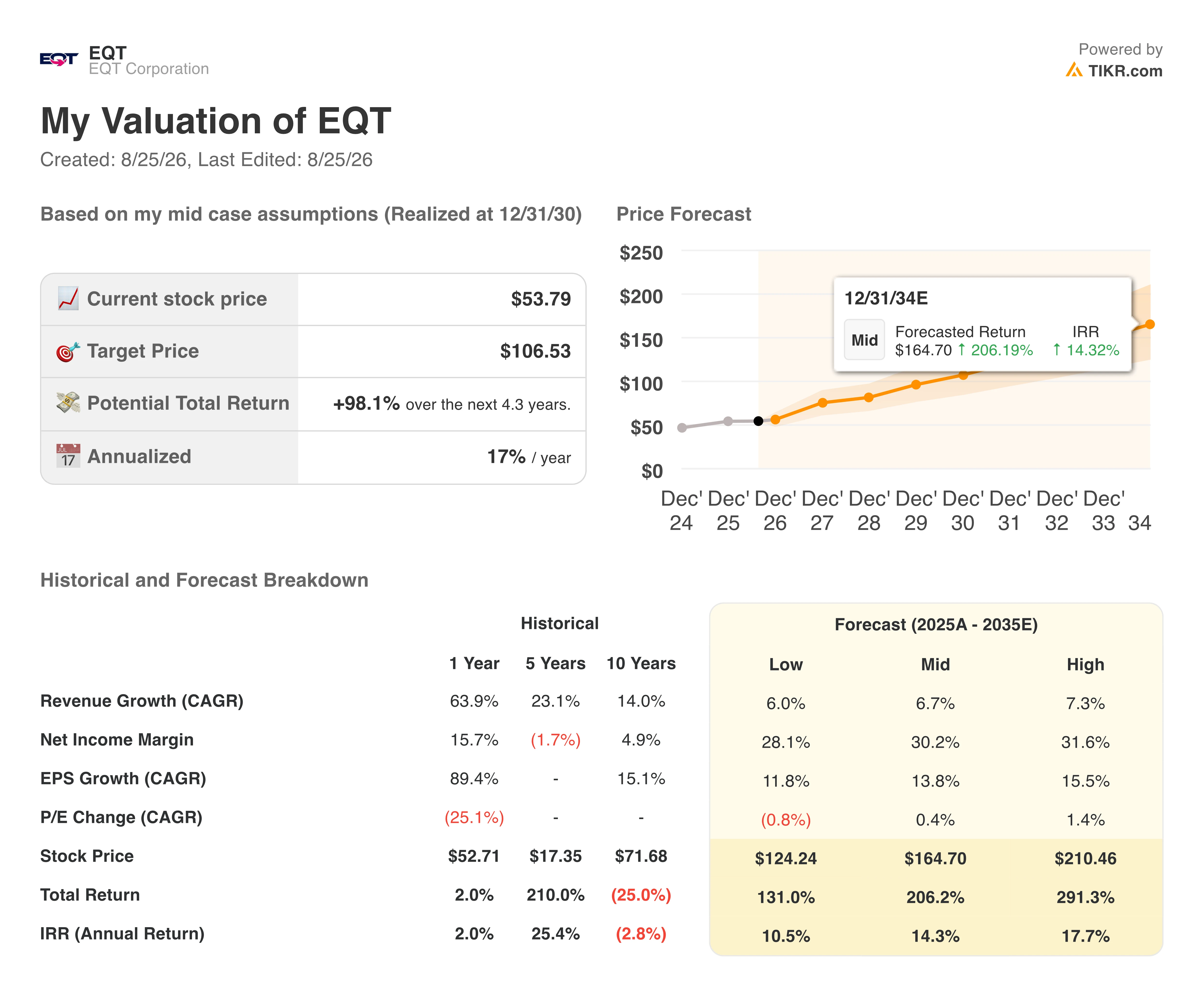
An annualized return in that range outpaces what large-cap gas producers trading near net asset value typically offer investors, positioning EQT stock as one of the more asymmetric setups among its integrated peers.
The model’s bullishness leans on the same forces driving Section 1: production outperformance from compression investment that is lowering base declines, a growing slate of demand contracts like the CPV agreement that add fee income without new capital, and a balance sheet close enough to its debt target to fund buybacks straight through the current gas-price trough.
The Street’s climbing mean target already treats $68 as achievable within a year. TIKR’s model treats that level as a floor on the path to $107, not a ceiling.
Should You Invest in EQT Corporation?
The only way to really know is to look at the numbers yourself. TIKR gives you free access to the same institutional-quality financial data that professional analysts use to answer exactly that question.
Pull up EQT Corporation stock and you’ll see years of historical financials, what Wall Street analysts expect for revenue and earnings in the quarters ahead, how valuation multiples have moved over time, and whether price targets are trending up or down.
You can build a free watchlist to track EQT Corporation alongside every other stock on your radar. No credit card required. Just the data you need to decide for yourself.
Access Professional Tools to Analyze EQT stock on TIKR for Free →
Looking for New Opportunities?
- See what stocks billionaire investors are buying so you can follow the smart money.
- Analyze stocks in as little as 5 minutes with TIKR’s all-in-one, easy-to-use platform.
- The more rocks you overturn… the more opportunities you’ll uncover. Search 100K+ global stocks, global top investor holdings, and more with TIKR.
Disclaimer:
Please note that the articles on TIKR are not intended to serve as investment or financial advice from TIKR or our content team, nor are they recommendations to buy or sell any stocks. We create our content based on TIKR Terminal’s investment data and analysts’ estimates. Our analysis might not include recent company news or important updates. TIKR has no position in any stocks mentioned. Thank you for reading, and happy investing!


