Key Takeaways
- Eli Lilly reports third-quarter results before the open on Thursday, Oct. 29, after a 10% gain in a week took the stock to a new 52-week high.
- The stock’s price depends on whether Lilly can keep cutting prices to reach more patients without giving up operating margin.
- Lilly’s operating margin rose to 45.6% in 2025 from 30.3% in 2023, and analysts expect normalized EPS to nearly double from 2025 to 2027.
- At 33x forward earnings, below its five-year average of 40x, the stock holds up if Thursday’s U.S. pricing, operating income and full-year guidance show the margin holding.
Eli Lilly (LLY) gained 10% in a week to a new 52-week high, and it reports third-quarter results before the open on Thursday, Oct. 29.
Everyone knows the patients are coming. A stock at its high needs this report to show that Lilly can keep cutting prices and still hold on to its operating margin.
Lilly has been trading price for patients
Lilly’s playbook for Mounjaro and Zepbound is to cut the price and let volume make up the difference. In 2025, its realized prices fell 6% and volume rose 50%. In the second quarter of 2026, prices fell 13% and volume rose 60%.
That math is why revenue could dip even as patient numbers grow. But the margin has moved the other way. On TIKR’s basis (before acquired research and special charges), Lilly’s operating margin sat around 30% from 2021 to 2023, then jumped to 37.8% in 2024 and 45.6% in 2025.

It kept widening in the second quarter of 2026. Revenue rose $7.4 billion from a year earlier and operating income rose $5.4 billion, so about 73 cents of each new dollar reached operating income. Gross margin rose to 85.8% from 84.3%, which Lilly credits to lower production costs and a better mix.
TIKR tracks 31 analysts on Eli Lilly. How many say “Buy”?
See the full breakdown of Buy, Hold, and Sell ratings on Eli Lilly, along with Wall Street’s revenue and earnings estimates, all in one place. More than 500,000 investors use TIKR to research stocks like this one. See Eli Lilly’s Analyst Ratings
The estimates need that margin to keep widening
Analysts expect normalized EPS of $34.46 this year and $47.39 in 2027, up from $24.21 in 2025.
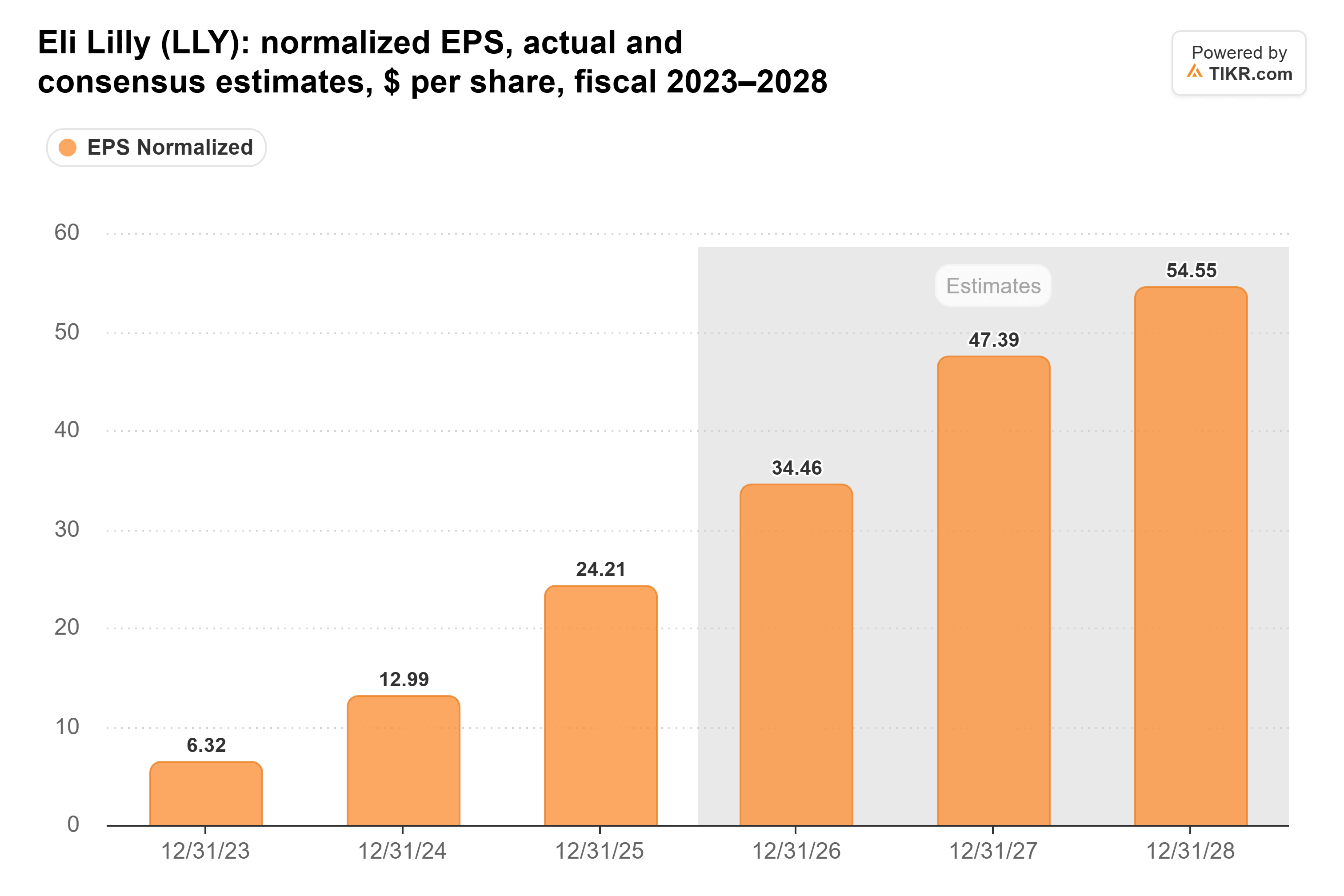
That’s nearly double in two years. Revenue isn’t expected to keep pace (consensus has it rising about 21% a year from 2025 to 2028), so the estimates lean on margin: they take Lilly’s normalized net margin from 33.4% in 2025 to 42.3% in 2028.
And the multiple leans on those estimates. At 33x forward earnings as of Oct. 27, Lilly trades below its five-year average of 40x, well off its 67x peak in October 2023 and above its 23x low in August 2025…
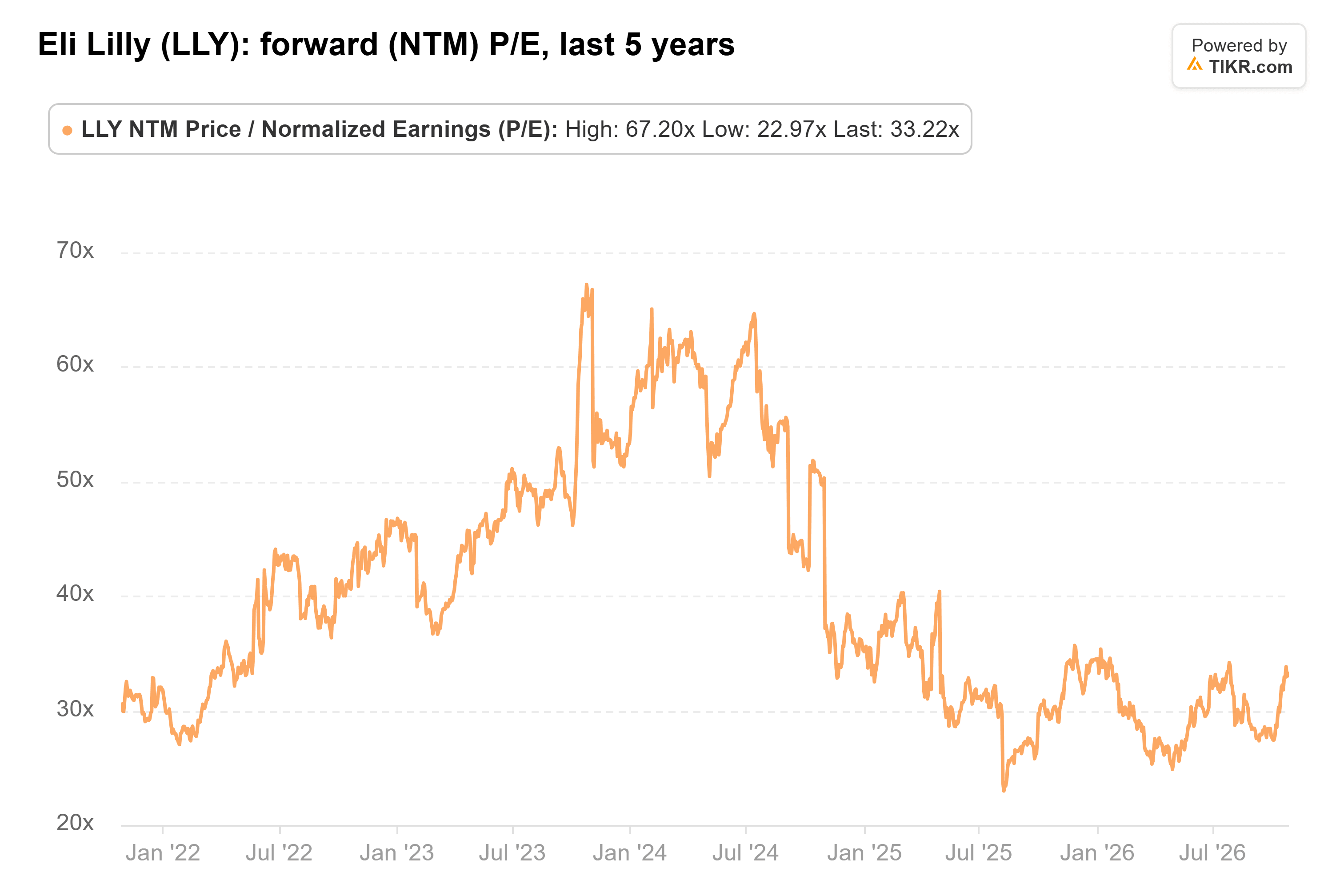
That 33x only looks reasonable if the earnings behind it show up. If margins slip and those estimates come down, the stock gets more expensive at the same price.
What Thursday has to show
Start with U.S. price excluding rebate-estimate adjustments. It fell about 9% in the second quarter, against 3% as reported, and Lilly’s CFO said on that call that he doesn’t expect those adjustments to continue in the second half. So the reported figure should land closer to the underlying one this time.
CEO Dave Ricks laid out the trade-off on the first-quarter call: “pretty much every time we reduce pricing, we see a pretty large expansion,” and he added that “there’s a floor on that.”
Then there’s guidance. Analysts already expect $88.7 billion of 2026 revenue, above the top of Lilly’s $85 billion to $87 billion range. If Lilly only holds that range, the Street stays ahead of the company, so guidance could move the stock more than the quarter itself.
Deal charges matter too. Lilly counts acquired research in its adjusted EPS, and that cost it $3.03 a share in the second quarter. Those charges ($2.8 billion, against $154 million a year earlier) plus $703 million of special charges pulled GAAP operating margin down to 39.1% from 44.1%.
The high holds if the margin does
My take: at 33x, below its own five-year average, Lilly stock is fairly priced as long as the margin keeps widening. For that, Thursday has to show U.S. pricing near the second quarter’s pace, operating income still growing faster than revenue, and a revenue range raised above $87 billion. If Lilly clears that bar, I think the stock has earned its new high.
Of course, one quarter won’t settle it. CVS restores Zepbound coverage in the fourth quarter, and the CFO has said to expect Zepbound’s price per prescription to fall when it does (he says that’s already in the guidance). Lilly’s long-term margin targets at its Dec. 7 investor update are the bigger test.
So what is Eli Lilly stock actually worth?
TIKR lets you forecast the future price of any stock in less than a minute. Just enter a few assumptions into TIKR’s valuation model and see what Eli Lilly could be worth. Start from Wall Street consensus estimates, or adjust the inputs to reflect your own view of the business. It’s free to use.
Disclaimer:
Please note that the articles on TIKR are not intended to serve as investment or financial advice from TIKR or our content team, nor are they recommendations to buy or sell any stocks. We create our content based on TIKR Terminal’s investment data and analysts’ estimates. Our analysis might not include recent company news or important updates. TIKR has no position in any of the stocks mentioned. Thank you for reading, and happy investing!