Key Stats for Eli Lilly Stock
- Current Price: $1,146.90
- Target Price (Mid): ~$2,130
- Street Target: ~$1,270
- Potential Total Return: ~86%
- Annualized IRR: ~15% / year
- Max Drawdown: 23.31% on 4/29/26
Now Live: Discover how much upside your favorite stocks could have using TIKR’s new Valuation Model (It’s free) >>>
What Happened?
Eli Lilly and Company (LLY) agreed on July 16 to acquire AtaiBeckley for up to $3.8 billion, and its own stock closed roughly flat. The target soared 33%. The buyer, signing what CNBC called the largest psychedelics deal in Big Pharma history, barely moved. That gap is the real story, and it is not only about scale. It is about a company acquiring assets so fast that the pace itself has become the thing investors, and now lawmakers, are scrutinizing.
Lilly is generating obesity-drug cash faster than almost any company in the S&P 500 and spending it at a speed management describes as relentless. For most of 2026, the market has cheered that. This month, a sharper question arrived: is every one of these deals a good one, and is the strategy behind them drawing the wrong kind of attention?
A Bet on Rewiring the Brain
AtaiBeckley develops neuroplastogens, meaning compounds designed to help the brain form new neural connections rather than just adjust chemical levels like standard antidepressants. Its lead candidate, BPL-003, is an intranasal psychedelic being tested for treatment-resistant depression, patients who have failed existing drugs.
Lilly is paying $6.75 per share in cash, about $2.8 billion upfront, plus a contingent value right worth up to $2.50 per share tied to milestones. That structure keeps roughly a quarter of the value linked to results BPL-003 has not yet produced. This is an announced agreement to buy a clinical-stage asset, not a product with revenue, and any depression franchise it points toward is years and several trials away. The stock did not react because the deal, on its own, does not move a company guided to $82 billion to $85 billion in 2026 revenue. What moves the thesis is what the deal represents.
See historical and forward estimates for Eli Lilly stock (It’s free!) >>>
The Pace Is the Point
AtaiBeckley is the latest entry in a cadence that has defined Lilly’s year. It is Lilly’s eleventh drugmaker acquisition of 2026, the most of any pharmaceutical company, according to BioPharma Dive. In Q1 alone, the company struck deals for Orna Therapeutics, Centessa Pharmaceuticals, Kelonia Therapeutics, and Ajax Therapeutics, spanning oncology, sleep, and genetic medicine. At the Goldman Sachs Global Healthcare Conference on June 9, Ken Custer, EVP and president of Lilly’s cardiometabolic health division, put a number on it.
“I believe we’re doing a deal every 9 days, but that may be starting to maybe 8 days,” Custer said. The logic behind that pace is that no drug class lasts forever, so Lilly is using its obesity windfall to diversify while it dominates. The risk is that a company buying an asset every eight days can overpay in hot markets, lose focus, or accumulate exposures that invite scrutiny. This month delivered an example of the last one.
Washington Just Supplied the Counterweight
On June 29, the House Select Committee on the Chinese Communist Party opened an investigation into five drugmakers, Lilly among them, over clinical trials run in China, requesting documents by July 17 on data protection, trial oversight, and ties to military-linked hospitals and sites in Xinjiang. The committee has stated it is examining data-governance risk and has not alleged wrongdoing by any company. It is an industry-wide inquiry, not a Lilly-specific charge, and it remains a request for information, not an enforcement action.
It lands on Lilly’s dealmaking directly. The same strategy funding AtaiBeckley has deepened Lilly’s China ties, including an oncology and immunology collaboration with Innovent Biologics worth up to $8.8 billion and an agreement with Haisco Pharmaceutical worth up to roughly $3 billion, both cited in the committee’s letter. The probe does not threaten near-term earnings. It does reframe the acquisition spree: aggressive capital deployment is a strength when every deal compounds and a liability when some of it draws political and compliance risk. That tension, not the psychedelics science, is what LLY holders are now underwriting.
The Cash Machine Behind It All
The reason a $3.8 billion deal barely registered is the free cash flow. Lilly generated $8.97 billion in 2025, and consensus estimates compiled by TIKR project roughly $24 billion in 2026 and above $30 billion in 2027. Net debt of $35.2 billion at the end of 2025 is forecast to fall toward zero and flip to a net cash position by 2027 on those flows. A company minting cash like that can absorb a $2.8 billion payment without noticing.
The engine is the incretin franchise. Q1 2026 revenue hit $19.8 billion, up 56% year over year, with Mounjaro and Zepbound contributing $12.8 billion combined, and non-GAAP EPS of $8.55 beat the $6.79 estimate by nearly 26%. Behind the current products sits retatrutide, Lilly’s investigational triple agonist, which delivered up to 28.3% average weight loss at 80 weeks and 30.3% in a 104-week extension, though it remains in Phase 3 and unapproved. That internally funded growth is what the acquisitions are meant to supplement.
Valuation is the standing tension. LLY trades near 24 times NTM EV/EBITDA, meaning enterprise value against next-twelve-month earnings before interest, taxes, depreciation, and amortization. Merck sits near 14 times, Novo Nordisk near 11, and Johnson & Johnson near 17 on TIKR’s data. The premium is defensible while growth runs at a multiple of peers, but it means any stumble, a slower obesity ramp or a costly China outcome, compresses the multiple fast.


See how Eli Lilly performs against its peers in TIKR (It’s free!) >>>
TIKR Advanced Model Analysis
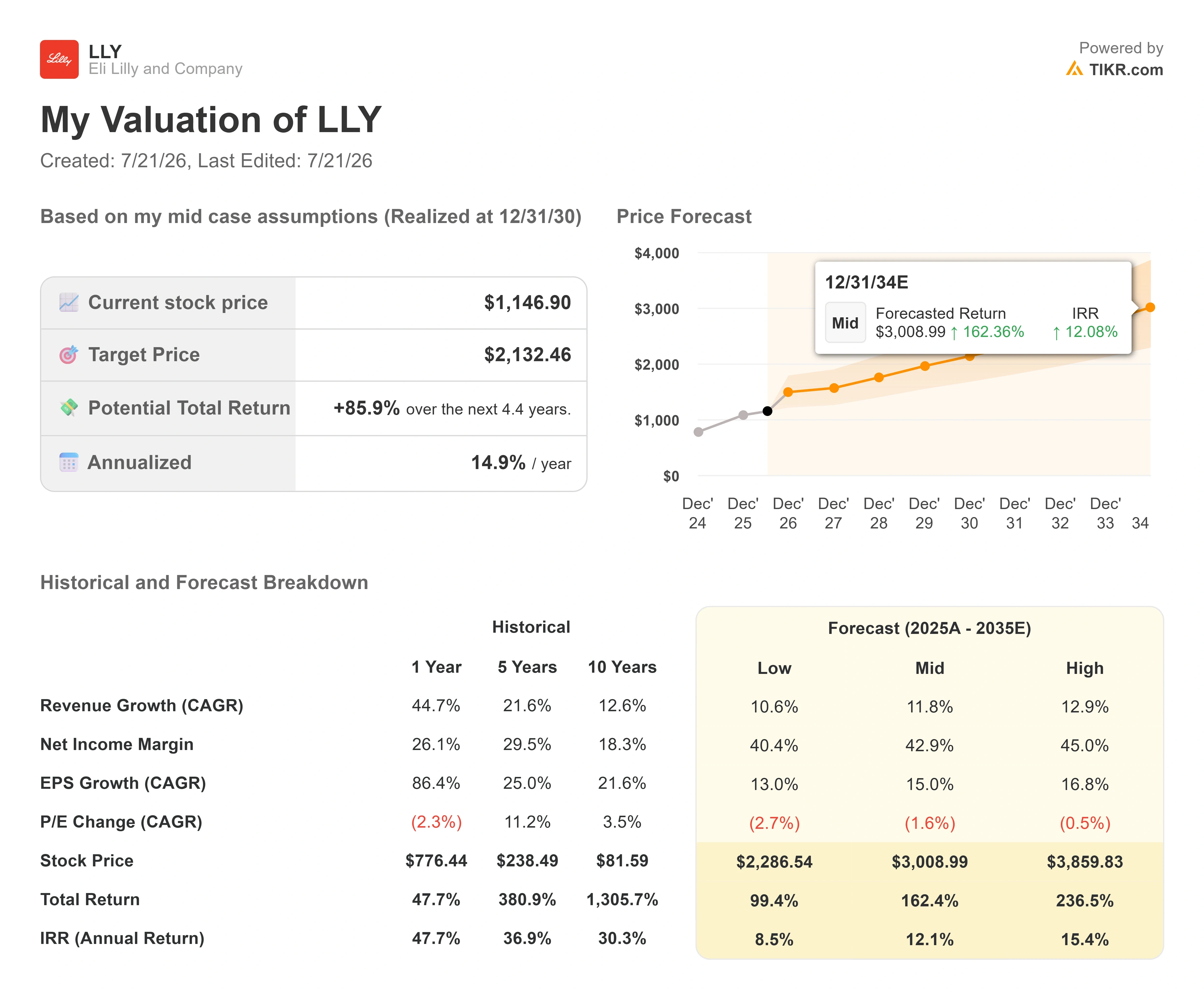
- Current Price: $1,146.90
- Target Price (Mid): ~$2,130
- Potential Total Return: ~86%
- Annualized IRR: ~15% / year
See analysts’ growth forecasts and price targets for Eli Lilly stock (It’s free!) >>>
The mid-case points to around $2,130, an annualized return near 15% per year over about 4.4 years. Two drivers carry it: continued injectable-incretin volume growth from Mounjaro and Zepbound, and widening access as Medicare’s GLP-1 Bridge and international launches add patients. The margin driver is operating leverage, with net income margin modeled toward the low-40% range as high-margin obesity products scale. The primary risk is pricing: realized prices fell 13% in Q1 as rebates, Zepbound cash-pay cuts, and China reimbursement pressured net revenue, and that headwind persists this year.
Upside: volume growth near 65% keeps overwhelming price erosion while the pipeline and acquisitions compound into new franchises. Downside: pricing pressure deepens, the China probe raises compliance costs, and the premium multiple contracts toward peers.
Conclusion
The psychedelics deal is a rounding error on Lilly’s cash flow, which is why the stock ignored it. The thing to watch is not the next acquisition but how Lilly handles the House committee inquiry and whether it widens beyond a document request. A quiet resolution confirms the dealmaking machine can keep running without friction, and the growth story stays clean. An escalation, new limits on China trials, or a broader compliance drag would put a real cost on a strategy the market has so far treated as free. The cash flow funding the spree is not in question. Whether every deal it funds is a good one is the question 2026 will answer.
See what stocks billionaire investors are buying so you can follow the smart money with TIKR.
Should You Invest in Eli Lilly?
The only way to really know is to look at the numbers yourself. TIKR gives you free access to the same institutional-quality financial data that professional analysts use to answer exactly that question.
Pull up Eli Lilly, and you’ll see years of historical financials, what Wall Street analysts expect for revenue and earnings in the quarters ahead, how valuation multiples have moved over time, and whether price targets are trending up or down.
You can build a free watchlist to track Eli Lilly alongside every other stock on your radar. No credit card required. Just the data you need to decide for yourself.
Analyze Eli Lilly on TIKR Free →
Looking for New Opportunities?
- See what stocks billionaire investors are buying so you can follow the smart money.
- Analyze stocks in as little as 5 minutes with TIKR’s all-in-one, easy-to-use platform.
- The more rocks you overturn… the more opportunities you’ll uncover. Search 100K+ global stocks, global top investor holdings, and more with TIKR.
Disclaimer:
Please note that the articles on TIKR are not intended to serve as investment or financial advice from TIKR or our content team, nor are they recommendations to buy or sell any stocks. We create our content based on TIKR Terminal’s investment data and analysts’ estimates. Our analysis might not include recent company news or important updates. TIKR has no position in any stocks mentioned. Thank you for reading, and happy investing!