

Key Takeaways
- Morgan Stanley’s Adam Jonas reiterated his Overweight rating and $300 target on SpaceX hours before Flight 15. The target is 116% above the Nov. 13 close, with the stock 31% below its June closing high.
- Jonas’s target works out to 99x analysts’ next-12-month earnings estimate, so it depends on 2027 estimates that analysts doubled in the past month.
- The bigger risk is concentration: one AI compute customer supplied 34.5% of SpaceX’s third-quarter revenue.
- Morgan Stanley could be right if SpaceX’s compute deals renew at today’s prices, but $170 of Jonas’s $300 rests on the AI business where that one customer supplies most of the sales.
SpaceX (SPCX) finally caught a Starship from orbit over the weekend, and the call riding on it most is Morgan Stanley’s. Adam Jonas reiterated his Overweight rating and $300 price target on Nov. 13, hours before Flight 15 lifted off. That’s 116% above the stock’s Nov. 13 close of $139.11, which left it 31% below its June closing high.
The spending keeps climbing
Third-quarter revenue rose 161% year over year to $14.6 billion, and the Super Intelligence (SI) segment supplied $7.6 billion of it, led by new cloud services agreements. But capex hit $19.6 billion in the quarter, more than revenue. And CFO Bret Johnsen guided fourth-quarter capex to $35 billion to $40 billion.
Starship has also fallen behind Elon Musk’s own dates. In August he talked about a flight a day within a year; in October, he said Starship would fly weekly “at some point in the first half of next year.” Then on Nov. 13, SpaceX called off Flight 15’s booster catch, and the booster was lost.
TIKR tracks 40 analysts on SpaceX. How many say “Buy”?
See the full breakdown of Buy, Hold, and Sell ratings on SpaceX, along with Wall Street’s revenue and earnings estimates, all in one place. More than 500,000 investors use TIKR to research stocks like this one. See SpaceX’s Analyst Ratings
Jonas got his catch
Before the flight, Jonas called a successful ship catch “one of the most significant potential catalysts in SpaceX’s nearly 25-year history.” On Nov. 14, the ship came back from orbit and was caught by the tower’s arms, a first that could cut Starlink’s launch costs if SpaceX can fly the same ship again quickly. Other firms updated on Nov. 16, the first trading day after the catch: Citi raised its target to $280 from $240, Bank of America kept its $275, Bernstein stayed at $268, and UBS at $230.
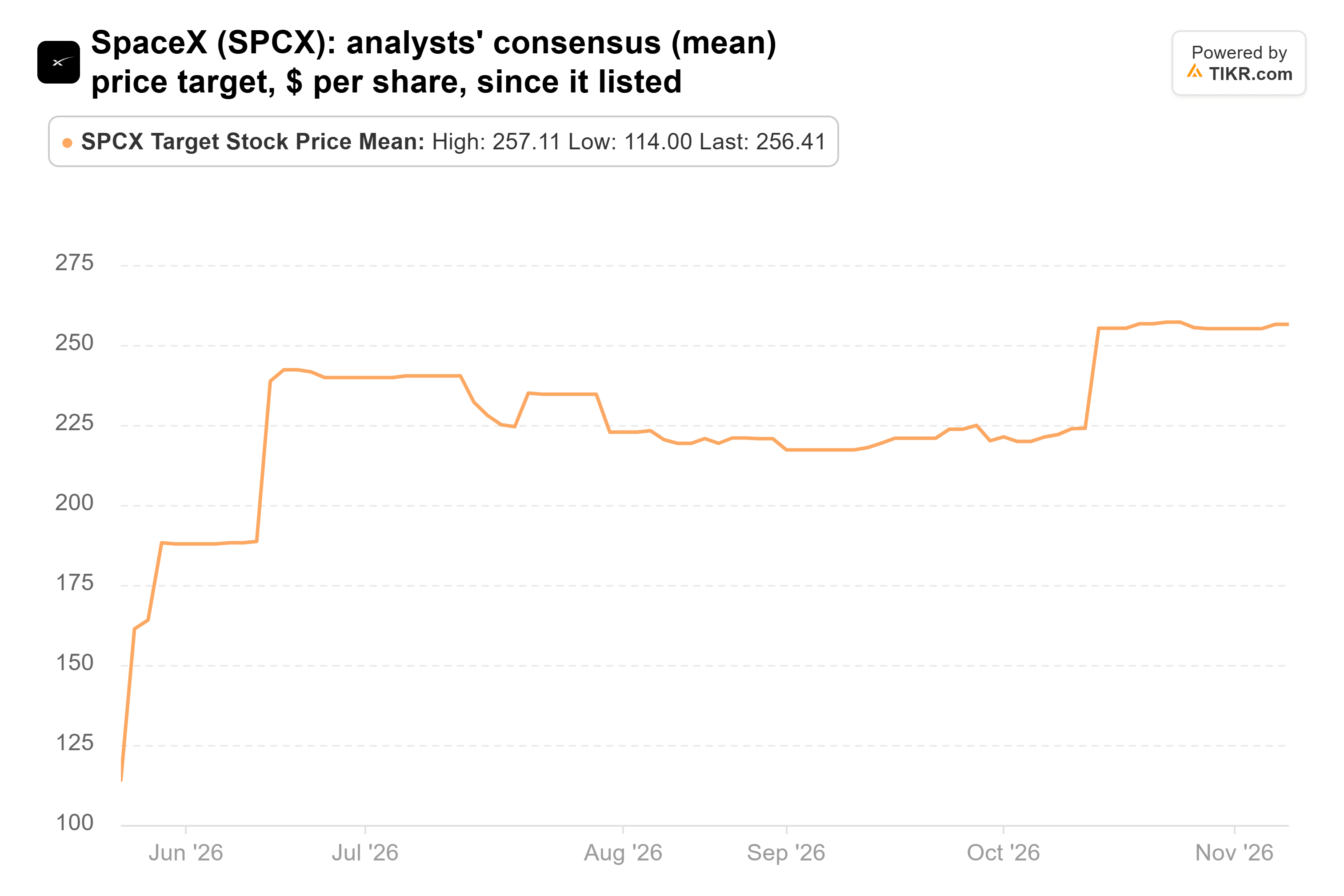
The consensus target has climbed his way, to $256 from $114 when SpaceX listed in June:
Analysts doubled their 2027 estimate in a month
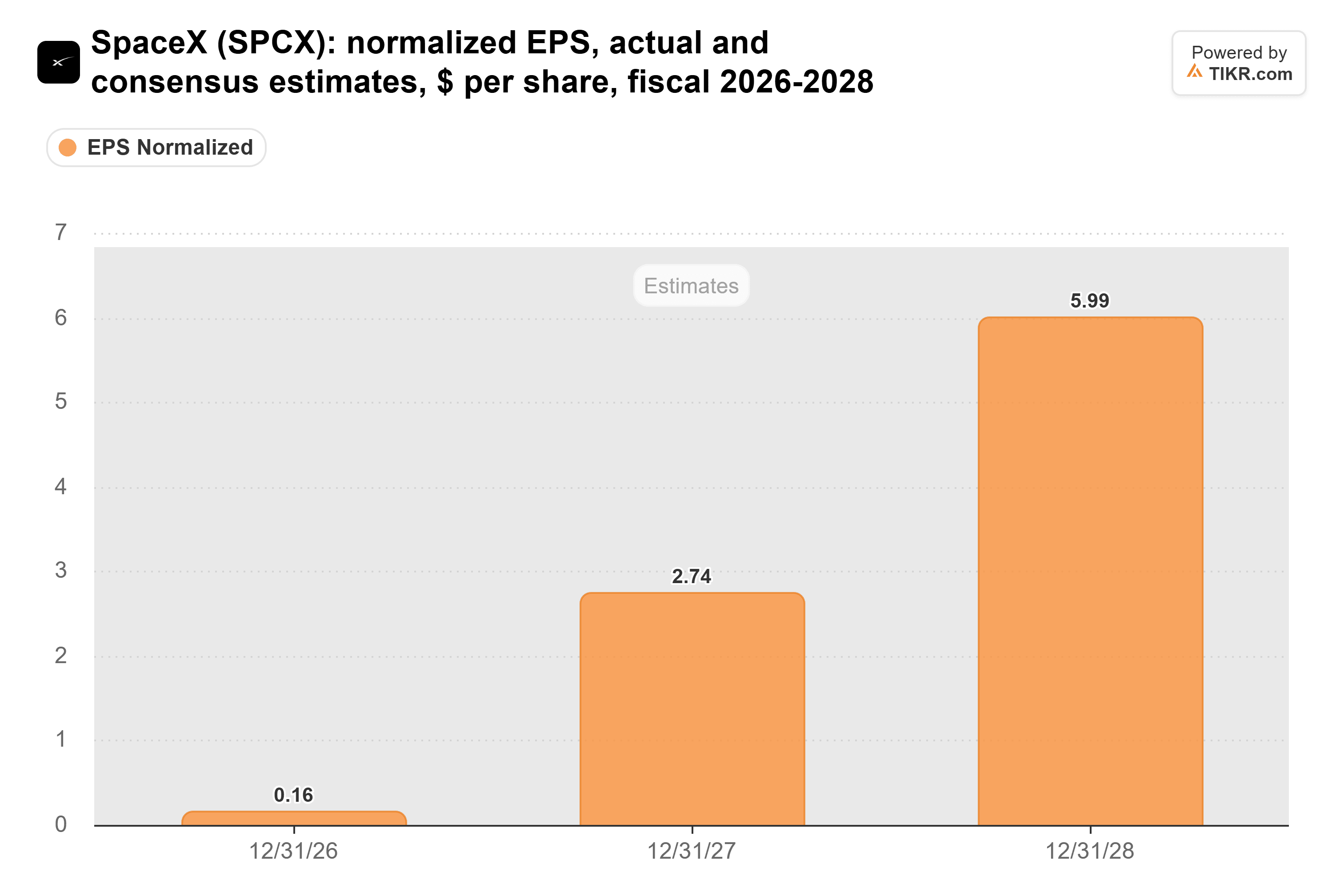
Morgan Stanley’s $300 works out to 99x analysts’ next-12-month earnings estimate. The stock traded at 46x at the Nov. 13 close, down from 97x at the end of September. The share price fell less than 10% over that stretch, so most of the drop came from higher estimates. Yahoo Finance’s consensus for 2027 earnings per share has more than doubled in the last 30 days, and TIKR’s normalized estimates show earnings more than doubling again in 2028:
One customer is a third of revenue
SI supplied $6.7 billion of the third quarter’s $9.0 billion year-over-year revenue increase. SpaceX’s quarterly report shows one SI customer alone supplied 34.5% of the quarter’s revenue, about two-thirds of the segment’s sales. Bloomberg has reported that the customer is Anthropic; neither company has confirmed it. SpaceX’s IPO prospectus says either side can end the Anthropic compute agreements on 90 days’ notice after an initial term.
So is Morgan Stanley totally wrong? No. If those compute deals renew at today’s prices, the estimates can keep climbing, and $300 in a year is possible. But $170 of Jonas’s $300 comes from enterprise AI, the business where one customer supplies most of the sales. The ship catch helps the Starlink side of his math; it says little about the part that carries most of the target.
Fourth-quarter results in early 2027 will show whether that customer’s share falls as SI revenue grows. After that comes first-quarter revenue, which management has guided to $33 billion to $37 billion, against $14.6 billion in the third quarter.
So what is SpaceX stock actually worth?
TIKR lets you forecast the future price of any stock in less than a minute. Just enter a few assumptions into TIKR’s valuation model and see what SpaceX could be worth. Start from Wall Street consensus estimates, or adjust the inputs to reflect your own view of the business. It’s free to use.
Disclaimer:
Please note that the articles on TIKR are not intended to serve as investment or financial advice from TIKR or our content team, nor are they recommendations to buy or sell any stocks. We create our content based on TIKR Terminal’s investment data and analysts’ estimates. Our analysis might not include recent company news or important updates. TIKR has no position in any of the stocks mentioned. Thank you for reading, and happy investing!


