Key Takeaways
- SpaceX caught a Starship upper stage returning from orbit for the first time on Nov. 14, though it lost the Super Heavy booster on the same flight.
- Starship spending is weighing on the Space segment, which posted a $7 million operating loss in the third quarter, against $259 million in operating income a year earlier.
- Most of the payoff from reusable ships would go to Starlink. Connectivity earned $2.37 billion in operating income last quarter, and 75% of the mass SpaceX put in orbit was its own payloads.
- The stock closed Friday at $139.11, about 3% above its $135 IPO price. A caught ship flying again quickly matters more to the stock than the first catch itself.
SpaceX (SPCX) caught a Starship upper stage with its launch tower for the first time on Saturday, Nov. 14, about 22.5 hours after Flight 15 lifted off from Starbase. Ship 42 flew 14 orbits and deployed 26 Starlink V3 satellites before the tower’s arms closed around it, CNBC reported. “Mechazilla has caught the Starship,” SpaceX’s Dan Huot said on the company’s livestream, Universe Today reported.
The flight wasn’t clean. The Super Heavy booster’s catch was called off minutes after liftoff on Friday, Nov. 13, when its onboard systems flagged a fuel-system problem, and it exploded before reaching the Gulf of Mexico. The catch also raises the bar for Rocket Lab (RKLB), whose reusable Neutron rocket hasn’t flown: Rocket Lab signed eight Neutron missions worth more than $515 million last quarter, but its first launch has slipped into 2027.
What a Reusable Ship Means for SpaceX
The case for the catch is cost. Starship carries far more than Falcon 9: Flight 14’s 26 V3 satellites added about 10 times the downlink capacity of a Falcon 9 Starlink launch, according to SpaceX’s third-quarter results. SpaceX is also its own biggest customer. Of the 476 metric tons it put in orbit in the third quarter, 358 tons, or 75%, were its own payloads, mostly Starlink satellites. A ship that comes back to the tower instead of burning up is what turns that capacity into cheaper launches.
Starship Spending Weighs on SpaceX’s Space Segment
Right now, Starship is a cost. SpaceX’s revenue reached $14.58 billion in the third quarter, almost double the second quarter’s $7.81 billion, but the Space segment contributed little of that growth.
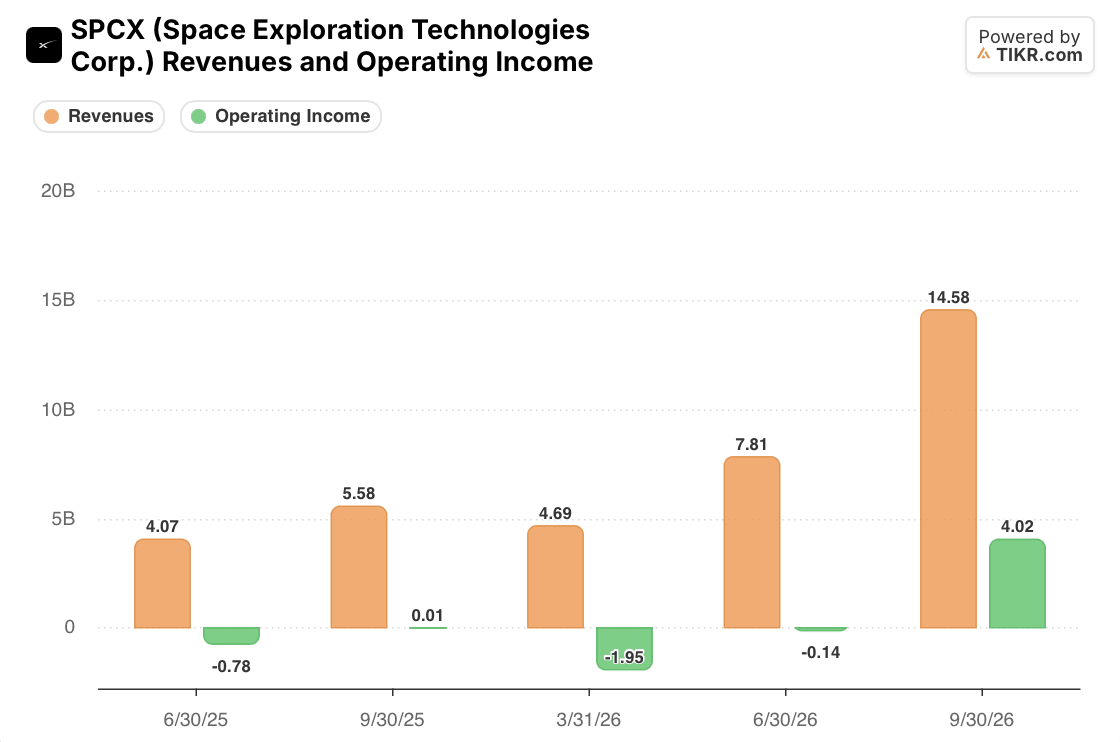
The Space segment brought in $1.77 billion and lost $7 million, against a $259 million profit a year earlier. SpaceX said faster Starship R&D drove a $367 million rise in the segment’s costs, and it spent $1.61 billion on Space capex, about 91% of the segment’s revenue. Starlink is where the payoff should land: Connectivity earned $2.37 billion in operating income on $5.25 billion of revenue, a 45% margin, before any savings from reusable ships.
TIKR Tracks 40 Analysts on SpaceX. How Many Say “Buy”?
See the full breakdown of Buy, Hold, and Sell ratings on SpaceX, along with Wall Street’s revenue and earnings estimates, all in one place. More than 500,000 investors use TIKR to research stocks like this one. See SpaceX’s Analyst Ratings
Why One Catch Isn’t Enough for SpaceX Stock
SpaceX stock closed Friday at $139.11, down 0.6%, then slipped to $136.25 after hours as the booster was lost. Friday’s close was about 3% above the $135 IPO price, and well below the $200-plus level the stock reached in mid-June.
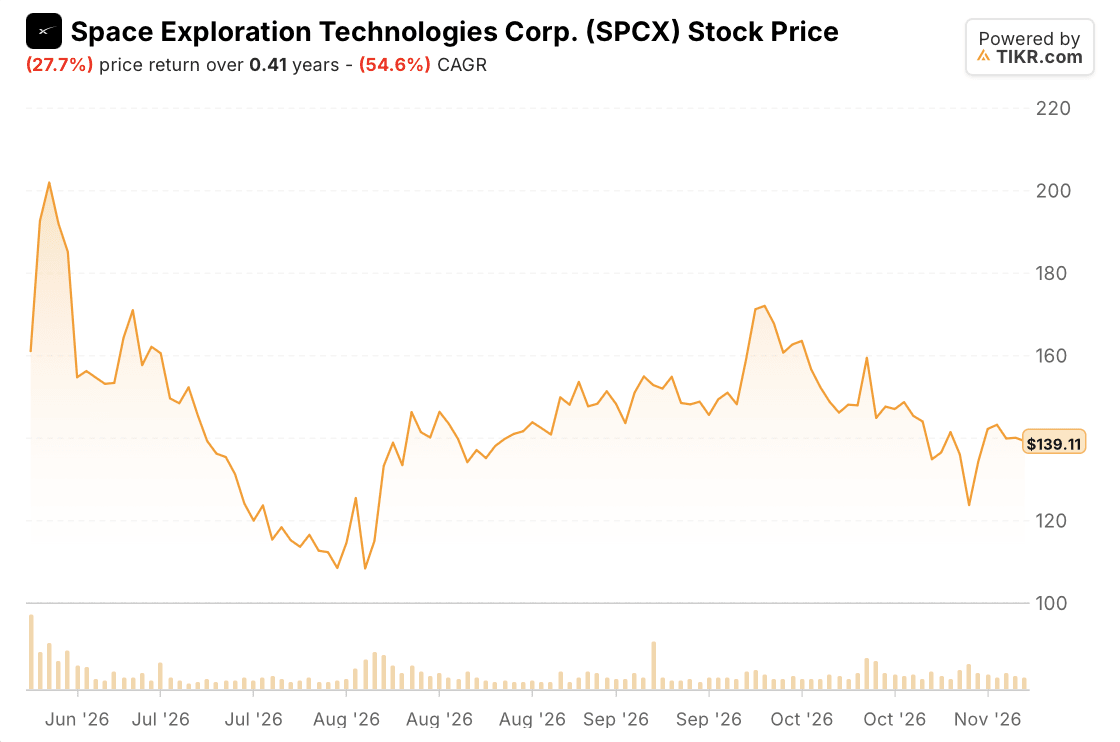
The market has seen Starship firsts before. Flight 14 reached orbit on Sept. 28, and the stock was still down about 4% from that day by Thursday’s close. What hasn’t been shown is the part that cuts costs: flying the same ship again, quickly, and catching both stages on one mission. SpaceX has never done that.
The Question SpaceX Still Has to Answer
How fast can Ship 42 fly again? SpaceX hasn’t announced a reflight date. Its Q3 release does target 2029 for the first launch from Starbase, Louisiana, the planned spaceport it has picked as Starship’s main launch base, but that’s a new-site milestone, not a reuse deadline. If the next flights repeat the ship catch and add the booster, the Space segment’s losses start to look temporary, and Starlink’s deployment costs should fall. If the next catch fails, Saturday reads as a one-off. Until a caught ship flies again, I’d treat this as proof the hardware works, not yet proof the costs come down.
So What Is SpaceX Stock Actually Worth?
TIKR lets you forecast the future price of any stock in less than a minute. Just enter a few assumptions into TIKR’s valuation model and see what SPCX stock could be worth. Start from Wall Street consensus estimates, or adjust the inputs to reflect your own view of the business. It’s free to use.
Value Space Exploration Technologies Corp. for free→
Disclaimer:
Please note that the articles on TIKR are not intended to serve as investment or financial advice from TIKR or our content team, nor are they recommendations to buy or sell any stocks. We create our content based on TIKR Terminal’s investment data and analysts’ estimates. Our analysis might not include recent company news or important updates. TIKR has no position in any of the stocks mentioned. Thank you for reading, and happy investing!