


Key Takeaways
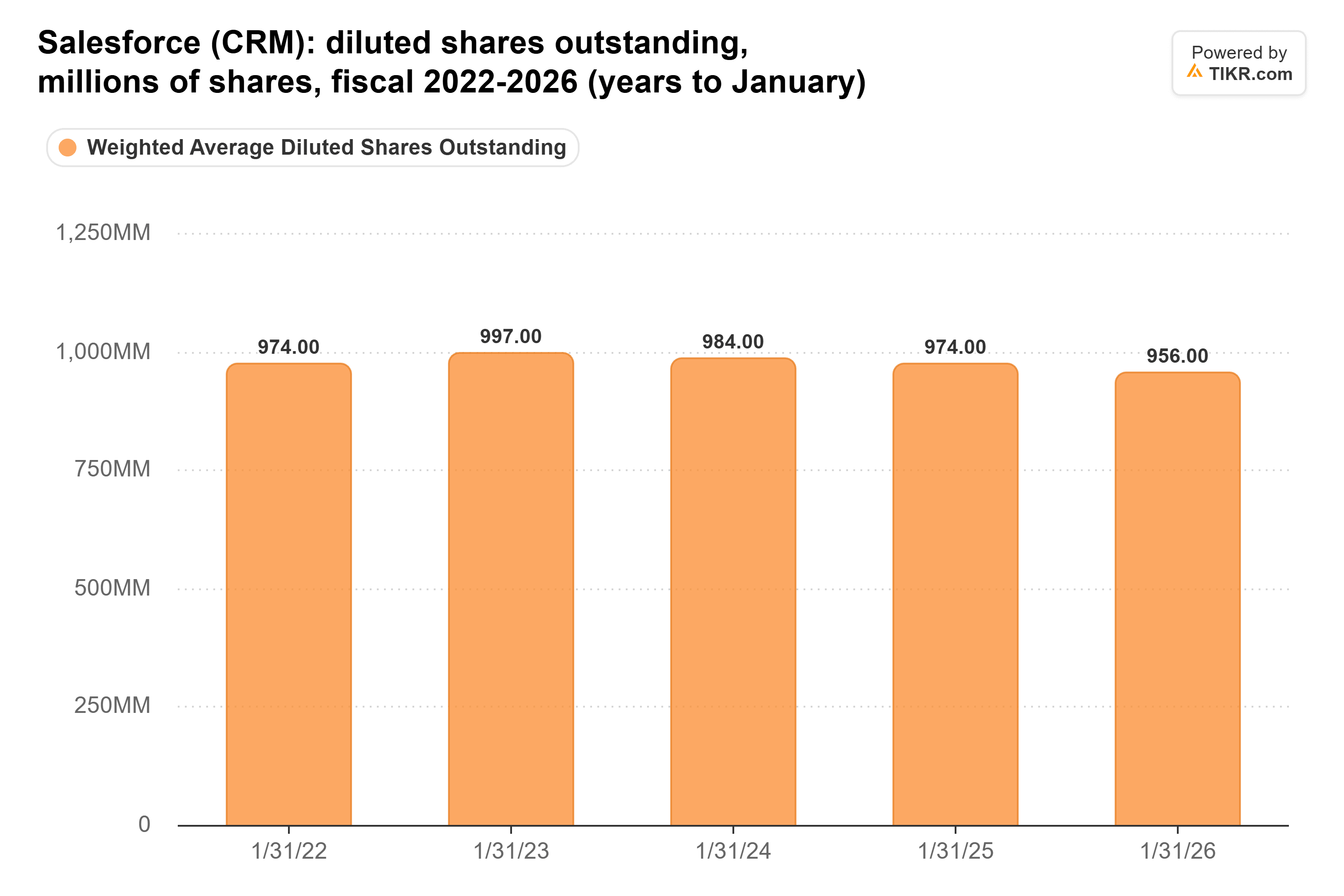
- Salesforce spent about $32 billion on buybacks in the five fiscal years to January 2026, yet its diluted share count rose from 930 million to 956 million.
- Most of that money offset stock pay and the shares Salesforce issued to buy Slack, so shareholders’ slice of the company didn’t grow.
- In fiscal 2026, dividends and buybacks used all of Salesforce’s $14.4 billion of free cash flow before the Informatica deal, and debt made up the difference.
- The share count is now falling fast, but the cut is paid for with debt, so the next test is whether Salesforce can pay that debt down while stock pay keeps running.
Salesforce (CRM) spent about $32 billion buying back its own stock in the five fiscal years to January 2026. It ended that stretch with more shares than it started with: 956 million diluted shares in fiscal 2026, against 930 million in fiscal 2021.
One investor laid this out in a post this week on the r/ValueInvesting subreddit. The post compares Salesforce with Adobe, which the poster says spent a similar $35.7 billion on buybacks and ended up with 12.1% fewer shares. Salesforce’s own share counts back up the poster’s numbers. And the post comes just as Salesforce is borrowing to keep its buybacks and deals going.
TIKR tracks 56 analysts on Salesforce. How many say “Buy”?
See the full breakdown of Buy, Hold, and Sell ratings on Salesforce, along with Wall Street’s revenue and earnings estimates, all in one place. More than 500,000 investors use TIKR to research stocks like this one. See Salesforce’s Analyst Ratings
Stock pay and Slack ate most of it
Salesforce kept issuing new shares while it bought old ones back. Over the five years, the poster counts $15.5 billion of stock pay and $11.1 billion of stock issued to buy Slack in 2021. That’s $26.6 billion of new stock in all. It’s more than the $25.4 billion Salesforce spent on buybacks after subtracting the cash it took in from employee stock plans.
Diluted shares peaked at 997 million in fiscal 2023, the first full year with Slack’s shares in the count. Buybacks have brought the count back down only partway since:
The buyback is part of the pay bill
The buybacks weren’t wasted. Stock pay is a real cost, and without the buybacks Salesforce’s shareholders would own a smaller slice of the company today. The poster asked the thread a fair question: does a buyback that only offsets dilution count as money returned to shareholders, or as a pay cost? I’d call it a pay cost. Stock pay came to $3.5 billion in fiscal 2026, about a quarter of Salesforce’s $14.4 billion of free cash flow, and it isn’t taken out of that figure.
Fiscal 2026 took borrowed money
Salesforce’s free cash flow nearly tripled from fiscal 2022 to fiscal 2026, which makes all this spending look easy:
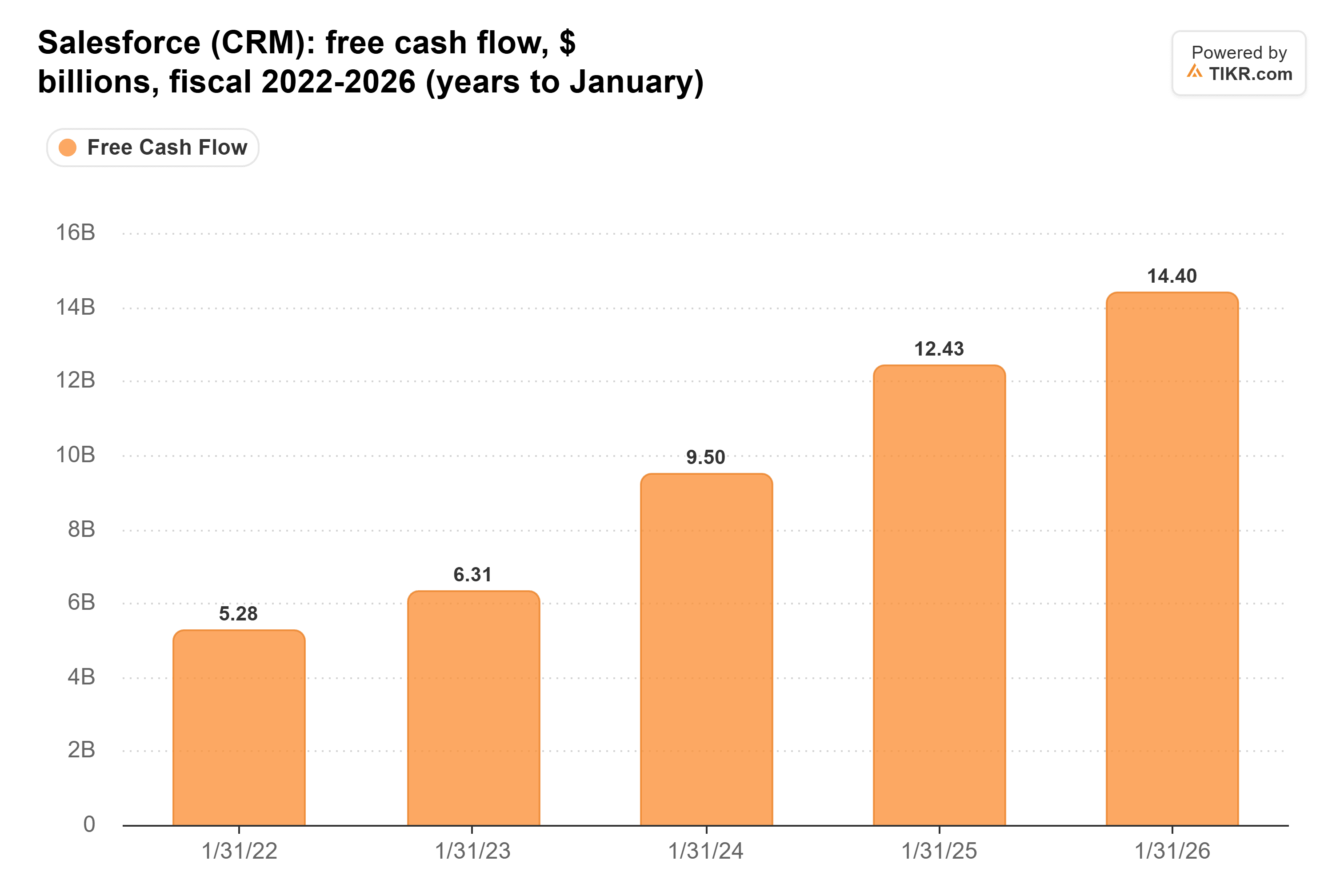
But in fiscal 2026, dividends of $1.6 billion and buybacks of $12.9 billion used up all of that $14.4 billion before Salesforce paid for Informatica, a deal of about $9.6 billion. The poster puts that year’s dividends, net buybacks and cash deals at $8.0 billion more than free cash flow, and new debt filled most of the gap. Salesforce’s total debt rose to $17.7 billion by the end of fiscal 2026, from $12.1 billion a year earlier:
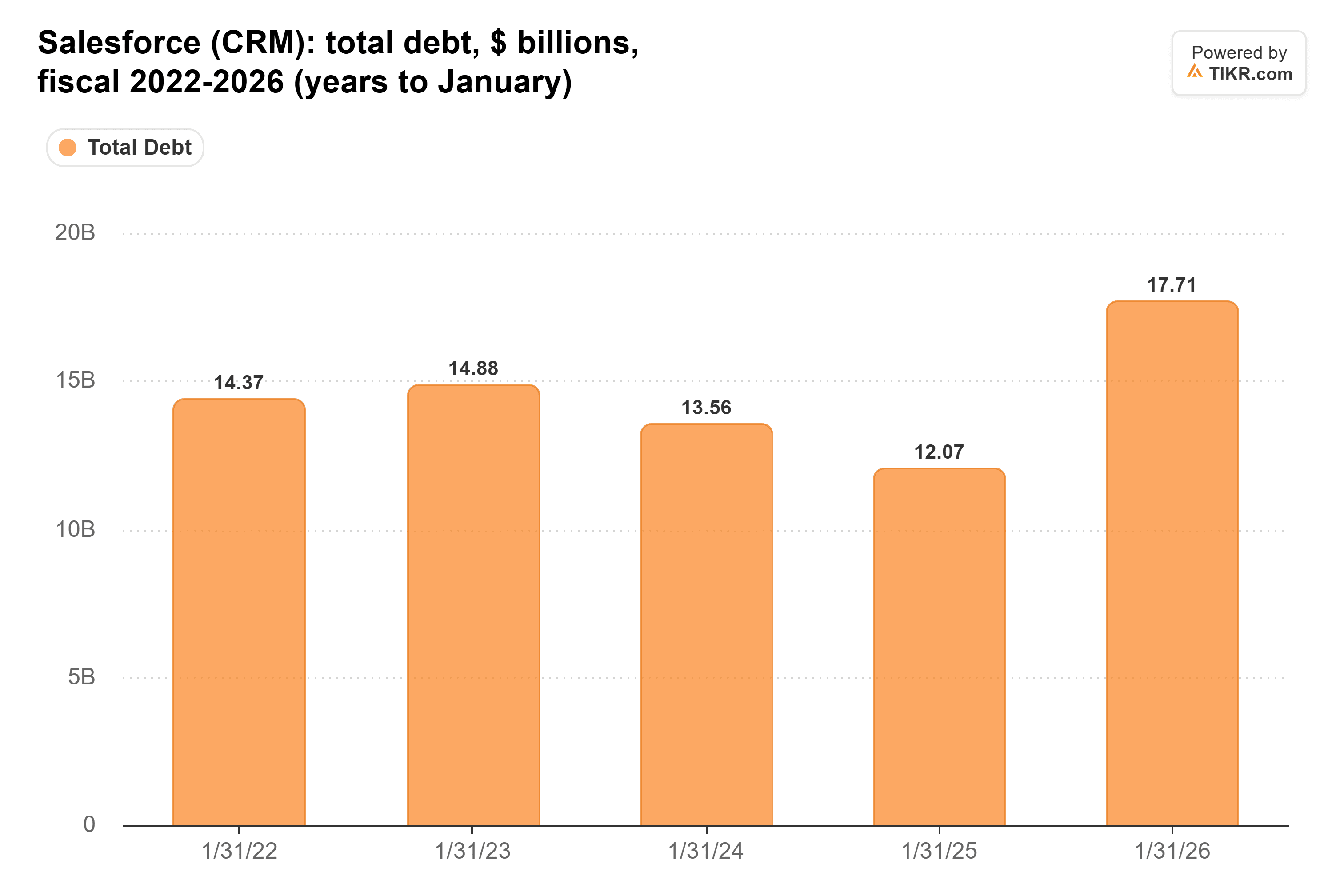
The bigger borrowing came after that. Salesforce’s debt principal reached $39.5 billion by July 31, 2026, mostly to pay for a $25 billion accelerated buyback. S&P cited that kind of spending, more deals and more shareholder returns, when it cut Salesforce’s rating to A from A+ on Nov. 4.
Now the count is falling, on borrowed money
That buyback has finally shrunk the share count. Diluted shares averaged 821 million in the second quarter of fiscal 2027, down 15% from 962 million a year earlier. The cost shows up as interest: $473 million in the quarter, against $67 million a year before. CEO Marc Benioff has said Salesforce will probably sell its Anthropic stake to pay down the buyback debt. That stake was about 45% of Salesforce’s $11.3 billion of strategic investments at July 31.
The way I see it, Salesforce spent five years of buybacks paying its people and paying for Slack. The first real cut to its share count came with borrowed money. Before I’d count the buyback as cash returned to shareholders, I’d want to see that debt come down, from the Anthropic stake or from free cash flow, with stock pay and new deals kept in check. We’ll get the next look when Salesforce reports its third quarter on Dec. 2. That report will show the share count, stock pay and the interest bill together.
So what is Salesforce stock actually worth?
TIKR lets you forecast the future price of any stock in less than a minute. Just enter a few assumptions into TIKR’s valuation model and see what Salesforce could be worth. Start from Wall Street consensus estimates, or adjust the inputs to reflect your own view of the business. It’s free to use.
Disclaimer:
Please note that the articles on TIKR are not intended to serve as investment or financial advice from TIKR or our content team, nor are they recommendations to buy or sell any stocks. We create our content based on TIKR Terminal’s investment data and analysts’ estimates. Our analysis might not include recent company news or important updates. TIKR has no position in any of the stocks mentioned. Thank you for reading, and happy investing!


