Key Stats for GLW Stock
- Past-6-Month Performance: 140%
- 52-Week Range: $37 to $162
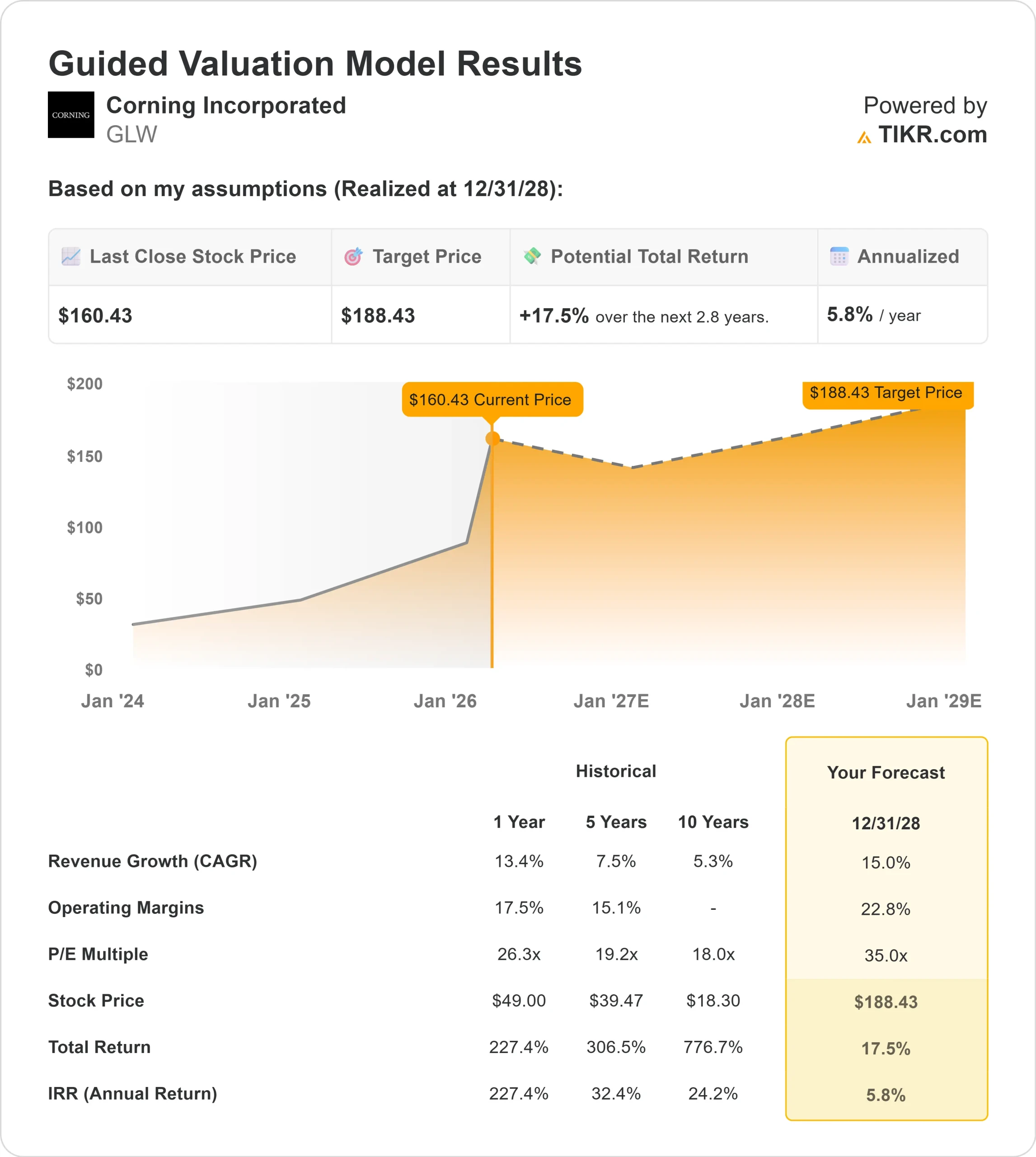
- Valuation Model Target Price: $188
- Implied Upside: 17.5%
Value your favorite stocks like Corning Incorporated with 5 years of analysts’ forecasts using TIKR’s new Valuation Model (It’s free) >>>
What Happened?
Corning Incorporated stock has surged about 140% over the last six months, recently trading near $160 per share and approaching its 52-week high of $162, as investors repriced the company around accelerating AI-driven optical demand, record profitability, and major long-term customer agreements.
The stock moved sharply higher because investors gained confidence that Corning is emerging as a key infrastructure supplier to hyperscale AI data centers.
The company reported Q4 sales up 14% year over year to $4.4 billion, EPS up 26% to $0.72, and operating margin expanding to 20.2%, achieving its 20% profitability target a full year early.
Optical Communications sales rose 24% to $1.7 billion, while Enterprise revenue grew 61% for the full year, driven by “outstanding adoption of our new Gen AI products,” according to CEO Wendell Weeks.
Management also upgraded its Springboard plan and guided Q1 2026 sales growth of about 15% year over year to $4.2 billion to $4.3 billion, reinforcing expectations for continued momentum this year.
Analyst sentiment strengthened alongside the earnings release. UBS raised its price target from $125 to $160 and maintained a Buy rating, reflecting improved visibility into AI infrastructure demand.
The company also announced a multiyear agreement with Meta worth up to $6 billion to supply advanced optical fiber, cable, and connectivity solutions, with similar agreements in progress with other major customers, improving revenue visibility through 2026.
Institutional positioning was active. Bornite Capital initiated an 830,000 share stake valued at about $68.1 million, making Corning 6.3% of its portfolio and its second-largest holding.
WT Asset Management opened a 100,000 share position worth $8.2 million, and NEOS Investment Management increased its stake by 43.9%.
At the same time, Oppenheimer reduced its stake by 42.6%, AMG National Trust cut its position by 32.4%, and SG Capital trimmed holdings by 27%.
The combination of strong financial execution, upgraded growth targets, analyst support, and visible AI-related contracts has driven the stock’s sharp re-rating over the past six months.
See analysts’ growth forecasts and price targets for Corning Incorporated (It’s free) >>>
Is GLW Undervalued?
Under valuation assumptions, the stock is modeled using:
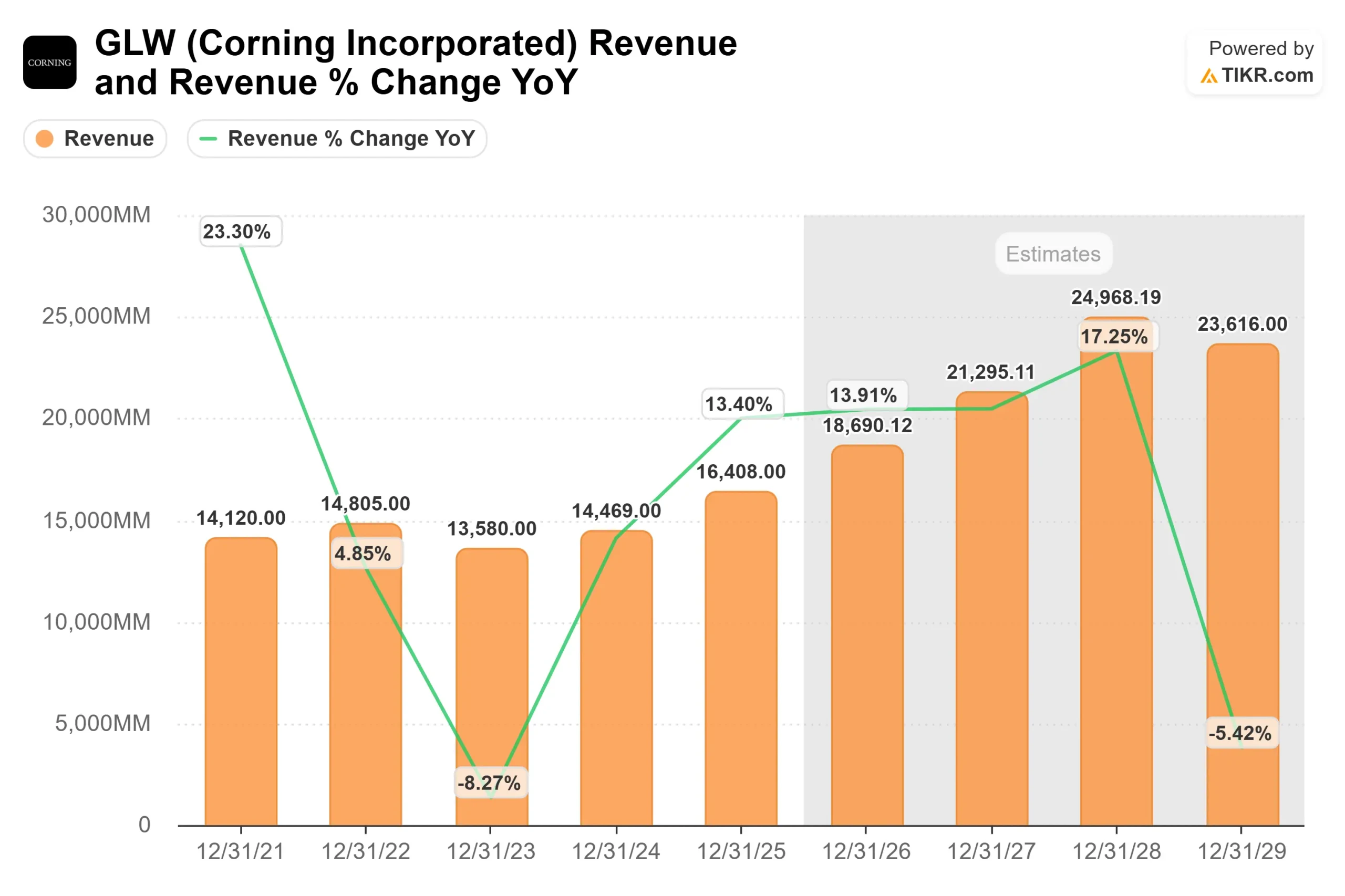
- Revenue Growth (CAGR): 15%
- Operating Margins: 22.8%
- Exit P/E Multiple: 35x
Revenue growth is projected to remain strong as hyperscale data center fiber intensity increases and long-term capacity agreements convert into realized sales.
The $6 billion Meta agreement and similar structured contracts provide revenue assurance, customer prepayments, and committed capacity, which reduces volatility and supports forward planning.
Margin expansion toward the low 20% range depends on mix shifting further into high-density AI fiber, connectivity systems, and manufacturing scale efficiencies.
Optical Communications net income margin has already reached 18%, and sustained volume growth could lift consolidated operating margins above the 20% threshold achieved in Q4.
Based on these inputs, the model estimates a target price of $188, implying about 17.5% total upside over roughly 2.8 years.
While the stock has already rerated significantly, continued AI infrastructure expansion and disciplined capital allocation could still support incremental upside in 2026.
At current levels near $160, Corning appears moderately undervalued relative to its forward earnings power, with performance this year tied closely to AI-driven optical demand, backlog conversion, and sustained margin expansion.
Estimate a company’s fair value instantly (Free with TIKR) >>>
Value Any Stock in Under 60 Seconds (It’s Free)
With TIKR’s new Valuation Model tool, you can estimate a stock’s potential share price in under a minute.
All it takes is three simple inputs:
- Revenue Growth
- Operating Margins
- Exit P/E Multiple
From there, TIKR calculates the potential share price and total returns under Bull, Base, and Bear scenarios so you can quickly see whether a stock looks undervalued or overvalued.
If you’re not sure what to enter, TIKR automatically fills in each input using analysts’ consensus estimates, giving you a quick, reliable starting point.
See a stock’s true value in under 60 seconds (Free with TIKR) >>>